7.0 Out of 10

CompanyCam review:
What we found testing it hands-on

Kyo Zapanta By Kyo Zapanta · Reviewed by Rouselle Isla · Published October 12, 2026

The verdict: 7.0/10

CompanyCam does what it's built for. Contractors tell us they keep paying for it because their crews actually use it to photograph the work, and in our test the checklists, reports, PDFs, and signature requests around those photos held together inside each project.

Where it may fall short is everything past documentation. Time Tracking is a free beta without the overtime rules, approvals, or cost codes payroll depends on, and we saw nothing that ties hours to job costs. If documentation is the job, CompanyCam may be a strong fit. If you also need verified hours and live job costs, you may end up running a second system beside it.

That's the choice most contractors in our calls were weighing: keep two apps, or move photos, forms, and time into one. Neither answer is wrong. It depends on how much you use CompanyCam's photo tools and how much the second subscription costs you.

Top wins

  • Photo documentation 8.0
  • Photo-required checklists 8.0
  • Reports and PDFs 7.5

Top gaps

  • Job costing by cost code 2.0
  • Payroll-ready time tracking 3.5
  • Cost per extra user 5.0
Best for
Photo documentation of job progress
Checklists that require a photo to finish
Reports and PDFs built inside each project
Not ideal for
Payroll-ready time tracking
Job costing by cost code
Large crews on a tight per-user budget

How we reviewed CompanyCam

Most software review sites rely on ratings from their own user base. We take a broader view. This review combines our own hands-on test of CompanyCam on its Scale trial with what contractors told us about it in sales and research calls, plus public reviews from four platforms.

18
Research Calls
103
Capterra Reviews
32
G2 Reviews
30,501
App Store Ratings
7.9K
Google Play Ratings

We tested CompanyCam hands-on in its web app on the Scale plan trial between September 25 and September 28, 2026, building a sample customer, project, checklist, report, and time entry. We did not test the mobile app.

Disclosure: Workyard competes with CompanyCam in some areas, and many of our contractors use both. This review reflects our honest assessment of the product based on hands-on testing, our own sales-call data, and public research, and we've aimed to make it as balanced and data-driven as possible. Software products change frequently, so CompanyCam's features, pricing, and plan inclusions may have changed since our research. Check out our full review methodology.

How we scored across 7 categories

Our overall CompanyCam score (7.0/10) is computed from seven weighted categories and rounded to the nearest half point. Here's the breakdown:

Category Weight Score Tier
Usability & Onboarding 20% 7.0 Adequate
Core Features & Functionality 20% 7.5 Strong
Workflow & Task Management 15% 7.5 Strong
Reporting, Analytics & Data 15% 7.0 Adequate
Customer Support 15% 6.5 Adequate
Integrations 10% 7.5 Strong
Vendor Reliability & Value 5% 6.0 Adequate
OVERALL 100% 7.0 Adequate

What contractors are telling us

CompanyCam comes up in our sales and research calls as the photo app contractors already pay for. The first pro comes from those calls and the second from public reviews. The cons combine what we found in our hands-on test with the complaints that come up most in public reviews.

What works well 27 mentions
STRENGTH The photo app contractors keep

…We used CompanyCam... So we would probably keep CompanyCam. They do an amazing job at that.

— Stone and masonry contractor

Test This Yourself

During your trial, have one crew photograph a full day on a live job from the mobile app. Check how fast the photos land in the project and whether the office can find them by tag.

STRENGTH Photos stored and organized by job

It stores all of our photos in one place efficiently. Integrates well with our CRM software.

— Construction company owner

Test This Yourself

Have two crews photograph a week on different jobs. Then ask the office to find one specific photo by project and tag, and time how long it takes.

Areas worth testing 15 mentions
HIGH Time tracking that stops short of payroll and job costing

You have early access to Time Tracking, no cost to you while we fine-tune things. We'll give you a heads-up before pricing kicks in.

— CompanyCam in-app notice

Test This Yourself

Run one full pay period of real crew hours through Time Tracking during your trial. Check for overtime rules, break rules, approvals, and cost codes before you retire your current time system.

HIGH App lag and photo uploads that fail on weak signal

Really glitchy where there is limited service. They claim photos can be taken while you're offline. I don't believe that statement anymore. I have lost a lot of important work photos because of this.

— Google Play reviewer

Test This Yourself

Photograph a full day on your lowest-signal job from the mobile app. Back at the office, check that every photo arrived in the right project.

MEDIUM Costs that climb with crew size and add-ons

$79/month for an app that organizes photos is a joke.

— App Store reviewer

Test This Yourself

Price your real crew size before you commit: $29 per extra user on annual billing, $34 on monthly. Ask CompanyCam in writing whether the Marketing Suite is included in your plan or a $99/month add-on.

CompanyCam overview

CompanyCam was founded in 2015 in Lincoln, Nebraska, by Luke Hansen, who built it for his family's roofing business, where the team needed a better way to keep track of job photos. Luke Hansen is CEO. The company reportedly raised a $415 million Series C (per PitchBook) led by B Capital at a $2 billion valuation.

Its homepage headline is "How field work moves forward," and it claims 285,000+ pros using the app on 79 million jobs. In practice the product is photo-first: capture, tags, and annotations on mobile, with a web app that has grown into checklists, reports, proposals, invoices, a Marketing Suite, and, most recently, a Time Tracking beta. Its public ratings are high, with admins and field users both scoring it 4.7 or better.

CompanyCam hands-on testing

We spent four days in CompanyCam's web app on the Scale plan trial, building a sample customer, project, checklist, report, and time entry from scratch. Here's what each workflow did in practice, what held up, and what we couldn't verify. We didn't test the mobile app, so field capture is outside this review.

Sign-up & onboarding

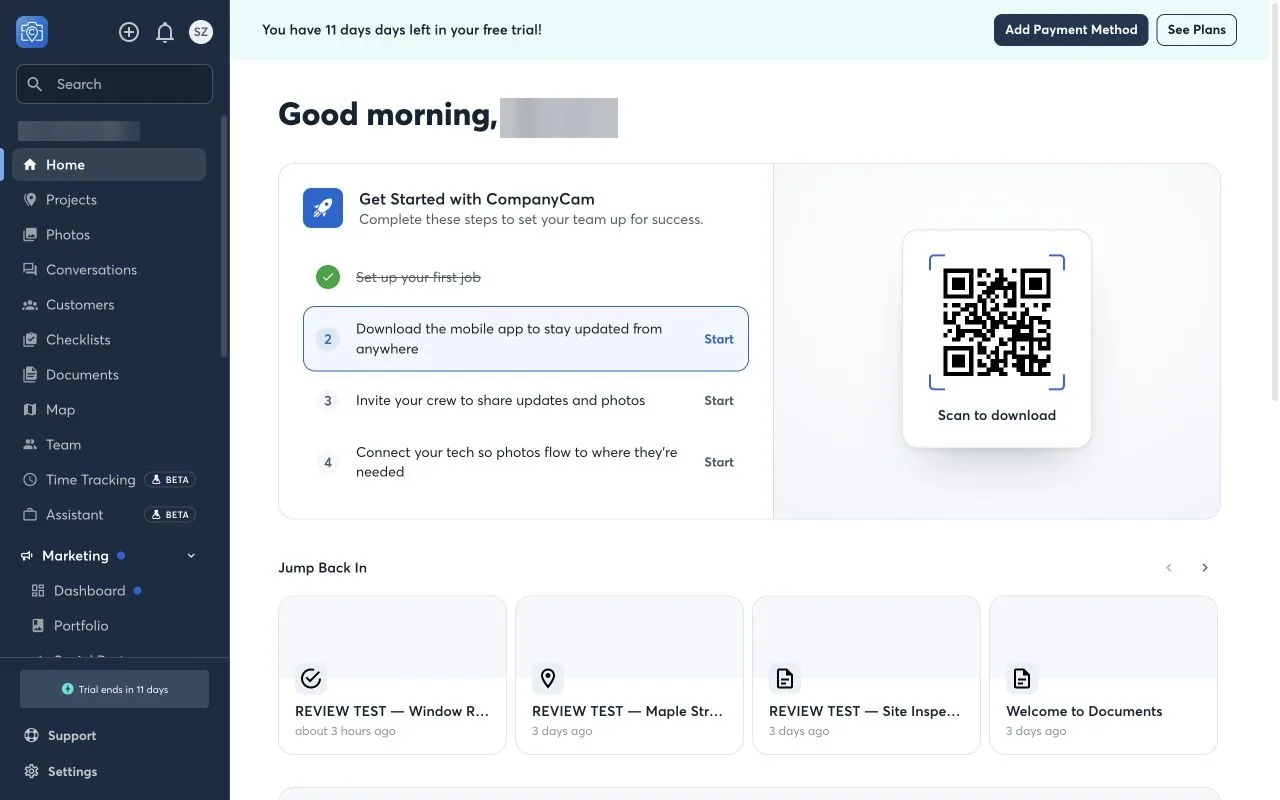
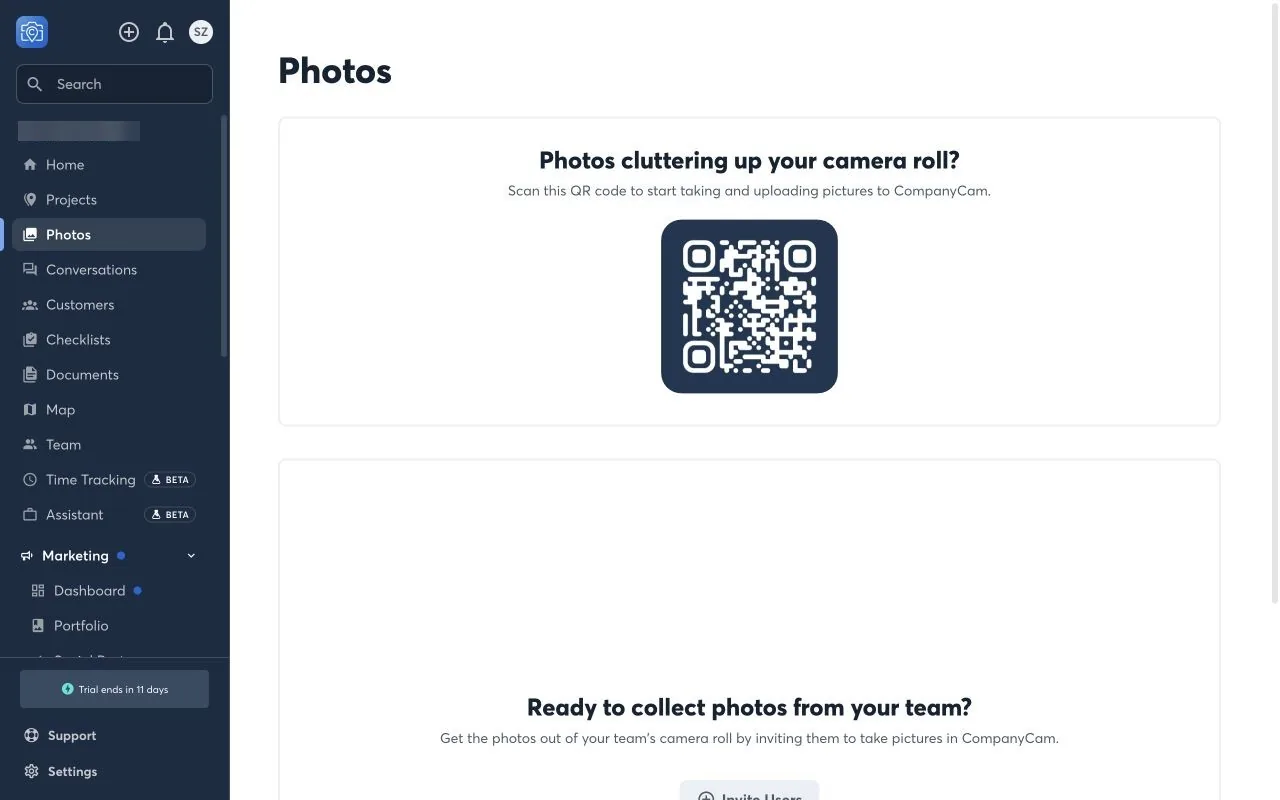
The trial opened on the Scale plan with a 14-day banner and one active user. The home screen points you straight at the mobile app: the empty Photos library shows a QR code to download it and an option to invite your crew. That tells you where CompanyCam expects the real work to happen.

Company Settings hold your address, industry, company size, timezone, and logo. One thing to check early: our account's timezone defaulted to International Date Line West even though the country was set to the Philippines. If your timestamps look off, that setting is the first place to look.

Customers, projects & project boards

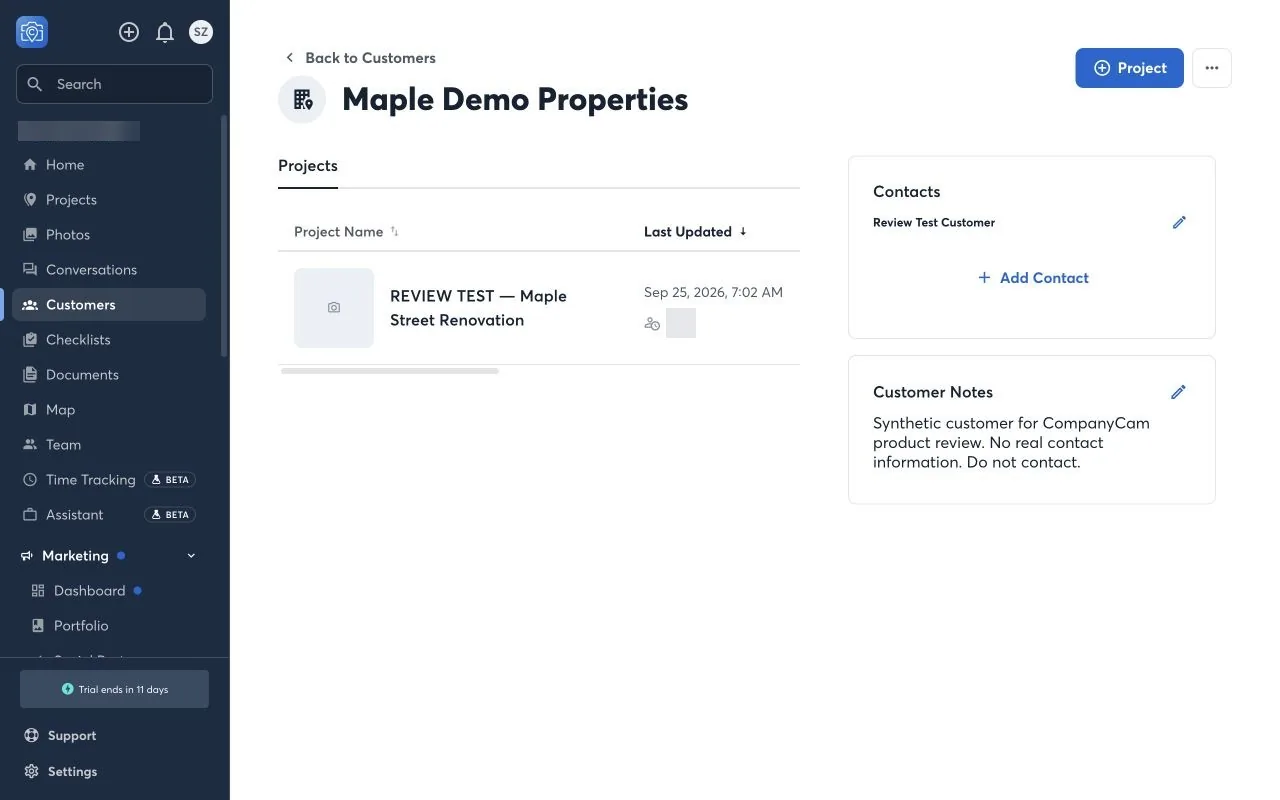
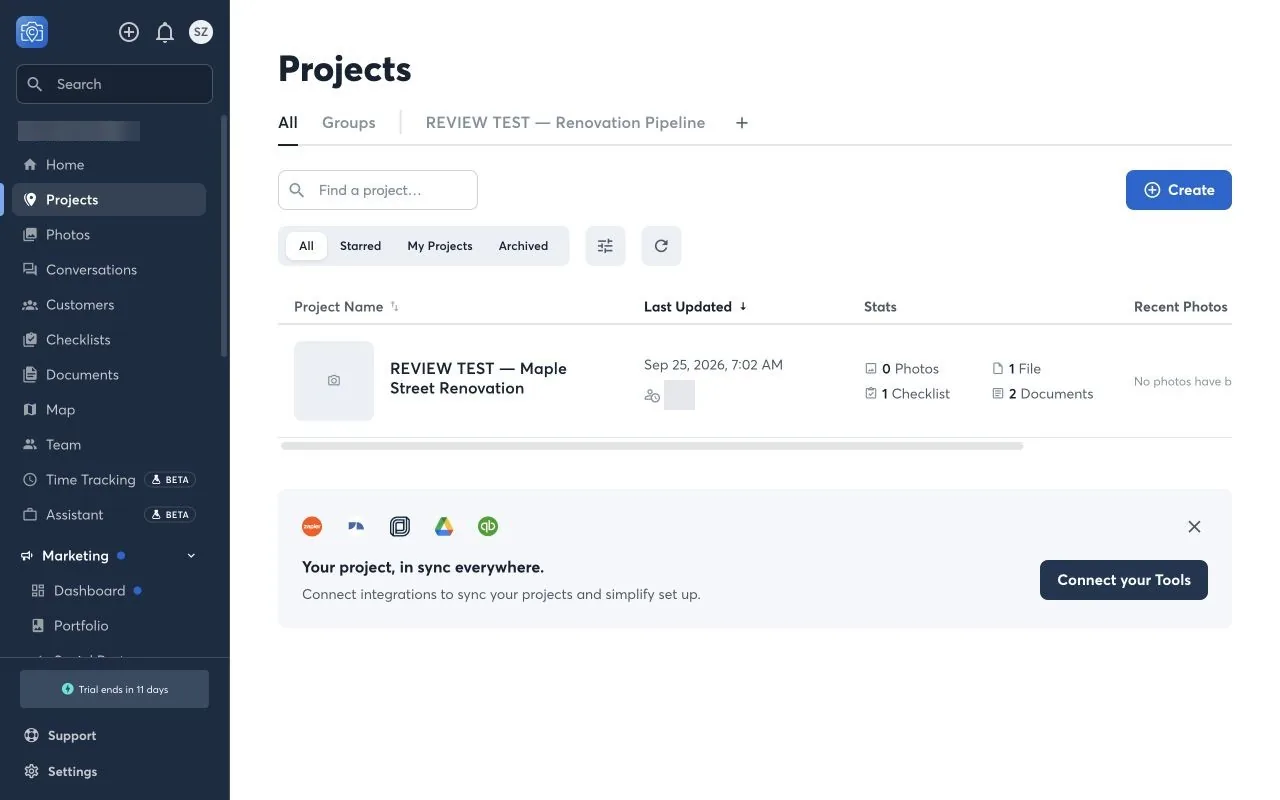
We created a sample customer and a renovation project linked to it. The customer form covers extra contacts, billing address, notes, and a lead source (website, referral, search, social, yard signs, and a few more). The project form adds address, templates, groups, labels, assigned users, and a map for dropping a pin or drawing a geofence.

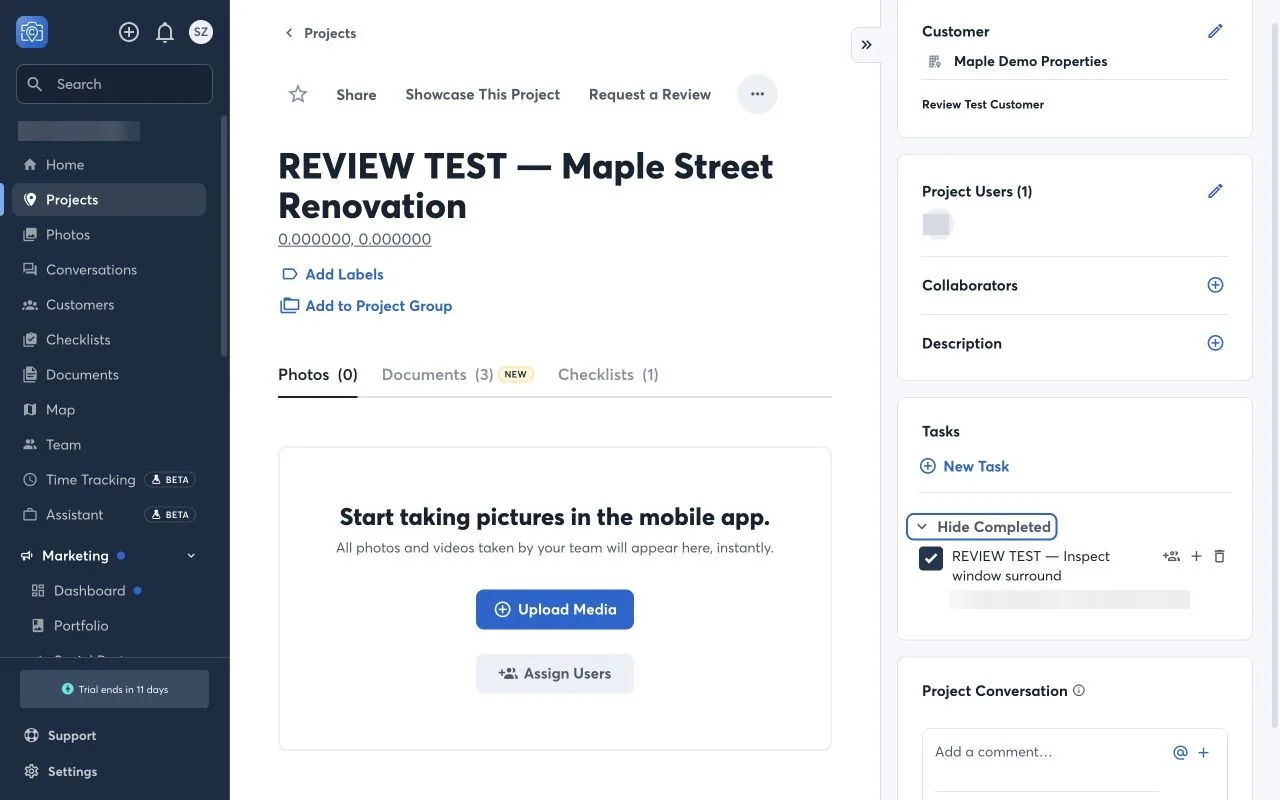
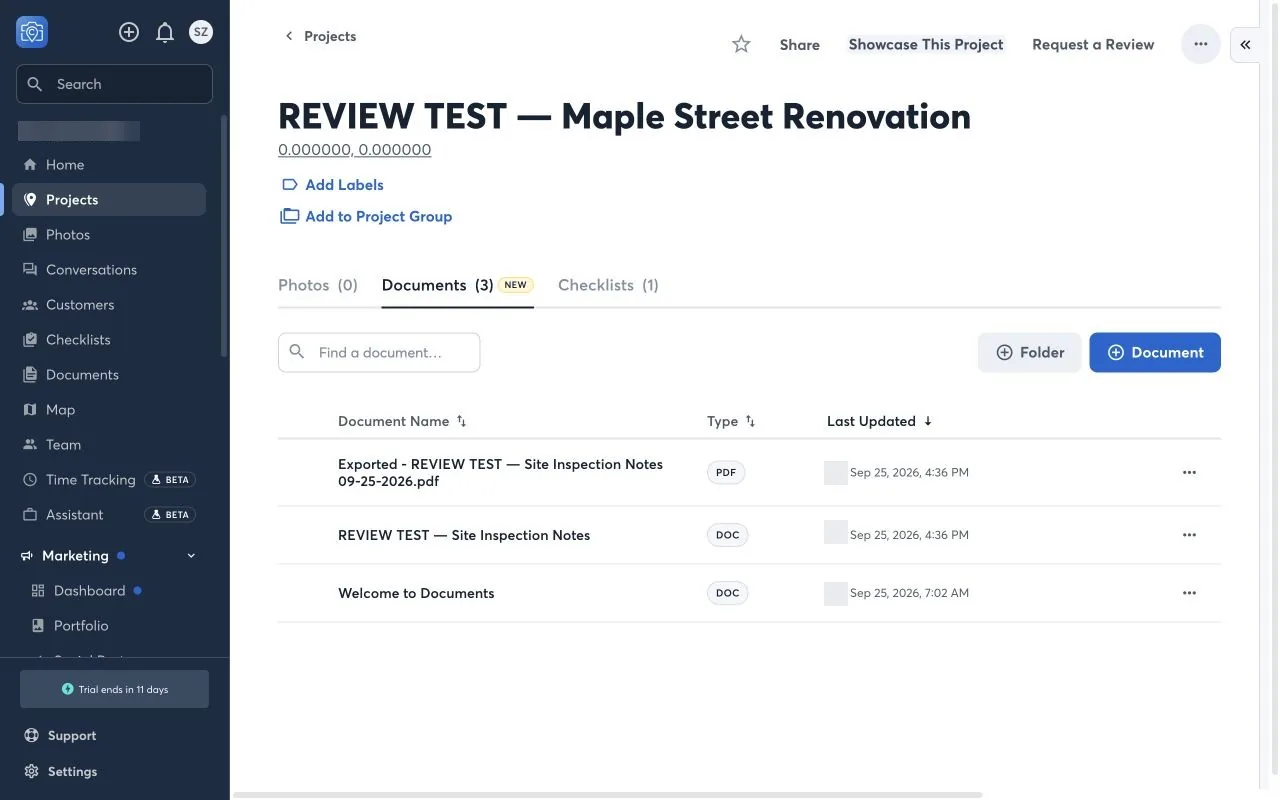
Each project keeps Photos, Documents, and Checklists in tabs, with customer details, collaborators, tasks, and a project conversation in the sidebar. The Projects list shows photo, file, checklist, and document counts on every row, which makes it easy to spot a job nobody has documented yet.

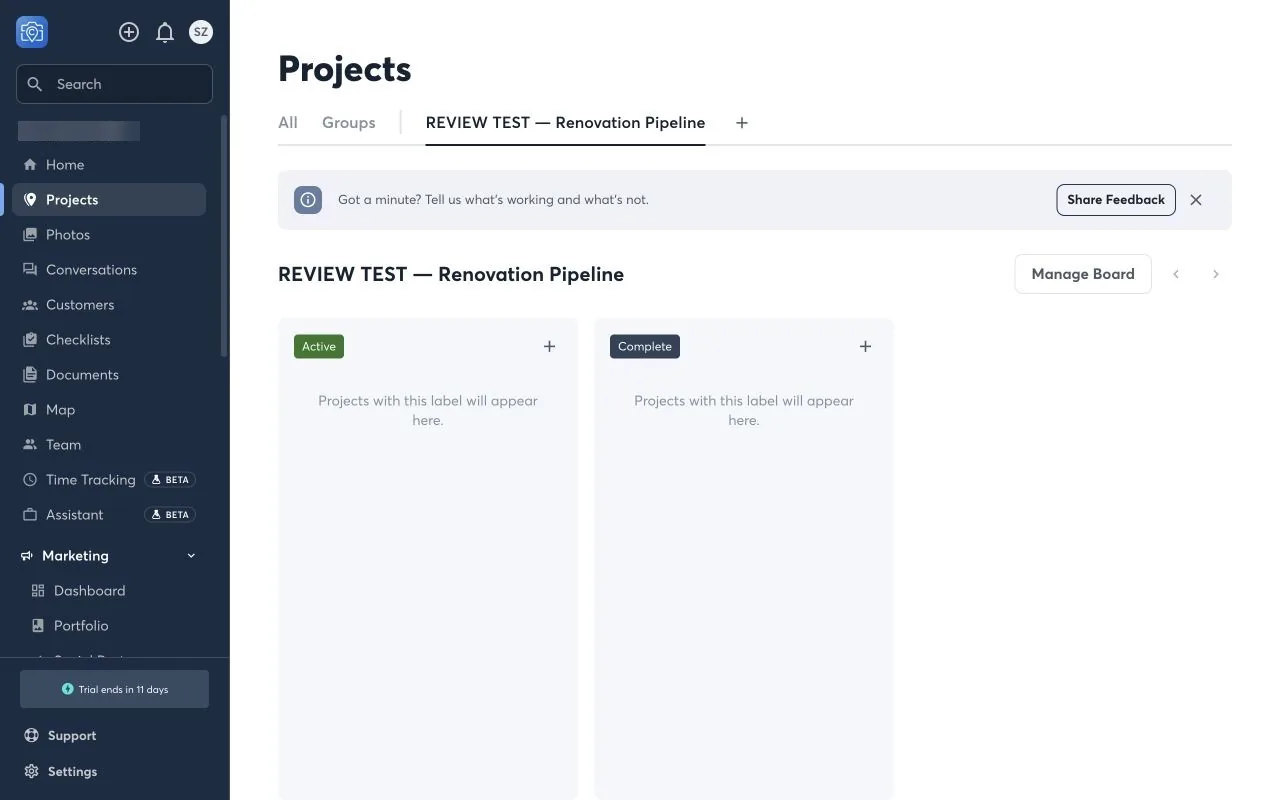
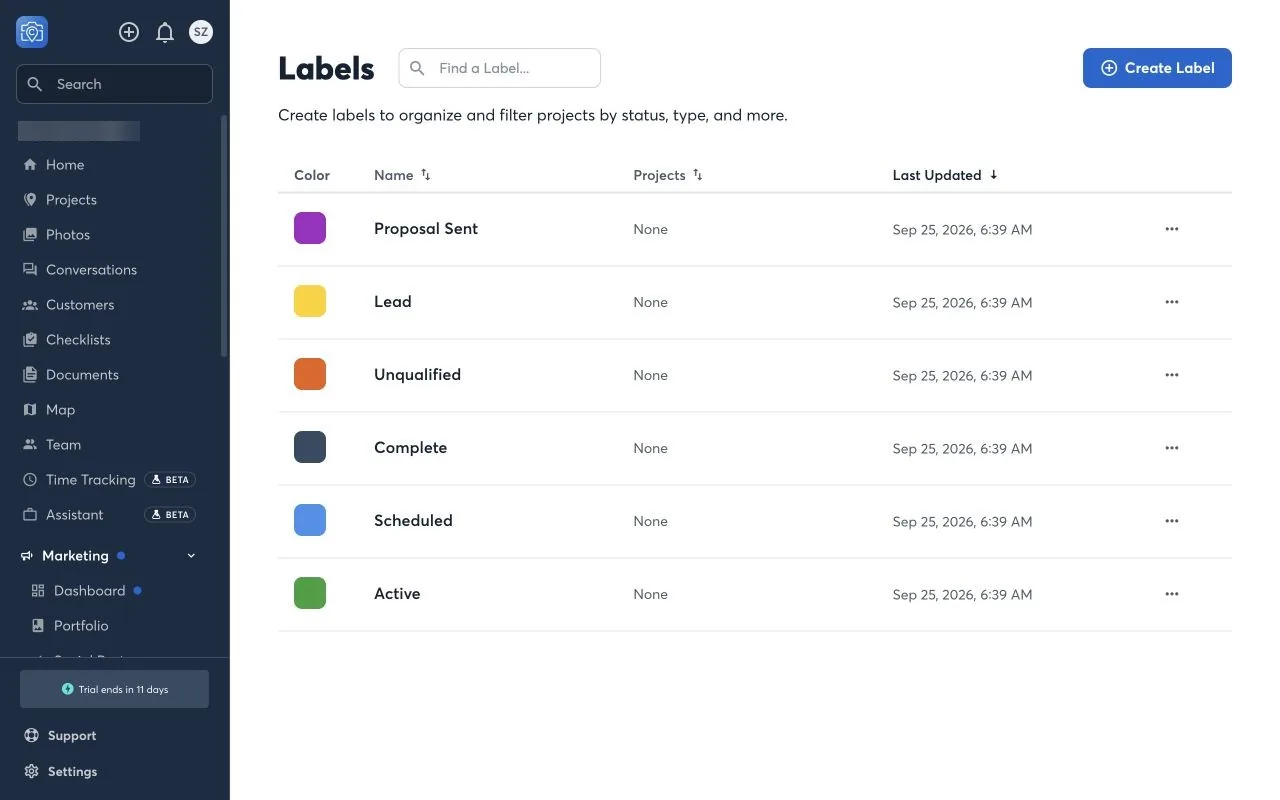
Project boards turn your labels into columns. We built a two-column board from the Active and Complete labels in a couple of minutes. We did not move a populated project across the board, and we saved our project without an address, so we can't speak to how the location features behave.

Tasks & checklists

Tasks live in the project sidebar. We added one, marked it complete, and Show Completed displayed who finished it and when. Assignment and attachments are there too, though we didn't test notifications.

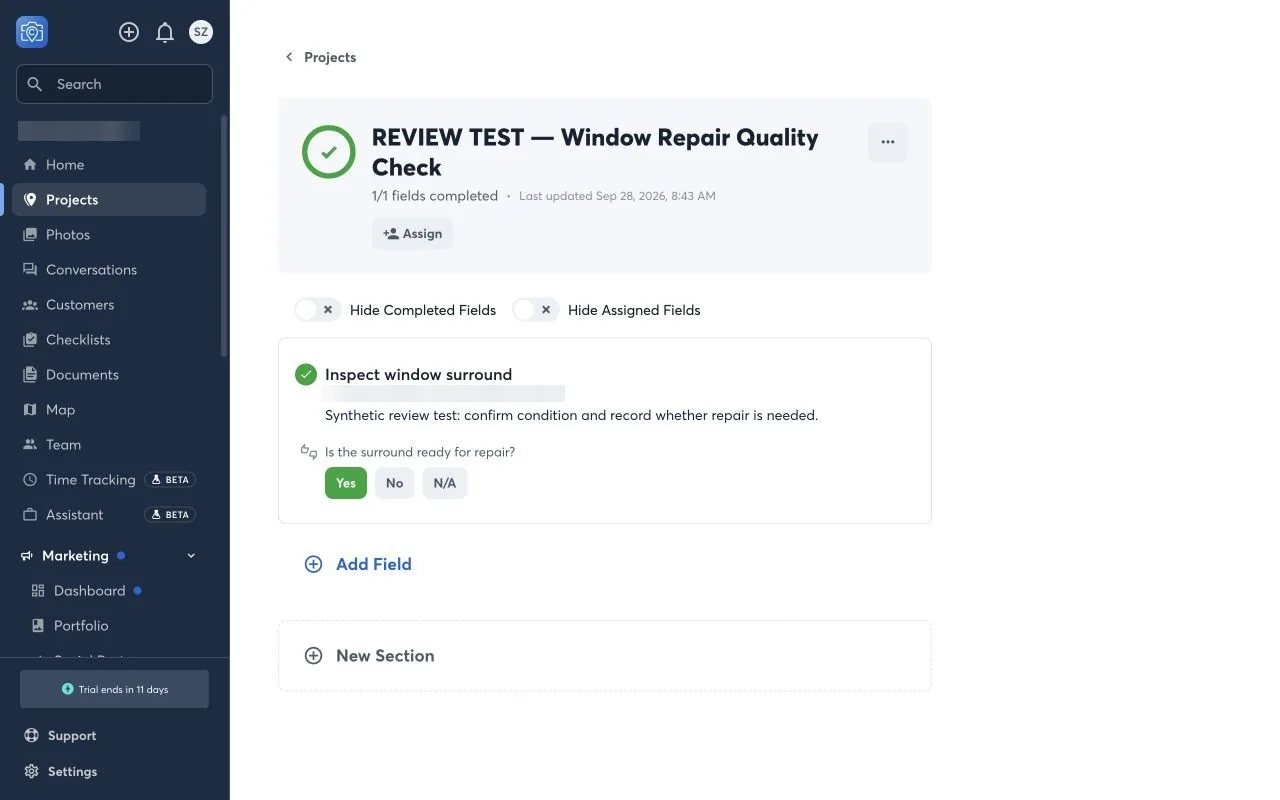
Checklists are the stronger feature. We built an inspection checklist with a field, notes, and a yes/no question, then switched on Photos Required. When we tried to complete it without a photo, CompanyCam stopped us: "You must add photos to complete this task." For any trade that needs proof a step was done, that rule matters.

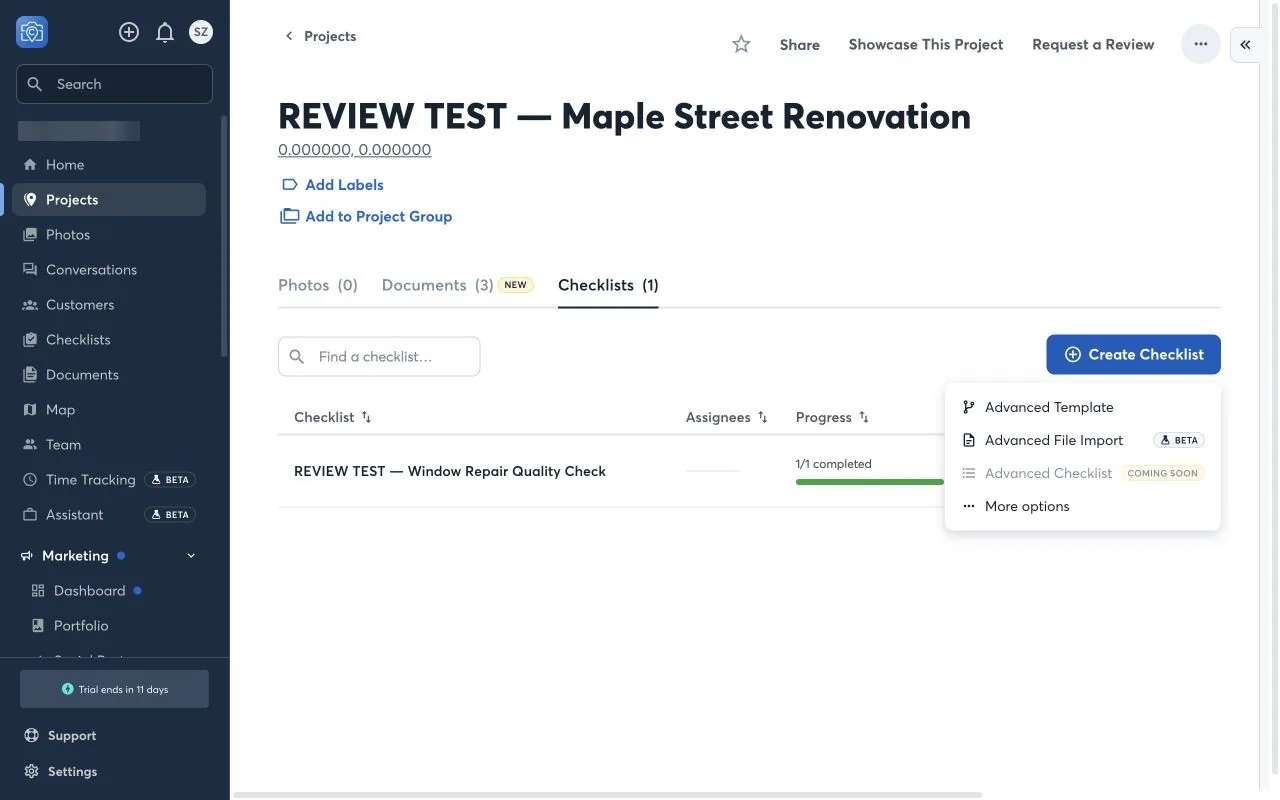
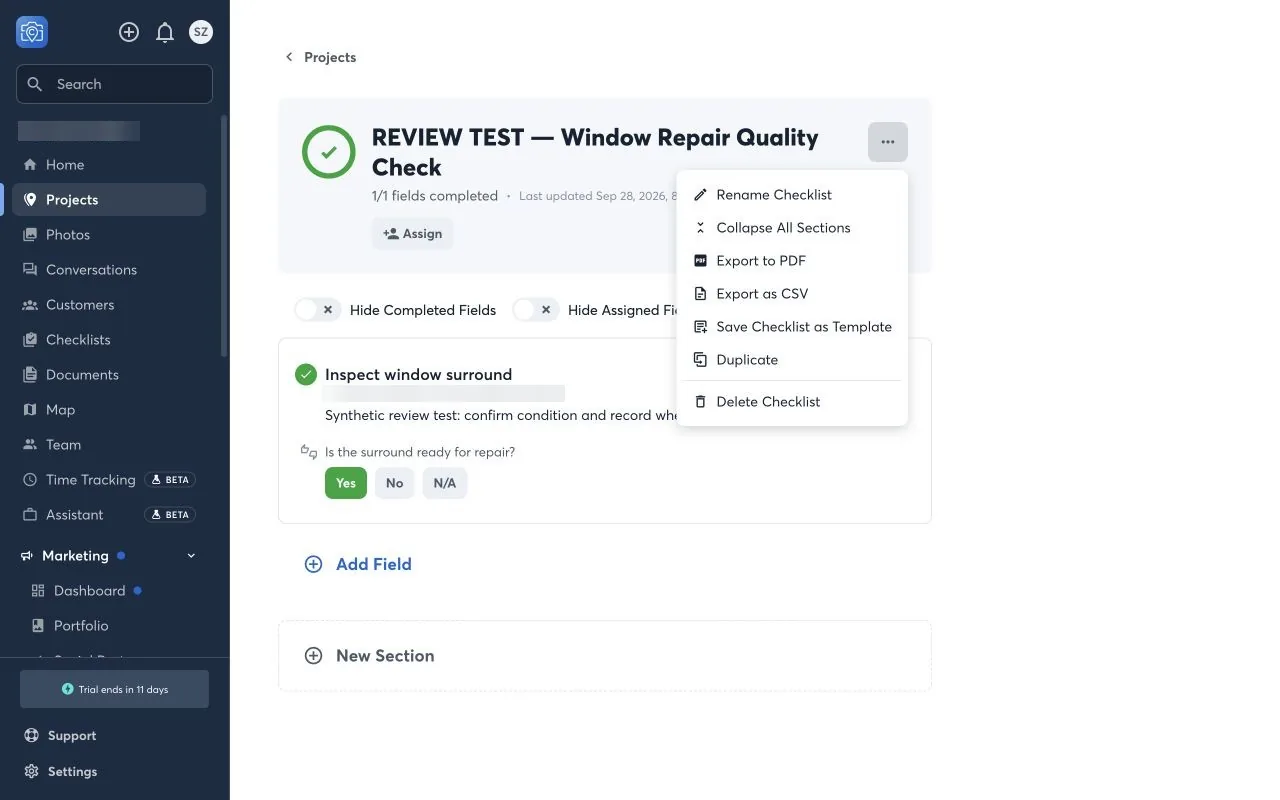
Question types include yes/no, rating, text, and multiple choice, with sections, reference images, and assignment. You can export a checklist as PDF or CSV, save it as a template, and attach that template to a project template. The Advanced Checklist option was marked Coming Soon in our account.

Reports, PDFs & signatures

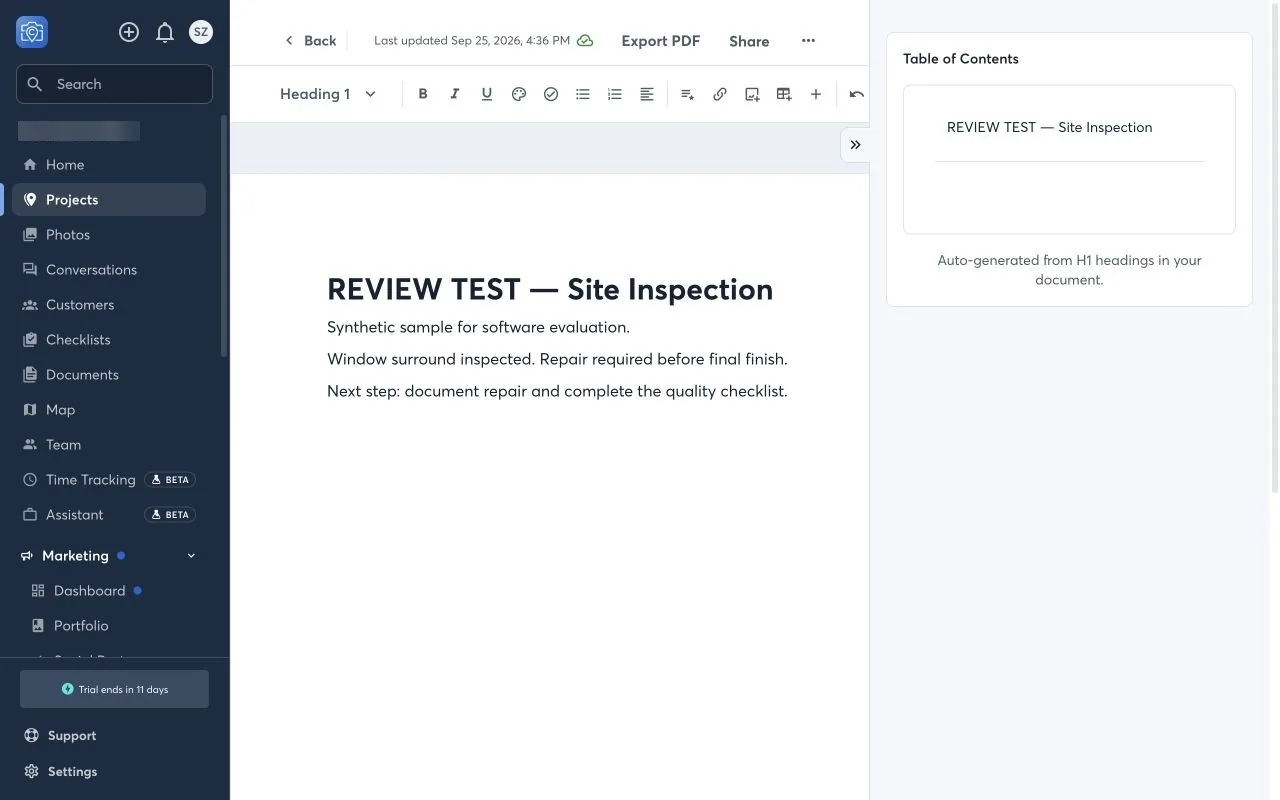
The document editor handles headings, lists, checkboxes, tables, images, and saved text snippets. We wrote a short inspection report, and the editor built a table of contents from the heading on its own.

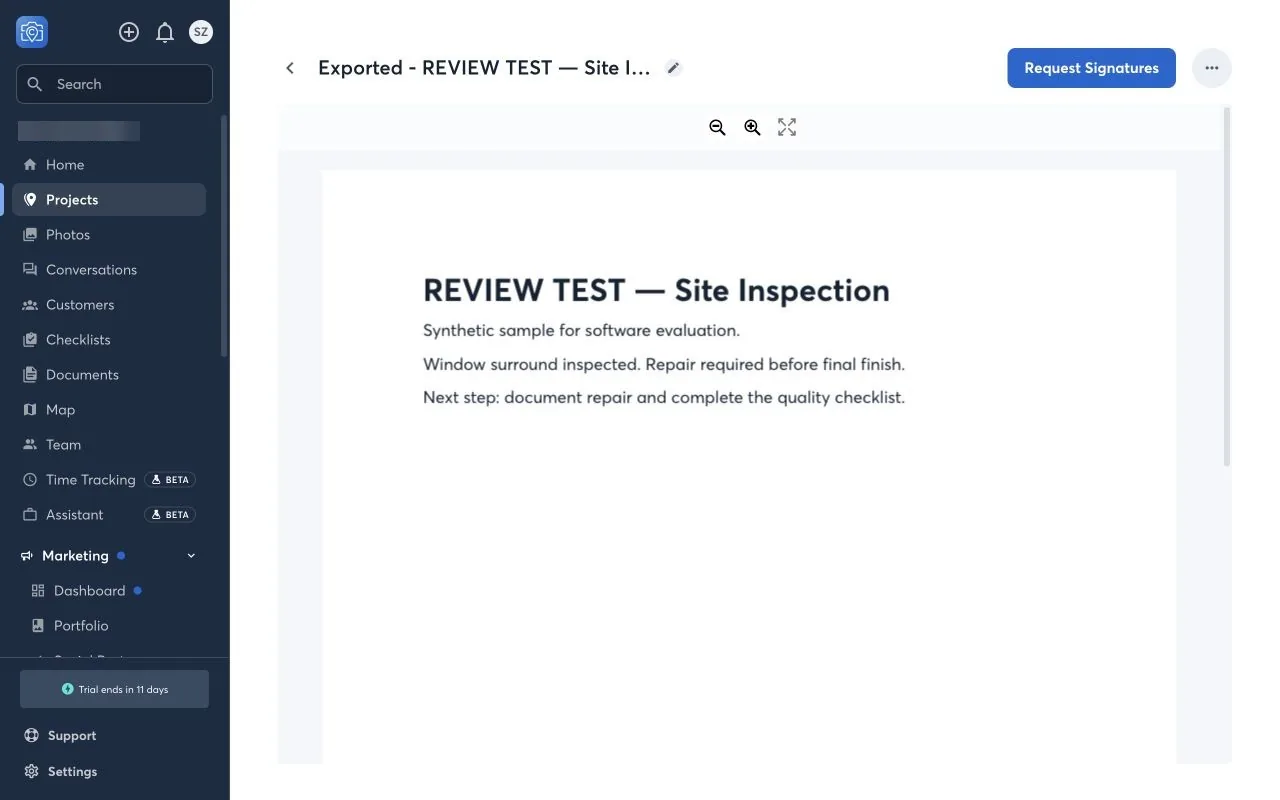
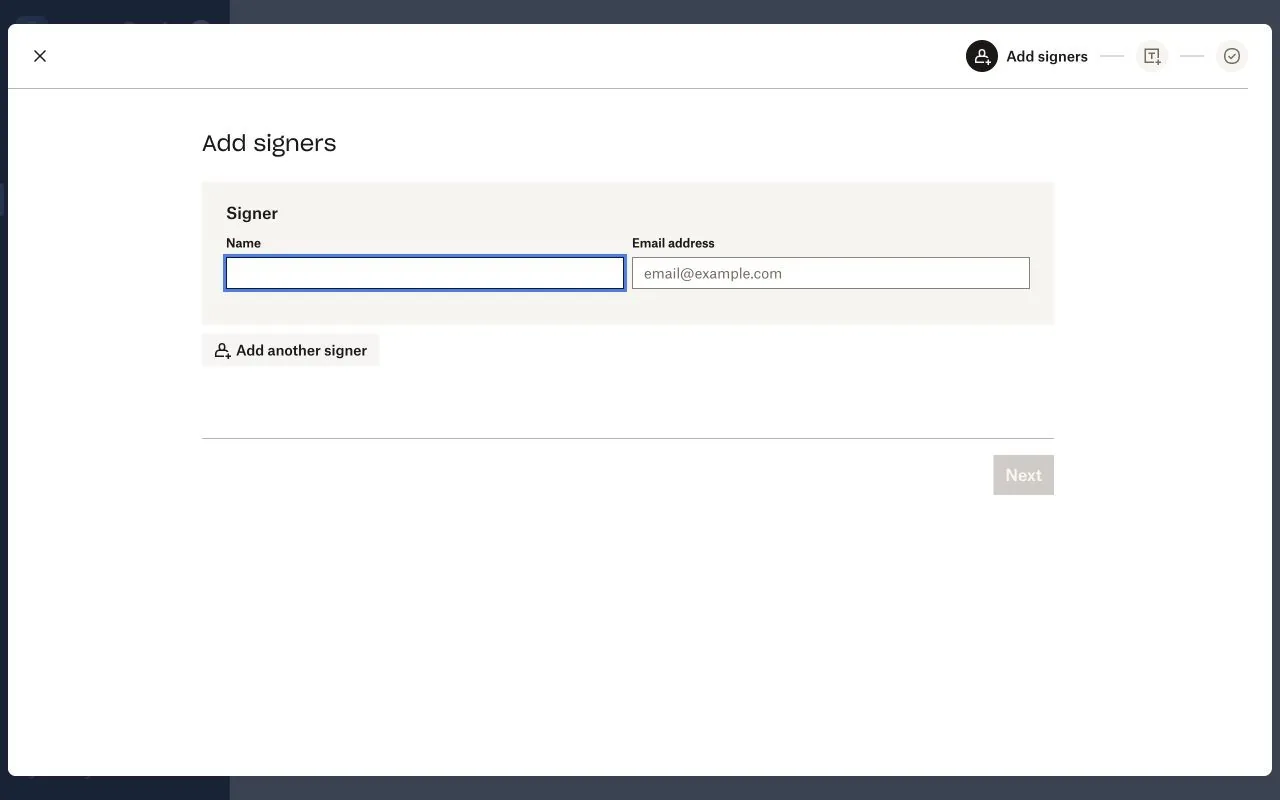
Export to PDF saved the file straight into the project's Documents tab, next to the editable version, and the preview showed our text exactly as written. From there, Request Signatures opened a Dropbox Sign flow to add signers, place fields, and send. We stopped before sending, so we can't confirm delivery or the signed record.

Report templates include Report, Daily Log, and Summary. CompanyCam says Daily Log and Summary build the document from your photos with AI. We had no photos in the project, so we couldn't test that.

Time Tracking (beta)

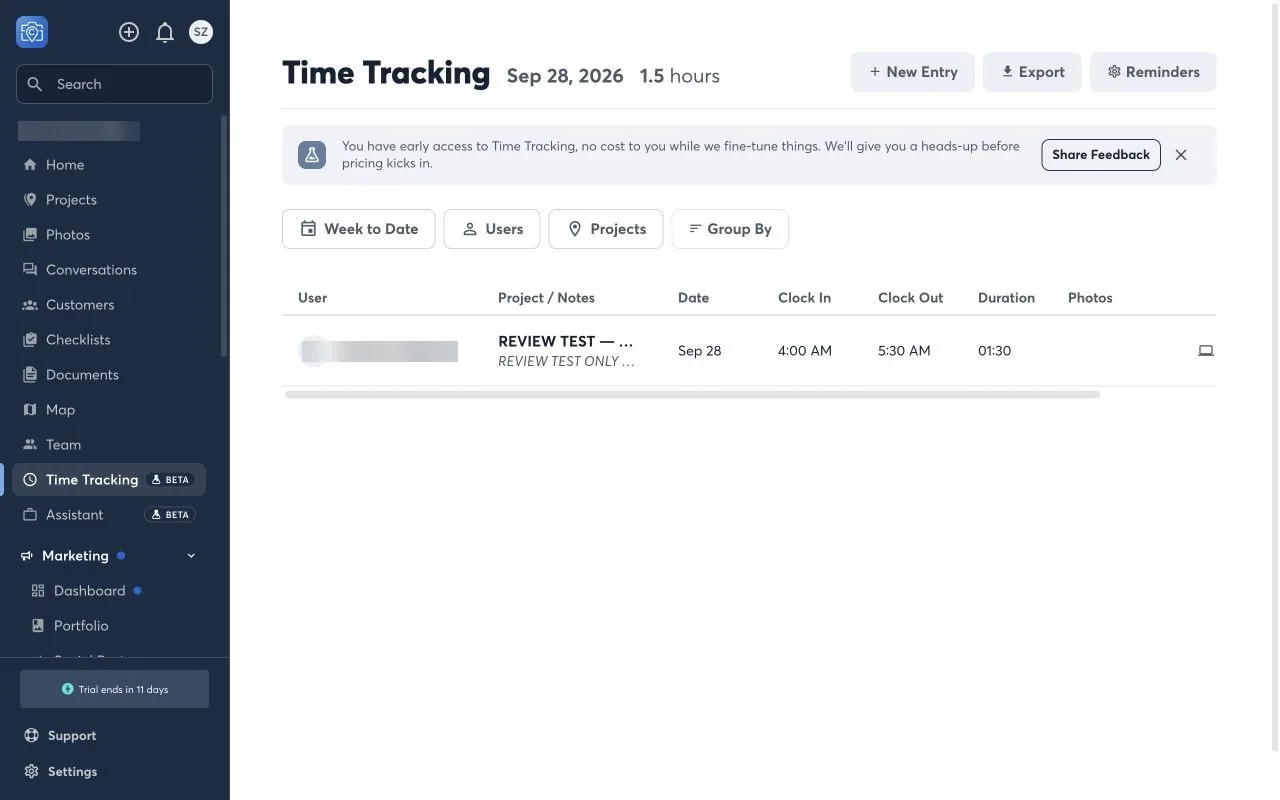
CompanyCam labels Time Tracking as a free early-access beta and says it will give notice before charging for it. We saved one 90-minute entry against our test project from the web. It showed up with the right duration and project and was marked "Created on the web."

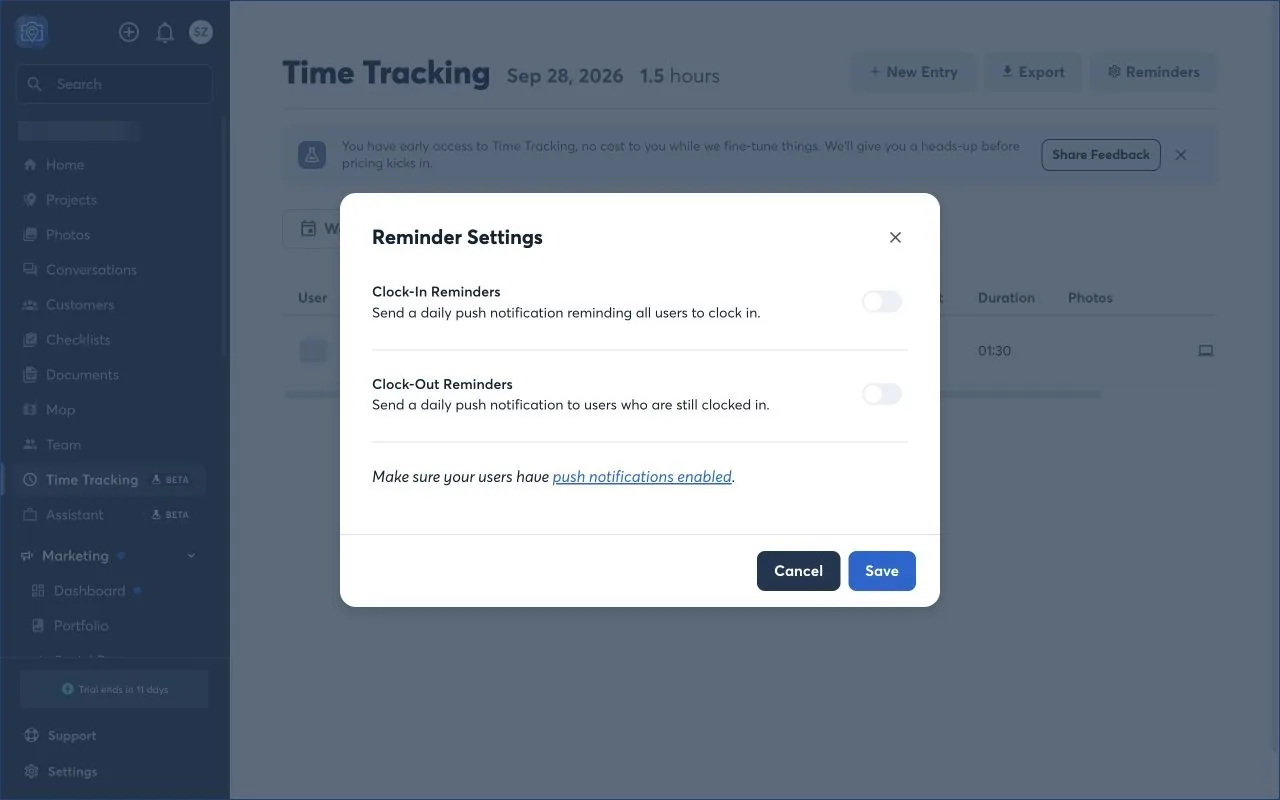
One oddity: the submit button still read Clock In after we'd filled in both a start and an end time. It saved the entry correctly anyway. Filters for date, user, and project are there, plus reminders for clock-in and clock-out. The Export button was enabled, but we couldn't confirm what the file contains.

What we didn't see: overtime rules, break rules, timesheet approvals, or cost codes. We didn't test mobile clock-in or GPS. Treat this as a way to log hours against a project, not as a replacement for a payroll-ready time tracking system.

Templates, tags & labels

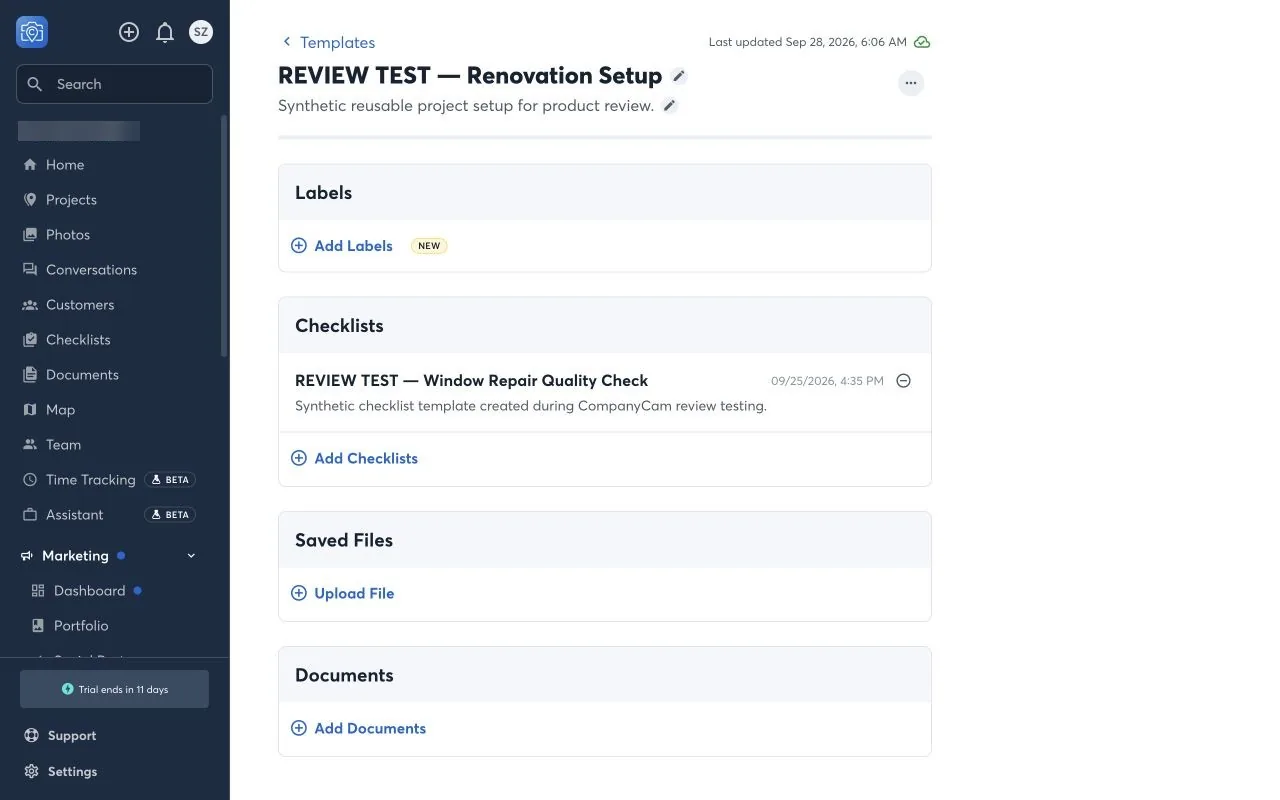
Project templates bundle labels, checklists, saved files, and documents so each new job starts the same way. We attached our inspection checklist to a template. We didn't create a second project from it, so we haven't confirmed everything copies across.

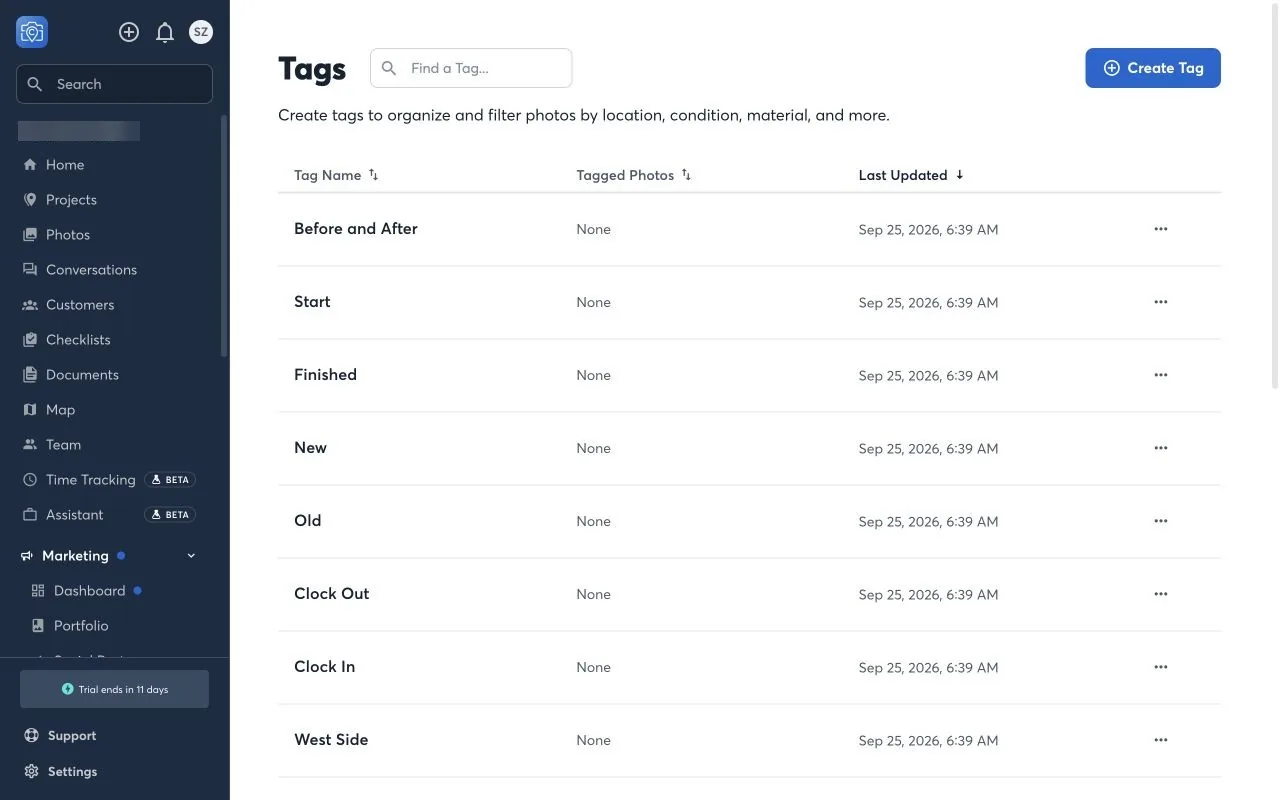
CompanyCam keeps two ways to organize. Tags sort photos (Before and After, Start, Finished, Receipt, and more). Labels sort projects (Lead, Proposal Sent, Scheduled, Active, Complete). It's a sensible split once you know it's there, and labels double as the columns on project boards.

Team roles & permissions

CompanyCam has four roles. Admin controls the whole account. Manager sees every project and manages users. Standard sees every project without user management. Restricted sees only projects they created or were assigned to. Restricted is the one to look at if you bring in subs or short-term crew.

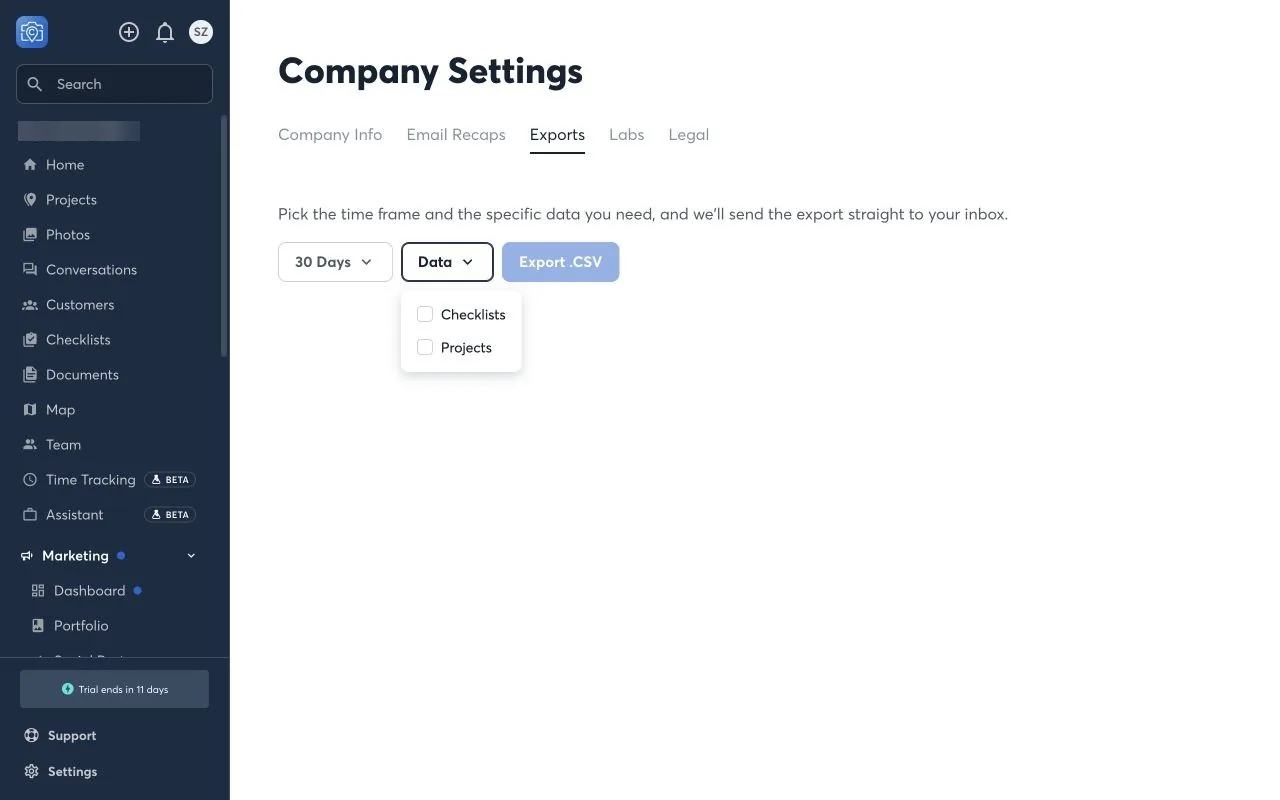
The account export sends project or checklist data as a CSV to your inbox for a date range you pick. We read the role descriptions but didn't test them with a second login, so we can't confirm how strictly each role is enforced.

Integrations & Marketing Suite

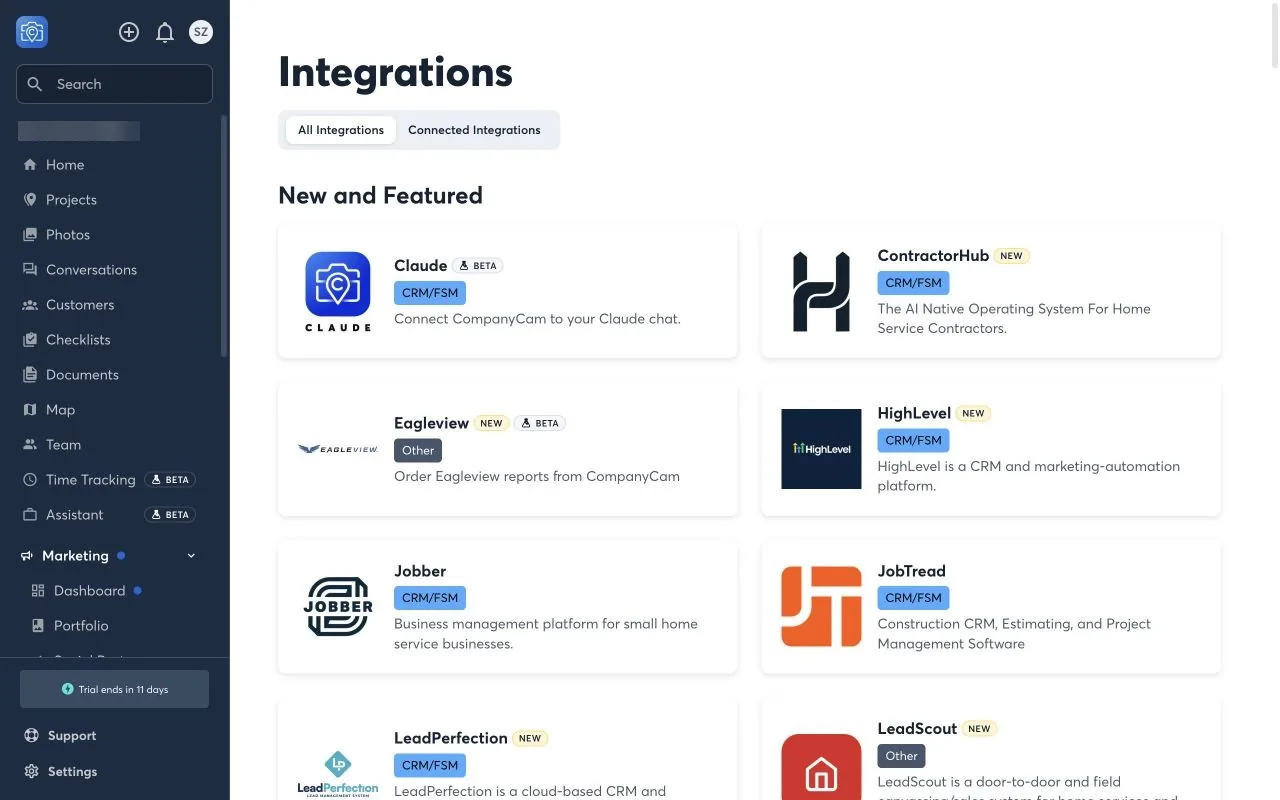
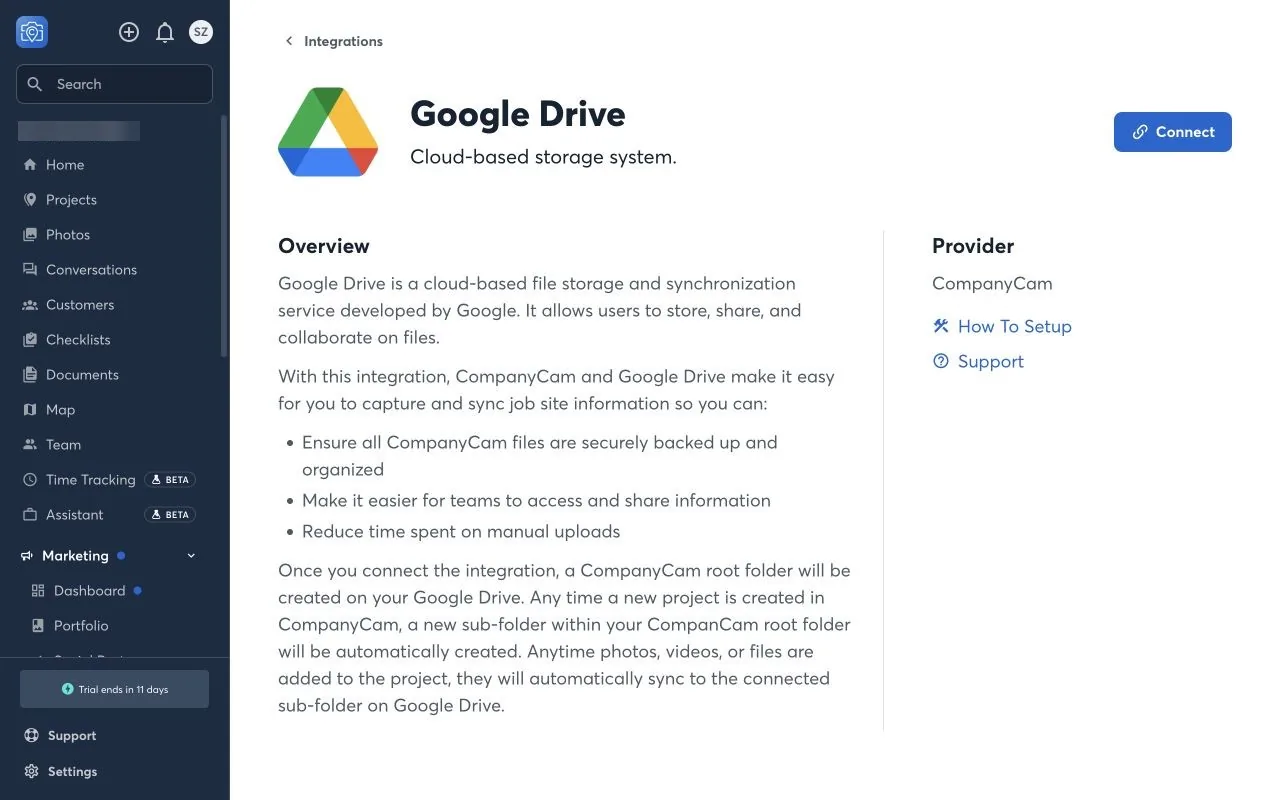
The App Marketplace groups connections into CRM and field service, estimating, time tracking and scheduling, and other tools. Names we saw include Jobber, JobNimbus, JobTread, QuickBooks Online, Google Drive, Dropbox, SharePoint, busybusy, and Zapier, with Procore and a Claude/MCP connection marked beta. The Google Drive listing describes a CompanyCam folder with one subfolder per project that syncs automatically. We didn't connect any integration.

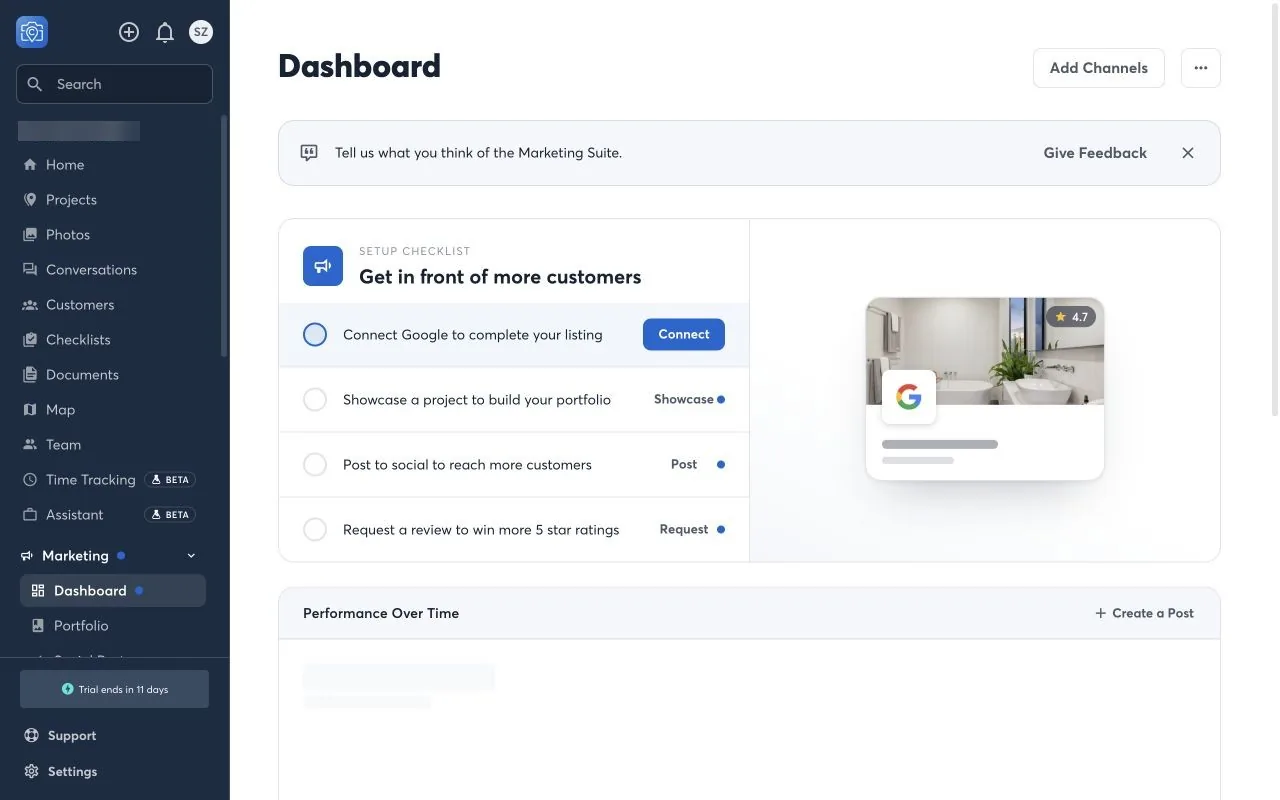
The Marketing Suite covers a hosted portfolio, social posts, review requests, and Google Business locations. In our account it billed as a separate $99/month trial add-on, even though the onboarding screen called it "Included in your plan." Confirm with CompanyCam which is true for your plan before you count on it.

CompanyCam pricing

How much does CompanyCam cost? Each plan has a monthly base that includes one or three users, then $29 per extra user per month on annual billing ($34 if you pay monthly). Here's the annual math behind Core, Crew, and Scale.

Core
$29/user/mo + $63/month base

Plan features:

  • 1 user included (2-user limit)
  • Photos and videos stored in the cloud (5-minute video limit on Core)
  • Photo annotations and before/afters
  • Tasks, notes, and reports
  • Price book and invoices
  • Shareable portfolios
  • 10 AI credits
Crew
$29/user/mo + $119/month base

Plan features:

  • 3 users included
  • Everything in Core
  • 5 proposals and 5 templates
  • User assignments and guest access
  • Project groups, checklists, and task assignment
  • 100 AI credits
Scale
$29/user/mo + $249/month base

Plan features:

  • 3 users included
  • Everything in Crew
  • Unlimited proposals, templates, and AI actions
  • Subcontractor access
  • LiDAR measurements
  • Digital signatures

What it costs as your crew grows

CompanyCam Crew against Workyard Starter on annual billing. Starter is GPS time tracking and payroll export at $6 per user per month with no base fee; it does not include the Pro features (checklists, job costing, scheduling). Figures are the software line item only.

15 workers
CompanyCam
Crew plan (annual)
$467/mo
Workyard
Starter plan
$90/mo
100 workers
CompanyCam
Crew plan (annual)
$2,932/mo
Workyard
Starter plan
$600/mo
300 workers
CompanyCam
Crew plan (annual)
$8,732/mo
Workyard
Starter plan
$1,800/mo

These are different products, so read the rows as the cost of putting every worker on each one. CompanyCam's $29 per extra user adds up quickly as your crew grows, and the Marketing Suite billed as a separate $99/month in our trial. Workyard's Pro and Autopilot plans add job costing, checklists, scheduling, and automatic clock-in, and are priced on request, so the gap narrows once you need them. The bigger question for many contractors is whether they pay for both: one owner told us CompanyCam was one of several apps costing $350 a month before they moved photos and forms into Workyard.

Pricing verified October 12, 2026. Visit the CompanyCam website for current pricing.

What contractors say about CompanyCam

Contractors rate CompanyCam highly across every platform we checked, 4.7 stars or better. The complaints cluster around app stability and photos that don't upload on weak signal. We looked at four sources: Capterra, G2, the Apple App Store, and Google Play.

Capterra
4.7
103 reviews
G2
4.7
32 reviews
iOS App Store
4.8
30,501 ratings
Google Play
4.7
7.9K reviews

Star rating figures captured as of October 12, 2026.

From Capterra, we read 30 reviews, almost all from construction companies, and grouped them into recurring strength and weakness themes, counting how often each came up so the patterns reflect frequency, not cherry picking.

From the Apple App Store, we read the 50 most recent reviews (April to September 2026). That's the field perspective: the crews taking photos on the job every day.

For G2 and Google Play we captured the headline ratings. Too few written reviews were readable on those platforms to count themes, so we don't draw patterns from them.

What’s working
Easy for crews to learn (about 10 of 30 Capterra reviews)
Photos stored and organized by job (about 9 of 30 Capterra reviews)
Photo proof for customer disputes and insurance claims
What’s not
Lag, crashes, or slow uploads (9 of the 50 latest App Store reviews)
Photos lost or stuck when signal is weak
Price and paid add-ons (3 Capterra and 3 App Store reviews)

Real CompanyCam user reviews

We sourced verified quotes directly from the reviews, so nothing on this page is paraphrased or generalized. The result is a side-by-side view of what is working well for CompanyCam and what doesn't.

@Lyla H., Capterra · ★★★★★

The sales people are able to take photos on Company Cam and they link into our CRM which saves time and energy.

@Chimneysweep2222, iOS App Store · ★★★★★

Constant issues with UI lag, forcing restarts and broken camera shutter button. Absolutely no reply after contacting their support over a year ago.

How CompanyCam compares to Workyard

CompanyCam and Workyard overlap less than most tools we review. CompanyCam is built around photos. Workyard is built around verified hours and job costs. Here's where each one is stronger across the areas contractors ask us about most.

Feature CompanyCam Workyard
Job-site photo documentation Core of the product; contractors pay for it alongside their field system Photos and notes on timecards and jobs; a lighter photo toolset
Checklists & inspections Checklists can require a photo before completion; PDF and CSV export Checklists (Pro) and Smart Forms (add-on) that trigger at the right moment, filed to the job
Reports & signatures Project reports export to PDF; signature requests via Dropbox Sign Signed PDF timecard sign-offs (Autopilot); daily reports via Smart Forms templates (add-on)
Time tracking Free beta; basic hours logged against a project GPS-verified time with geofence clock-in reminders and restrictions (Pro); automatic clock-in (Autopilot)
Overtime & break rules Not seen in our test of the beta Overtime and break calculations on every plan; automatic meal-break rules by state (Autopilot)
Job costing by cost code No cost-code labor costing seen in our test Labor costs by job and cost code, live (Pro)
Payroll & accounting integrations QuickBooks Online listed; no payroll export tested QuickBooks, ADP, Gusto and more; Sage and other ERPs on Autopilot
Scheduling crews Project assignments and boards; Google Calendar sync; no native crew scheduler seen Office-to-field scheduling pushed to crews' phones (Pro)
Customer-facing marketing Portfolios, social posts, review requests ($99/mo add-on in our trial) Not offered
Pricing model $63 to $249/mo base plus $29/user/mo (annual) From $6/user/mo (Starter, annual); no base fee; Pro and Autopilot priced on request

See how Workyard handles construction photo documentation

What are the key areas you should test in CompanyCam?

Three areas where CompanyCam's pitch and what we saw in testing are worth comparing before you commit.

Photo documentation

How CompanyCam positions it

Keep a close eye on your projects and what your team is doing with a steady flow of photos, updates, checklists, and reports coming straight from the field.

Testing approach

This is CompanyCam's strongest ground, and our own data agrees. In our sales calls, 18 companies told us they pay for CompanyCam alongside their field system, and one told us they'd keep it for photos even after switching their field system. We couldn't finish a photo upload in our browser test, so our hands-on view of capture, tags, and annotation is still to come. If photos are the heart of your documentation, test capture on the mobile app first.

The question that matters

Will your crews actually photograph the work, every day, on every job?

Checklists

How CompanyCam positions it

Standardize checklists across teams.

Testing approach

In our test, the Photos Required setting did exactly what it promised: the checklist would not complete until a photo was attached. Templates carried the checklist into a project template, and PDF and CSV export sat one menu away. The limit is scope. These checklists document the work. They don't connect to hours, cost codes, or payroll, so the office may still reconcile them against a separate time record.

The question that matters

Does proof of the work connect to the hours and costs behind it?

Time Tracking

How CompanyCam positions it

Time Tracking gives Admins and Managers a full view of their crew's hours from the web.

Testing approach

Time Tracking is a free beta, and it behaved like one. It saved a bounded 90-minute entry against our project, with filters and reminders, and the help docs describe photo clock-ins and a CSV export for payroll. We saw no overtime rules, break rules, approvals, or cost codes, and we didn't test mobile clock-in or GPS. Contractors who need payroll-ready hours may find they still run a separate time system. If you plan to rely on it, run a full week of real hours through it before payroll.

The question that matters

Can you run payroll from these hours without cleaning them up first?

CompanyCam alternatives you should evaluate

If you need more than photo documentation, here's what we'd recommend evaluating, based on whether you want to replace CompanyCam or run it alongside something else.

Workyard Try free

We put payroll, job costing, and compliance on autopilot.

Best for

Construction teams (15 to 500) that need GPS-verified hours and live job costs, with photos, notes, and forms attached to the same jobs.

What it solves that CompanyCam doesn’t
  • GPS-verified hours with geofence clock-in reminders and restrictions (Pro); automatic clock-in (Autopilot)
  • Labor costs by job and cost code, in real time
  • Checklists (Pro) and Smart Forms (add-on) that trigger at the right moment
  • Verified hours flow to QuickBooks, ADP, Gusto and more; Sage and other ERPs on Autopilot
Honest tradeoff

Workyard's photo tools are lighter than CompanyCam's, and it has no marketing portfolio or review-request tools. One roofing contractor we spoke with chose not to switch because they needed to send job photos to customers. Contractors who live in photos often keep CompanyCam and use Workyard for time and job costs.

Best for

Contractors who want daily reports, photos, and production tracking in one field app.

Tradeoff

Built around daily reporting rather than GPS-verified time, and priced per user.

Best for

Crews that want construction time tracking with photos on timecards, and a CompanyCam integration.

Tradeoff

Contractors tell us reporting depth is limited, and prevailing wage runs through a payroll integration rather than native certified-payroll reporting.

CompanyCam FAQs

Questions we hear from contractors comparing CompanyCam with their other field tools.

Is CompanyCam worth it?

For photo documentation, contractors tell us it is. In our sales calls, 18 companies said they pay for CompanyCam alongside their field system, and it rates 4.7 stars or better on every platform we checked. It may be less worth it if you mainly need time tracking or job costing, which it wasn't built around.

How much does CompanyCam cost?

On annual billing, Core is $63/month with 1 user, Crew is $119/month with 3 users, and Scale is $249/month with 3 users. Each extra user is $29/month. Monthly billing runs $79, $149, and $299, with extra users at $34. A 15-person crew on Crew pays about $467/month on annual billing. Prices checked October 12, 2026.

Does CompanyCam have time tracking?

Yes, as a free beta. In our test it saved hours against a project from the web, with filters and reminders. CompanyCam's help docs also describe clock-in with a photo and a CSV export for payroll. We didn't see overtime rules, break rules, approvals, or cost codes, so test a full week of real hours before relying on it for payroll.

Does CompanyCam work offline?

CompanyCam's help docs say the mobile app works offline: photos, videos, clock-ins, and existing tasks and checklist fields queue up and upload when you're back in signal. Some reviewers report photos lost or stuck on weak signal, so test it on your lowest-signal job before you commit.

Can CompanyCam replace my time tracking app?

Probably not yet. Time Tracking is a beta, and we saw no overtime or break rules, timesheet approvals, or cost codes. Most contractors in our calls run CompanyCam for photos and a separate system for time. If you want both in one app, compare how much photo depth you'd give up.

Does CompanyCam do job costing?

Not for labor by cost code, in our testing. CompanyCam tracks documentation, tasks, and a basic time log per project, but we saw nothing that turns hours into labor costs by job and cost code. If job costing matters to you, you may need a separate system for it.

Does CompanyCam integrate with QuickBooks?

QuickBooks Online is listed in CompanyCam's App Marketplace, alongside Jobber, JobNimbus, JobTread, Google Drive, Dropbox, and Zapier. We didn't connect it, so check what actually syncs (invoices, customers, or time) during your trial.

Is CompanyCam's Marketing Suite included in the plan?

It wasn't clear in our trial. The onboarding screen said "Included in your plan," but billing listed it as a separate $99/month trial add-on. Ask CompanyCam to confirm in writing before you count on it.

What are the most common complaints about CompanyCam?

In the 50 most recent App Store reviews, 9 mentioned lag, crashes, or slow uploads. Reviewers on Capterra and Google Play also reported photos lost or stuck on weak signal, and a handful mentioned price and paid add-ons. These are worth testing during a trial rather than discovering after you've committed.

CompanyCam vs Workyard: which do I need?

Disclosure: we compete with CompanyCam in some areas. They do different main jobs. CompanyCam is built around job photos. Workyard is built around GPS-verified hours and live job costs, with lighter photo tools. Many contractors use both. If you're paying for two apps, it's worth checking which features you actually use in each.