


 (650) 332-8623
7 Best Painting Contractor Software for 2026
Compare 7 top painting contractor software picks for time tracking, GPS, and job costing. Find the best fit for your crew size and budget.


Quick Answer
The best painting contractor software is Workyard. It combines GPS-verified crew clock-ins with real-time job costing, something competitors split across separate tiers. From $6/user/month.
Timeero offers the best value. Cheapest per-user rate here, no base fee, mileage tracking built in. From $6/user/month.
Raken is the best for photo documentation. Strongest daily-report and photo tooling, best paired with a separate GPS time clock. Pricing by request.
This roundup covers time tracking, GPS, and job costing for painting contractors, not general business software.
Disclosure: Workyard is included in this comparison. This article is published by Workyard and reflects our honest assessment of each product based on hands-on testing, verified current pricing, and analysis of publicly available customer reviews across G2, Capterra, the App Store, and Google Play.
The best painting contractor software solves one problem: crews move between jobsites, and nobody tracks exactly when they arrived and left each one.
A five-person crew can hit three residential jobs before lunch. Without GPS verification, job costing turns into guesswork by the time payroll runs. That guesswork has a name at payroll time: correcting time, as one 75-person painting company’s admin put it.
Around 32 hours of computer time, probably, yeah. And that’s just the, that’s also including the payroll side though. But if we take out eight hours from that, we’re still up there, we’re still over 20 hours. So just correcting time.
That adds up to twenty-plus hours a week fixing errors GPS would have caught the first time.
We tested seven GPS and time-tracking platforms against real painting-crew scenarios, current pricing, and customer reviews. The goal: find which ones actually verify labor cost per job instead of just clocking hours. This roundup narrows that broader category of construction time tracking software down to the platforms built specifically for painting crews.
Best painting contractor software at a glance
| Brand | GPS accuracy | Job costing | Crew workflow | Use case | Starting price |
| Workyard | Geofenced GPS, verified per jobsite for the whole crew | Built-in, updates as hours are logged | Kiosk mode clocks in a whole crew at once | Crews bidding fixed-price jobs that need job costing | $6/user/mo, billed annually |
| ClockShark | GPS geofencing at the jobsite | Job/task cost tracking | Individual clock-in, mobile app or kiosk | Crews already clocking in individually | $40 base + $9/user/mo |
| BusyBusy | GPS clock-in, geofenced jobsite boundaries | Cost-code job costing, tracks material and labor per project | Individual clock-in | Job costing without construction-specific extras | Free plan; paid plans start at $9.99/user/mo + $40 base, billed annually |
| QuickBooks Time | GPS stamp at clock-in/out, geofencing available | Project tracking, budget-vs-actual on Elite tier | Individual mobile clock-in | Shops already running QuickBooks Payroll | $10/user/mo + $10 base |
| Connecteam | Location stamp per entry, not continuous | No job costing or cost codes | Individual clock-in | Very small crews on a tight budget | Free for up to 10 users; paid plans start at $29/mo base |
| Timeero | GPS clock-in plus automatic mileage tracking | Basic job tagging, no phase breakdown | Individual clock-in | Crews driving between sites needing mileage logs | $6/user/mo |
| Raken | No GPS clock-in; entries aren’t location-verified | Time capture only, no cost breakdown | Individual clock-in, no crew grouping | Photo-heavy daily reporting, not GPS accuracy | Quote-based |
What’s changed in this updated (July 2026)
- Full brand-lineup replacement: Removed Joist, Method: Field Services, PaintScout, PaintBox, MHelpDesk, and Builder Prime (estimating/CRM software with no time-tracking or GPS functionality), and added ClockShark, BusyBusy, QuickBooks Time, Connecteam, Timeero, and Raken
- Reframed the article’s focus from general painting business software toward time tracking, GPS, and crew/job cost management
- New sections added: a Quick Answer box, 7-brand comparison table, disclosure Statement, buying guide, and final recommendations
- Expanded FAQ section
How we chose these painting contractor software picks
We tested seven painting contractor software options against real painting-crew scenarios, current pricing, and verified customer reviews. Each pick had to hold up against an actual crew moving between jobsites, not just a features page. See our scoring methodology
1. Workyard: Best overall painting contractor software for GPS and job costing
Painting crews often move as a unit from one house to the next without clocking in individually per site. I tested Workyard specifically for how it handles that workflow, and it’s the only tool in this roundup built around it.
Workyard is cloud-based, so a foreman clocking in a crew from a jobsite and an office admin reviewing hours are looking at the same live data. It isn’t a CRM for painting contractors managing leads and bids, but its job structure sits alongside whatever CRM or estimating tool a contractor already uses.
Key features
- GPS geofencing: Verifies crew arrival and departure at each jobsite, down to the address
- Live labor-to-budget tracking: Shows labor burn against the bid in real time, not after the invoice goes out
- Job and phase costing: Breaks hours down by project instead of lumping a painter’s week into one total
- Payroll integrations: Native sync with QuickBooks, ADP, Gusto, and Sage
- Time clock kiosk: Shared jobsite clock-in for crews that don’t want to hand out individual logins
GPS geofencing built for crews, not individuals
Workyard’s geofencing verifies an entire crew’s arrival and departure at a jobsite, not just one person’s. That upstream guarantee is what everything else on this list depends on. If the software can’t confirm the crew was actually on-site, job costing downstream is only as good as an unverified guess.


Geofencing also closes a different gap: buddy punching, when one crew member clocks in for someone who hasn’t arrived yet. That’s a common source of time theft on multi-site crews, and it’s invisible to software that only checks whether someone tapped a button, not where they were standing when they did it.
In my testing, Workyard’s geofencing held exactly where I placed it for a five-person crew moving between three residential jobs in a day. There were no false positives on the wrong side of a property line, and no drift.
Whenever we bid a project to a general contractor, we give them the set amount that we’re not going to surpass. However, whenever we have issues with labor, if people remain clocked in or clock in yet don’t arrive on-site, we now catch it immediately instead of discovering it after the job is billed.
Job and phase costing tied to the bid
Workyard’s phase costing splits hours by project as they’re logged, so labor cost against the bid is visible the same day. That matters because painting crews often work as a unit rather than clocking in individually per site, which is exactly where hours get lumped into one weekly total with no job breakdown on other tools.

Payroll integrations that skip the manual export step
I set up the QuickBooks sync during testing, and approved hours moved into QuickBooks without a manual export or file upload. ADP, Gusto, and Sage sync work the same way. The same GPS-verified record is what ends payroll disputes before they start, since there’s a timestamped answer instead of two conflicting memories.
With Workyard, I get the answers I need in minutes. Everything is right there in front of me, and there is no more he-said she-said.
Pricing
| Plan | Price | What’s included |
| Starter | $6/user/mo | Field expense tracking, time tracking, location and mileage tracking, payroll integrations, and more |
| Pro | Custom quote | Everything in Starter + scheduling and tasks, labor cost reporting, clock-in photo verification, accounting integrations, and more |
| Autopilot | Custom quote | Everything in Pro + ERP integrations, API access, and more |
Free trial: 14 days
Pros and cons
| Pros | Cons |
| Most accurate GPS verification tested in this roundup | No free tier, so very small crews evaluating on price alone may look elsewhere first |
| Real-time job and phase costing tied to the bid | Some advanced features have a learning curve during setup |
| Deep payroll integration depth (QuickBooks, ADP, Gusto, Sage) | Requires accurate project setup to get full reporting value |
| Built for crews that don’t clock in one-by-one |
Ratings
App Store: 4.1/5
Google Play Store: 3.7/5
Capterra: 4.7/5
G2: 4.8/5
Who should use Workyard?
Workyard is best for:
- Painting contractors with five or more painters who need to know whether a job is running over budget before it closes, not after
- Companies bidding fixed-price jobs against a general contractor, where the live labor-to-budget view protects margin
- Crews that move between jobsites as a unit rather than clocking in individually per person
2. ClockShark: Painting contractor software for QuickBooks-first crews
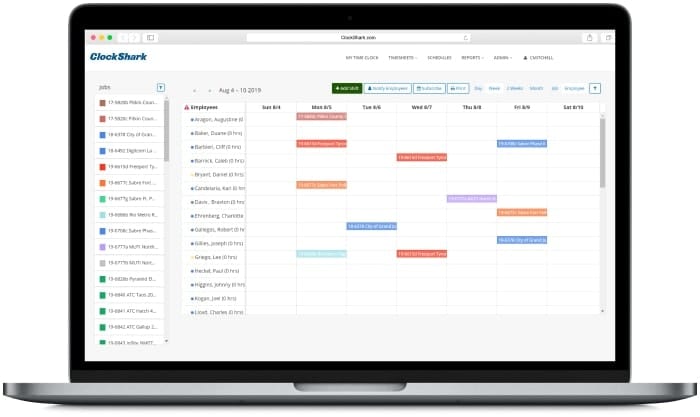
Painting companies already running individual clock-ins per employee, and prioritizing QuickBooks sync, get the most out of ClockShark. Crews that move together between jobsites may find its scheduling model a mismatch, since it’s built around individual logins, not crews that move as a unit.
GPS accuracy is a frequent complaint among users. One reviewer described clocking in from their own desk and having the app place them three miles away, calling the GPS unreliable.
The mobile-versus-web gap shows up in the ratings, too. Its admin-side Capterra score sits well above its iOS App Store rating, a sign the office likes it more than the crew using it in the field.
On integrations, ClockShark’s connections center on QuickBooks Online and Desktop, a narrower footprint than some other tools in this roundup.
See how the two stack up: Workyard vs ClockShark
Key features
- GPS time tracking with geofencing: Records employee hours and jobsite locations
- QuickBooks integration: Syncs approved timesheets with QuickBooks Online and Desktop
- Job and task tracking: Tracks labor hours by job and task
- Kiosk mode: Lets multiple employees clock in from a shared device


Pricing
| Plan | Price | What’s included |
| Standard | $40/mo base + $9/user/mo | GPS, geofencing, job costing, scheduling, kiosk |
| Pro | $60/mo base + $11/user/mo | Paid time off, advanced job costing, departure tracking |
Free trial: 14 days
Pricing verified against clockshark.com as of July 2026; confirm current rates before purchasing.
Pros and cons
| Pros | Cons |
| Strong admin-side ratings (Capterra 4.7, G2 4.6) | GPS accuracy complaints are the most-cited weakness |
| Job and task tracking by project | Scheduling built around individual employees, not crews |
| Native QuickBooks Online and Desktop sync | No prevailing wage support |
| Kiosk mode for shared-device clock-ins | Per-user pricing scales quickly as crew size grows |
Ratings
App Store: 2.9/5
Google Play: 3.4/5
Capterra: 4.7/5
G2: 4.6/5
Who should use ClockShark?
ClockShark is ideal for:
- Painting companies that already run individual clock-ins per employee
- Crews that don’t need crew-based GPS verification
- Contractors with no prevailing wage exposure and a QuickBooks-first payroll workflow
3. BusyBusy: Painting contractor software for job costing without construction-specific extras
Job costing without construction-specific scheduling is what painting contractors get from BusyBusy. Its job costing depth is a standout strength in its own reviews, tracking material and labor cost per project well.
Geofencing accuracy is BusyBusy’s most frequent complaint, directly relevant to painting crews checking in at tight residential lots. Some users described clocking in on-site while the app still registers them as outside the job’s geofence perimeter.
BusyBusy positions itself as built for construction and remote industries, and its job costing depth backs that up. The tradeoff shows up in payroll: there’s no built-in processing, so painting contractors need a separate add-on or export step.
See the full comparison: Workyard vs BusyBusy
Key features
- Job costing: Tracks material and labor cost per project
- GPS time tracking with geofencing: Records hours and jobsite locations
- Equipment tracking: Logs equipment usage alongside labor hours
- Offline mode: Queues entries locally without signal


Pricing
| Plan | Price | What’s included |
| Free | $0 | Unlimited users, GPS time tracking, job costing |
| Pro | $9.99/user/mo + $40 base, billed annually | GPS breadcrumbing, supervisor tools, photos and notes, scheduling |
| Premium | $14.99/user/mo + $40 base, billed annually | Everything in Pro + daily project reports, documents, progress tracking, Zapier, and more |
Free trial: 14 days
Pricing verified as of July 2026. Rates subject to change. Verify current pricing at BusyBusy’s website before purchasing.
Pros and cons
| Pros | Cons |
| Real job costing depth | Geofence misalignment is the most-cited weakness |
| Works offline | No built-in payroll; requires a paid add-on |
| Competitive base pricing | Mobile app rated lower than the admin dashboard |
Ratings
App Store: 4.1/5
Google Play Store: 4.1/5
Capterra: 4.5/5
G2: 4.8/5
Who should use BusyBusy?
BusyBusy is ideal for:
- Painting contractors who want job costing without construction-specific scheduling
- Teams comfortable troubleshooting occasional geofence issues
4. QuickBooks Time: Painting contractor software for QuickBooks-only shops
QuickBooks Time’s biggest selling point is simple: native Intuit sync, which matters most to painting contractors already running QuickBooks for invoicing.
Mobile app quality draws the most complaints, alongside reported GPS drift. Users describe the mobile experience as dated and clunky compared to modern time-tracking apps.
The strength/weakness split here is unusually wide: QuickBooks and payroll integration is its most-praised feature by a large margin, while mobile app quality draws the most complaints by an even larger one.
Job costing is real but locked to the pricier Elite tier, so painting contractors on Premium won’t get it without upgrading. QuickBooks Time also requires an active QuickBooks Online subscription. It isn’t a standalone QuickBooks time tracking purchase for contractors who don’t already run QuickBooks.
Check out the full comparison here: Workyard vs QuickBooks Time
Key features
- Native QuickBooks sync: Hours flow directly into QuickBooks Online and Desktop
- GPS tracking and geofencing: Records employee locations and hours
- Mobile time clock: Crews clock in and switch jobs from a mobile device


Pricing
| Plan | Price | What’s included |
| Time Premium | $10/user/mo + $10 base | Workforce app, payroll and invoicing, time off management, time kiosk |
| Time Elite | $12/user/mo + $20 base | Payroll and invoicing, time kiosk, mileage and project tracking, timesheet signatures, unlimited customer support |
| Workforce Premium | $10/user/mo + $44 base | Full service payroll, auto payroll, employee portal, and more |
| Workforce Elite | $12/user/mo + $67 base | Geofencing, mileage tracking, project estimates vs actuals, tax penalty protection, and more |
Free trial: 30 days
Pricing verified as of July 2026. Rates subject to change. Verify current pricing at QuickBooks’s website before purchasing.
Pros and cons
| Pros | Cons |
| First-party QuickBooks sync | User complaints of outdated mobile UX |
| Strong GPS/geofencing feature set on paper | Reported GPS drift |
| Familiar to existing QuickBooks users | Job costing locked to the Elite tier |
Ratings
App Store: 4.6/5
Google Play Store: 4.7/5
Capterra: 4.7/5
G2: 4.5/5
Who should use QuickBooks Time?
QuickBooks Time is ideal for:
- Painting contractors who already run QuickBooks for everything else
- Teams that prioritize accounting sync over GPS precision
5. Connecteam: Painting contractor software for very small crews on a tight budget
Very small painting crews on a tight budget will find Connecteam’s free tier the cheapest entry point on this list. It tracks location breadcrumbs instead of live GPS and has no job costing, a real gap for seeing labor cost per job.
The lack of live, continuous GPS, job costing, and cost codes is a real gap for job cost-focused painting crews that need to see labor costs per job. Connecteam is built for shift work and restaurant scheduling more than construction.
Key features
- All-in-one hub: Time tracking, scheduling, forms, and communication in one app
- GPS breadcrumbs: Location stamps on time entries
- Mobile time tracking: Clock in, track time, and switch jobs from mobile devices


Pricing
| Plan | Price | What’s included |
| Basic | $29/mo base (first 30 users, 1 hub) | GPS clock-in/out, payroll integration, unlimited checklists, and core scheduling |
| Advanced | $49/mo base (first 30 users, 1 hub) | Everything in Basic + full time clock customization, auto clock-out, up to 10 geofence locations |
| Expert | $99/mo base (first 30 users, 1 hub) | Everything in Advanced + unlimited sub-jobs, multiple schedule types, API access |
| Enterprise | Quote-based | Operations Expert + unlimited time clocks and schedules, biometric app lock, etc. |
Free trial: 14 days; free Small Business Plan for up to 10 users
Pricing verified as of July 2026. Rates subject to change. Visit Connecteam’s website for current pricing and plan details.
Pros and cons
| Pros | Cons |
| Free for crews under 10 | No live GPS, breadcrumbs only |
| All-in-one hub for scheduling and forms | No job costing or cost codes |
| Low starting cost | Not construction-specific |
Ratings
App Store: 4.9/5
Google Play: 4.8/5
Capterra: 4.6/5
G2: 4.6/5
Who should use Connecteam?
Connecteam is ideal for:
- Very small painting crews that need basic clock-in tracking on a tight budget
- Teams that don’t yet need job costing
6. Timeero: Painting contractor software for crews that drive between jobs
Mileage tracking and low per-user pricing make Timeero a strong fit for painting crews driving between residential jobs. GPS routing accuracy is a recurring complaint.
GPS routing accuracy is a recurring complaint from users, citing that it ignores actual roads, occasionally plotting a straight-line path instead of following the route actually driven, which affects mileage accuracy.
Customer support is Timeero’s most-praised feature, an unusual strength for a budget tool. Android stability and battery drain are the top complaints, worth weighing for painters running phones on jobsites all day. Scheduling isn’t available on the entry-level Basic plan.
Key features
- Mileage tracking: Automatic mileage logs between jobsites
- Segmented tracking: Separates drive time from on-site time
- GPS time tracking: Clock-in location stamps


Pricing
| Plan | Price | What’s included |
| Basic | $6/user/mo monthly ($5 annual, max 10 users) | Time tracking, GPS breadcrumbs, mileage tracking, etc. |
| Pro | $9/user/mo monthly ($7.50 annual) | Everything in Basic + geofencing, auto clock-in/out, job tracking, scheduling, etc. |
| Premium | $12/user/mo monthly ($10 annual) | Everything in Pro + facial recognition (kiosk), time-off management, and more |
| Enterprise | Quote-based | Custom features and support |
Free trial: 14 days
Pricing verified as of July 2026. Rates subject to change. Verify current pricing at timeero.com before purchasing.
Pros and cons
| Pros | Cons |
| Lowest per-user pricing in this roundup | GPS/mileage routing complaints (straight-line routing instead of actual roads) |
| Built-in mileage tracking | Android stability and battery-drain complaints |
| Strong customer support, an unusual strength for a budget tool | Scheduling locked out of the Basic tier |
Ratings
App Store: 4.7/5
Google Play Store: 4.6/5
Capterra: 4.5/5
G2: 4.8/5
Who should use Timeero?
Timeero is ideal for:
- Budget-conscious painting contractors whose crews drive personal vehicles between jobsites
- Teams that need mileage reimbursement data alongside time tracking
7. Raken: Painting contractor software for photo-based daily reporting
For painting contractors, Raken’s daily reports and photo documentation are the strongest in this roundup. It’s built for field reporting, not time tracking. That tradeoff shows up fast: it’s the one tool here without native GPS clock-in verification.
User reviews note that Raken doesn’t capture precise clock-in locations, making it difficult to verify whether employees were actually on-site when they clocked in.
For painting contractors, Raken is a solid companion to dedicated GPS time tracking software rather than a complete replacement.
Key features
- Daily reports: Field documentation with photos and notes
- Photo documentation: Attaches jobsite photos to daily records
- Time tracking: Basic time capture alongside reporting


Pricing
Raken uses custom pricing and does not publish rates on its website. Contact Raken for a personalized quote based on your team size and feature requirements.
Pros and cons
| Pros | Cons |
| Strong photo and daily report documentation | No native GPS time tracking |
| Intuitive mobile interface | Limited job costing |
Ratings
App Store: 4.7/5
Google Play Store: 4.3/5
Capterra: 4.6/5
G2: 4.6/5
Who should use Raken?
Raken is ideal for:
- Painting contractors who most need photo-based daily jobsite documentation
- Teams willing to pair it with a separate time-tracking tool for GPS verification
How to choose the best painting contractor software
The best painting contractor software combines GPS-verified time tracking, job costing, and crew-friendly workflows to help you track labor accurately and manage projects more efficiently.
While many painting business tools focus on estimating, CRM, or project management, this guide compares software built specifically for tracking crew time, verifying jobsite attendance, and controlling labor costs.
What to look for in painting contractor software
Choose painting contractor software that matches how your crews work in the field. Focus on GPS accuracy, job costing, payroll integration, and the features that will have the biggest impact on daily operations.
1. GPS accuracy and crew-based workflow fit
Why it matters for painting contractors: Painting crews often move between jobsites as a unit rather than clocking in individually. Software built around individual clock-ins, like ClockShark’s scheduling model, can create friction for teams that work this way.
What to look for:
- Geofenced GPS verification at the address level
- Crew-based clock-in support, not just individual logins
- Crew scheduling that assigns a whole team to a job, not just individuals
- No drift on adjacent parcels or dense residential lots
Questions to ask vendors:
- Can a foreman clock in an entire crew at once?
- How is GPS accuracy verified at the address level?
- What happens when two jobsites are close together?
2. Job and phase costing
Why it matters for painting contractors: For any painting contractor bidding fixed-price jobs, job costing is a must-have, not a nice-to-have. Without it, hours get lumped into one weekly total per painter with no breakdown by job, so nobody can see which jobs are profitable until it’s too late.
What to look for:
- Cost codes assigned at clock-in, not after the fact
- Real-time labor-to-budget visibility against the original bid
- Phase-level breakdown, not just job-level totals
Questions to ask vendors:
- When does labor cost data become visible: same day or at invoicing?
- Can hours be split across multiple jobs in one day?
3. Payroll and accounting integration
Why it matters for painting contractors: Most painting contractors already run QuickBooks for invoicing, so payroll sync depth is worth weighing alongside GPS accuracy. A tool with weak GPS but strong QuickBooks sync still leaves a manual reconciliation gap at payroll time.
What to look for:
- Native sync, not a CSV export step
- Support for QuickBooks Online and Desktop specifically
- ADP, Gusto, or Sage support if payroll runs through one of those
Questions to ask vendors:
- Is the integration a live sync or a file export?
- Do cost codes transfer with the hours, or get stripped on export?
4. Offline reliability for low-connectivity jobsites
Why it matters for painting contractors: New construction and remote jobsites often have poor connectivity. A dropped clock-in during a dead zone is the same problem as no time tracking at all.
What to look for:
- Local queuing of time entries without signal
- Automatic sync once connectivity returns
Questions to ask vendors:
- What happens to a clock-in recorded with no signal?
- Does GPS still verify location offline?
5. Photo documentation
Why it matters for painting contractors: Jobsite photo documentation alongside time entries is valuable for disputes over work quality or progress, though it’s a different feature from GPS time tracking.
Raken leads this roundup on photo documentation specifically, while lacking native GPS time tracking.
What to look for:
- Photos attached directly to a job record, not a separate app
- Time-stamped, location-tagged photo logs
6. Budget and crew size fit
Why it matters for painting contractors: Crews under 5 painters can often get by on a free or low-cost tier, but job costing and GPS accuracy usually become non-negotiable somewhere between 5 and 20 painters, when one owner can no longer personally verify every jobsite by memory.
What to look for:
- Per-user pricing that scales predictably as the crew grows
- No forced upgrade to unlock job costing or GPS accuracy features
Questions to ask vendors:
- What does the price look like at double the current crew size?
- Which features are locked behind a higher tier?
Pricing considerations
Per-user pricing on this list ranges from $4 to $15 per user per month, plus base fees on several tools. For a 10-person painting crew, actual monthly totals across these seven tools run from about $30 to $160, depending on which tool and tier you pick, not just the advertised starting price.
Hidden costs to watch for:
- Payroll add-ons priced separately from the base plan (BusyBusy)
- Per-hub pricing that multiplies if more than one module is needed (Connecteam)
- Custom or contact-sales pricing that isn’t visible until a demo call (Raken)
The per-user gap between tools is smaller than it looks once you run the numbers. At 10 painters, Workyard runs $60/month, ClockShark runs $130/month, and BusyBusy runs about $160/month.
The bigger cost usually sits upstream of any of these tools: one 75-person painting company’s admin described spending over 20 hours a week correcting timesheet errors. At a conservative $20/hour, that’s over $1,700 a month in corrective labor alone.
Residential vs. commercial painting
Residential crews moving between several small jobs a day get the most value from GPS geofencing accuracy. Commercial and industrial painting subcontractors bidding against general contractors get more value from deep job and phase costing tied to the original bid.
Best painting contractor software by use case
Workyard is the best painting contractor software for most crews bidding fixed-price jobs. It combines GPS geofencing, real-time job costing, and payroll integration in one tool. The picks below cover where other products fit.
For small crews (1–10 painters)
Top Pick: Workyard
Why: GPS verification and job costing without added complexity, even at small scale
Runner-Up: Timeero
Why: The lowest per-user price point for crews on a tight budget that still need mileage tracking
For mid-size crews (10–30 painters)
Top Pick: Workyard
Why: Real-time labor-to-budget visibility becomes essential once one owner can no longer verify every jobsite personally.
Runner-Up: BusyBusy
Why: Job costing depth worth evaluating for growing crews comfortable troubleshooting occasional geofence issues
By primary need
- Best for GPS accuracy: Workyard – geofenced verification with no drift in testing
- Best for QuickBooks-only shops: QuickBooks Time – native Intuit sync
- Best for mileage tracking: Timeero – built-in mileage logs for crews driving between jobs
- Best for photo documentation: Raken – daily-report and photo tooling
- Best free option: Connecteam – free for crews under 10
Final recommendation
Workyard is the best overall painting contractor software for GPS and job costing. It combines GPS geofencing, real-time job costing, and payroll integration in one tool, with no crew-based workflow mismatch to work around.
Here’s how the top three compare:
🥇Best Overall: Workyard
Why: Workyard combines GPS-verified crew clock-ins, real-time job costing, and payroll integration in one system. Labor cost against the bid is accurate the same day, not three weeks later at invoicing.
Two objections come up in almost every contractor evaluation. Here’s how each one actually plays out.
“My crew won’t use it.”
Workyard’s kiosk mode lets a foreman clock in an entire crew from one shared device, so individual adoption isn’t the barrier it is with tools built around one login per person.
“A few dollars cheaper per user is still cheaper.”
At 10 painters, Workyard runs about $60/month. ClockShark runs about $130/month for the same crew, and BusyBusy runs about $160/month. The per-user premium doesn’t hold once you compare actual monthly totals.
The bigger number sits upstream: one 75-person painting company’s admin described spending over 20 hours a week correcting timesheet errors. At a conservative $20/hour, that’s over $1,700 a month in corrective labor, more than ten times what Workyard costs outright.
Best for: Painting contractors with 5 or more painters bidding fixed-price jobs
Pricing: Starting at $6/user/month
🥈Best Value: Timeero
Why: The lowest per-user pricing in this roundup, with no base fee, plus mileage tracking built in for crews driving between residential jobs.
Best for: Budget-conscious crews under 15 painters
Pricing: Starting at $6/user/month, no base fee
🥉Best for Photo Documentation: Raken
Why: The strongest daily-report and photo tooling in this roundup, best paired with a dedicated GPS time clock since it lacks native GPS time tracking
Best for: Contractors who prioritize jobsite documentation over GPS accuracy
Pricing: Quote-based
References
- 1
QuickBooks Time (Intuit). Time Tracking Pricing. quickbooks.intuit.com/time-tracking/pricing
- 2
ClockShark. Pricing. clockshark.com/pricing
- 3
BusyBusy. Pricing. busybusy.com/pricing
- 4
Connecteam. Pricing. connecteam.com/pricing
- 5
Timeero. Pricing. timeero.com/pricing
GPS verification matters once you’re bidding fixed-price jobs, because basic clock-in/out can’t confirm a crew was actually on-site. Painting crews that move between multiple jobsites in a day benefit most from geofenced tracking that logs arrival and departure automatically.
Most painting contractors already invoice through QuickBooks, so payroll sync is worth prioritizing. Workyard, ClockShark, BusyBusy, and QuickBooks Time all offer QuickBooks integration, though sync depth and setup steps vary.
Yes, for any painting company that bids fixed-price jobs. Without job costing, you find out a job ran over budget after it’s billed instead of while there’s still time to fix it.
Offline functionality matters for new-construction sites or rural jobsites without reliable signal. Confirm the app queues time entries locally and syncs automatically once connectivity returns.
It’s valuable for disputes over work quality or progress, though it’s a different feature from GPS time tracking. Raken leads this roundup on photo documentation specifically, while lacking native GPS time tracking.
Yes. Residential crews moving between several jobs a day benefit most from GPS geofencing accuracy, while commercial painting subcontractors get more value from job and phase costing tied to the original bid.
It’s software that replaces paper timesheets and manual logs with GPS-verified digital clock-ins, letting painting contractors see exactly when and where crews worked on each job.
Among the best apps for painting contractors, this category is judged on GPS accuracy and job costing specifically, not general features.
Generic time clock apps don’t verify jobsite location or break hours down by project. Painting contractors need both to catch labor cost overruns before a job closes, not after.
Per-user pricing on this list ranges from $4 to $15 per month, with several tools also charging a separate monthly base fee. For a 10-person crew, actual monthly totals across these seven tools run from about $30 to $160.
Some crews are wary of being tracked. Owners who roll out GPS tracking successfully tend to frame it as protecting the crew’s hours from disputes, not just monitoring them, and to be transparent that tracking only runs during clocked-in hours.


