


 (650) 332-8623
6 Best Time Tracking Apps for Property Management Companies (2026)
Top time tracking apps for property management companies with GPS, geofencing & payroll integration. 6 tools compared for maintenance crews.


Quick Answer
🏆 Best Overall: Workyard – Best time tracking app for property management companies because of its GPS-verified time tracking built for maintenance crews working across dozens of properties, from $6/user/mo (annual) plus a $50/mo base fee
🥈 Best All-in-One: Connecteam – Scheduling, team chat, and time tracking for a deskless office, free for up to 10 users
🥉 Best Budget: Timeero – Cheapest GPS and mileage tracking option that still holds up for a scattered maintenance crew, from $5/user/mo (annual)
Disclosure: Workyard is included in this comparison, and this article is published by Workyard. Our evaluation is based on hands-on testing, feature documentation, verified user reviews, and how each tool performs for property management companies with field maintenance crews.
A property management company running maintenance crews across 30 properties has no reliable way to know if a tech’s clocked hours match the work order. The crew pieces together each pay period from paper notes and text messages, and payroll gets reconciled by hand every two weeks.
Manual project tagging drives a lot of that reconciliation work. Hours get logged against the wrong property, and someone in the office has to untangle it every pay period, exactly the failure mode a property management company needs to avoid. It’s a common complaint about QuickBooks Time specifically:
Spent 4-5 hours EVERY WEEK correcting project tagging errors because workers chose wrong projects.
We tested six construction time tracking software options against that exact problem, scoring each against GPS accuracy, property-level cost tracking, and payroll integration using our scoring methodology.
At a glance: time tracking apps for property management companies
| Brand | GPS & geofencing | Offline mode | Payroll integrations | Use case | Starting price |
| Workyard | Continuous GPS, geofenced clock-in | Yes | QuickBooks, ADP, Gusto, Paylocity, Sage | Maintenance crews across multiple properties needing GPS-verified payroll | $6/user/mo (annual) |
| Connecteam | GPS at clock-in and clock-out (breadcrumbs) | Limited | QuickBooks, Gusto, Xero | Deskless property management offices wanting scheduling and chat in one app | Free (10 users) / $29/mo |
| ClockShark | GPS clock-in with geofencing | Yes | QuickBooks | Field crews already comfortable with construction-style time tracking | $40/mo base + $9/user/mo |
| QuickBooks Time | GPS and geofencing, native to QuickBooks payroll | Limited | QuickBooks (native) | Property management companies already running payroll through QuickBooks | $20/mo base + $10/user/mo + required QuickBooks Online subscription |
| Timeero | GPS with geofencing and mileage tracking | Yes | QuickBooks, ADP, Gusto, Paychex | Budget-conscious teams tracking mileage between properties | $5/user/mo (annual) |
| Buddy Punch | Clock-in GPS point, facial recognition option | No | QuickBooks, ADP, Gusto, Paychex | Simple biometric clock-in for a shared office or yard location | $19/mo base + $4.49/user/mo |
What’s changed in this update (July 2026)
- This page previously compared property management platforms for DIY small landlords (Stessa, TurboTenant, DoorLoop, Buildium, Avail, Rentec Pro). None of those tools track employee time, so we rebuilt the article from the ground up around property management companies running field maintenance crews.
- Swapped in a lineup that actually competes on time tracking: Workyard, Connecteam, ClockShark, QuickBooks Time, Timeero, and Buddy Punch.
- Added a Quick Answer, an at-a-glance comparison table, and a Buying Guide covering pricing at scale, integration requirements, and picks by crew size.
How we chose the best time tracking apps for property management companies
We ran Workyard through a hands-on test scenario built around property management workflows, evaluating it against the best field crew time tracking apps with location verification, then checked the other five apps against user reviews and current pricing pages. Our review methodology explains exactly how each factor is weighted.
1. Workyard: Best overall for property management maintenance crews
I approached this review the way a property management operations manager evaluating vendors would: setting up a mock maintenance crew across four property addresses and running clock-ins from each site over two weeks, then comparing what I saw against the other apps’ published features and user reviews.
The clearest difference showed up in how Workyard handles time tracking for maintenance crews moving between properties. Most of the other apps in this comparison only check GPS at the moment someone punches in. Workyard kept recording position throughout the shift, so a maintenance tech’s movement from one property to the next got captured without anyone touching a phone.
Key features
- Geofenced auto clock-in and clock-out: Workyard’s time clock app with GPS triggers the punch automatically when a tech arrives at or leaves a property address.
- Continuous GPS tracking: Location capture runs for the full shift instead of a single check at the punch.
- Offline GPS caching: Time and location still get recorded when signal drops, then sync once the connection comes back.
- Cost code auto-assignment: Hours get tagged to the right property and task based on where the geofence places the tech.
- Payroll integrations: Native sync with QuickBooks Online, QuickBooks Desktop, ADP, Gusto, and Paychex on Starter; Sage, Foundation, and Spectrum ERP are added on Autopilot
A property visit that takes 40 minutes, not a punch that says so
A single flawed data point sums up why continuous tracking mattered in testing. At one of the mock properties, I had a tech clock in, then walk the property for close to 40 minutes checking units before finishing up. An app that only samples GPS at the punch would log that visit as a single point in time. Workyard’s route playback showed the full 40 minutes, including a stretch near the back of the property where cell signal was weak.
For a company trying to confirm a maintenance visit actually happened, and how long it took, that’s the difference between a timestamp and a record.


What happens when a property has no signal
I tested this directly by putting a phone into airplane mode at one of the mock addresses. Workyard kept logging GPS points and time data the entire time, and everything synced correctly once I reconnected. If a tech forgets to punch out, the app also trims the recorded clock-out time back to the last geofenced site they actually left, rather than leaving an open-ended shift on the books.
Fewer disputes once hours are tied to a property
I set up cost codes for a repair visit, an inspection, and a general maintenance task across two of the mock properties, Workyard’s employee task tracking tagged hours to the right code automatically based on which property the crew clocked in at. The labor total for each category updated on its own as hours came in, with no spreadsheet reconciliation waiting at the end of the week.
Workyard assigns those cost codes automatically based on geofenced location, but it doesn’t calculate certified payroll or prevailing wage rates on its own. It hands off GPS-verified hours by cost code, and a payroll system uses that data to run the actual wage calculation.
Allied Restoration, a property management and restoration firm with 11 to 50 employees, had been running payroll by hand with no time tracking system before adopting Workyard. Their office manager described what changed once hours were tied to verified locations instead of self-reported timesheets:
Workyard gave me a boost in confidence that I could identify issues and come up with a solution. I can now say that we haven’t had a payroll issue in 3 months.
Three months in, payroll errors had stopped entirely, a change the team credited with saving roughly $1,000 a month that had been going toward corrections and disputes.
Payroll systems it plugs into
The Workyard Starter plan includes native connections to ADP, Gusto, QuickBooks Online, QuickBooks Desktop, and Paychex, which covers most of what a property management office already runs for payroll.
Autopilot adds six more: Rippling, Sage 300 CRE, Foundation Software, Spectrum ERP, Sage Intacct, and ComputerEase. For a company paying through Gusto or Rippling specifically, Workyard is the only app in this lineup that connects to both.
Pricing
| Plan | Price | What’s included |
| Starter | $6/user/mo (billed annually) | GPS time clock, geofencing, offline mode, mileage and travel time, payroll sync (QuickBooks, ADP, Gusto, Paychex), break and overtime compliance |
| Pro | Quote-based | Everything in Starter plus scheduling and dispatch, job costing, real-time labor cost reporting, kiosk with face detection |
| Autopilot | Quote-based | Sage, Foundation Software, Spectrum ERP, and other ERP integrations, API access, time card sign-offs |
Free trial: 14 days, no credit card required
Pros and cons
| Pros | Cons |
| GPS tracking doesn’t stop recording when signal drops | The monthly base fee is noticeable for a very small crew |
| Labor cost tracking updates by property and cost code without manual entry | Job costing and scheduling are gated behind the Pro tier |
| Wide payroll and construction-accounting integration list | Getting Pro or Autopilot pricing means a sales call |
| A tech never has to open the app to get clocked in |
Ratings
App Store: 4.1/5
Google Play: 3.7/5
Capterra: 4.7/5
G2: 4.8/5
Who should use Workyard?
Workyard is a good fit for property management companies that:
- Manage 10 or more maintenance workers across multiple addresses and want labor costs broken out by property
- Run payroll through QuickBooks, ADP, or Gusto and would rather not re-key hours by hand
- Have properties with basements or dead zones where a punch still needs to be recorded correctly
2. Connecteam: Best all-in-one for deskless property management teams
Connecteam started as a communication and scheduling tool for shift-based teams and added time tracking on top, which is a different starting point than the other apps in this lineup. That shows in the product: one login covers the whole staff roster, office and field alike, with team chat and shift scheduling built in alongside the time clock.
The tradeoff is location accuracy. On the Basic plan, Connecteam only records a GPS point at clock-in and clock-out. Breadcrumb tracking, which logs location periodically through the shift, requires the Advanced plan, and live real-time GPS is limited to Expert. An admin on Basic checking in mid-shift has no way to see where a tech actually is right then. User reviews also flag GPS readings that land in the wrong spot.
Key features
- GPS at the punch: Location gets captured when a tech clocks in and clocks out.
- Shift scheduling: Drag-and-drop assignment inside the Operations hub
- Team-wide chat: Announcements and messaging live in the Communications hub, separate from time tracking


Pricing
| Plan | Price | What’s included |
| Basic | $29/mo base (first 30 users, 1 hub) | GPS clock-in/out, payroll integration, unlimited checklists, and core scheduling |
| Advanced | $49/mo base (first 30 users, 1 hub) | Everything in Basic, plus full time clock customization, auto clock-out, and up to 10 geofence locations |
| Expert | $99/mo base (first 30 users, 1 hub) | Everything in Advanced, plus unlimited sub-jobs, multiple schedule types, and API access |
| Enterprise | Quote-based | Operations Expert plus unlimited time clocks and schedules, biometric app lock, and more |
Free trial: 14 days. Connecteam also offers a free Small Business Plan for up to 10 users, with full access to all three hubs.
Pricing verified against connecteam.com as of July 2026; confirm current rates before purchasing.
Pros and cons
| Pros | Cons |
| Free tier and free plan | No way to see a tech’s location between the clock-in and clock-out points |
| Covers scheduling, messaging, and time tracking together | Nothing automatically ties hours to a specific project or cost center |
| Lowest cost to start of any brand in this comparison | Three separately billed hubs make the real monthly cost harder to predict |
Ratings
App Store: 4.9/5
Google Play: 4.8/5
Capterra: 4.6/5
G2: 4.5/5
Who should use Connecteam?
Connecteam is a good fit for a property management company that:
- Wants scheduling and basic time tracking under one login
- Isn’t relying on GPS precision to verify a maintenance crew working unattended across many addresses
- Has a total headcount under 30, where the free or entry tier covers everyone
3. ClockShark: Best for multi-property field service tracking
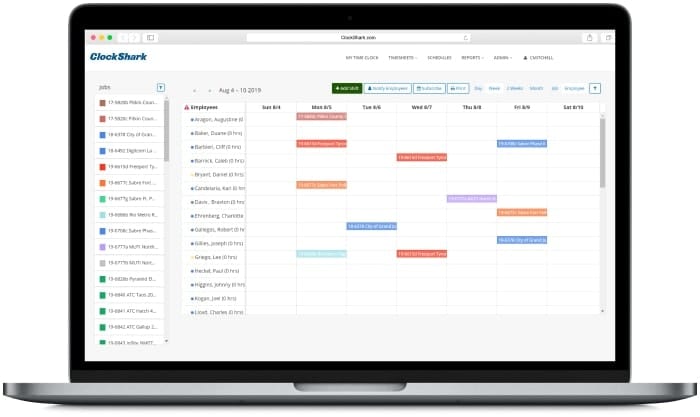
ClockShark is field service time tracking for property management built with construction crews in mind from the start, and two features carry over well: a crew clock that lets a foreman punch in an entire team at once, and job costing that separates labor by task rather than lumping it all under one project.
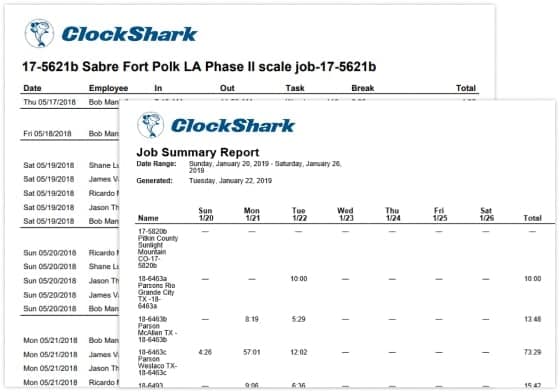
Location accuracy is the recurring complaint. Some users describe clock-ins that land miles away from where the punch actually happened, which defeats the point of verifying location at all. Reporting is also fairly basic, limited to per-job or per-employee views with no way to build a custom export, which starts to matter once a crew grows past 30 people.
Key features
- Geofenced clock-in: Flags supervisors when someone punches in from off-site
- Crew clock: One foreman can clock an entire team in or out from a single device.
- Kiosk mode: A shared tablet works as a punch station at an office or job trailer.
- Job costing: Per-job cost tracking on Standard, with more detail available on Pro


Pricing
| Plan | Price | What’s included |
| Standard | $40/mo base + $9/user/mo | GPS, geofencing, job costing, scheduling, kiosk |
| Pro | $60/mo base + $11/user/mo | Paid time off, advanced job costing, departure tracking |
Free trial: 14 days
Pricing verified against clockshark.com as of July 2026; confirm current rates before purchasing.
Pros and cons
| Pros | Cons |
| Crews get up and running with little onboarding time | GPS accuracy complaints show up repeatedly in user reviews |
| Location tracking is solid when conditions cooperate | Reporting can’t be customized beyond a couple of basic views |
| Works offline | Cost per user climbs fast once a team passes 30 to 50 people |
Ratings
App Store: 2.9/5
Google Play: 3.4/5
Capterra: 4.7/5
G2: 4.6/5
Who should use ClockShark?
ClockShark is a good fit for property management companies that:
- Are comfortable adapting construction tools like cost codes and crew clock to maintenance work
- Run smaller teams, generally under 30 people, where ease of setup outweighs integration breadth
- Are willing to accept some GPS risk in exchange for field-service features built for the job
4. QuickBooks Time: Best for teams already in the QuickBooks ecosystem
QuickBooks Time is time tracking software for property managers already running payroll through QuickBooks. The case for it comes down to one thing: this app plugs in without any middle step. There’s nothing to export and re-import.
Step outside that specific situation and the picture changes. Mobile app quality is the most-cited frustration across user reviews we found, with complaints describing the interface as outdated compared to newer competitors. GPS drift and geofence failures come up often as well.
Here’s a side-by-side comparison: Workyard vs QuickBooks Time
Key features
- GPS and geofencing: Tied directly into QuickBooks Online or Desktop payroll data
- Live crew visibility: A “who’s working” view alongside standard scheduling
- Project tracking: Estimate-versus-actual reporting is available on the Elite tier
- Mobile clock-in: Runs through the QuickBooks Workforce app


Pricing
| Plan | Price | What’s included |
| Time Premium | $20/mo base + $10/user/mo, plus a required QuickBooks Online subscription (from approx. $35/mo) | GPS, scheduling, core time tracking |
| Time Elite | $40/mo base + $12/user/mo, plus a required QuickBooks Online subscription (from approx. $35/mo) | Adds project tracking, job costing, geofencing |
Free trial: 30 days, no credit card required
Pricing verified as of July 2026. Rates subject to change. Verify current pricing at quickbooks.intuit.com before purchasing.
Pros and cons
| Pros | Cons |
| Payroll sync requires zero extra steps for QuickBooks users | GPS drift shows up regularly in user feedback |
| GPS and geofencing come standard even at the Premium tier | Requires an active QuickBooks Online subscription just to sign up, stacking $30–$200+/month on top of the rates, depending on plan |
| Nothing new to learn for an office that already runs QuickBooks |
Ratings
App Store: 4.6/5
Google Play Store: 4.7/5
Capterra: 4.7/5
G2: 4.5/5
Who should use QuickBooks Time?
QuickBooks Time is a good fit for a property management company that:
- Already runs payroll inside QuickBooks Online or Desktop
- Wants to skip a separate export step between time tracking and payroll
- Can live with a dated mobile experience in exchange for that sync
5. Timeero: Best budget option for GPS mileage + time tracking
Timeero’s pitch is straightforward: GPS time tracking at a lower per-user price than most of the category, with mileage tracking built in rather than bolted on. That mileage feature is genuinely useful for maintenance staff and inspectors who spend part of the day driving from one address to the next.
What’s missing is depth. There’s no cost code system for breaking labor down by task, and geofencing reliability draws complaints, with some users reporting clock-ins that go through without triggering a geofence alert at all. Android performance has improved substantially in recent months, but occasional logouts and battery drain are still mentioned in reviews.
See how these two stack up: Workyard vs Timeero
Key features
- Auto clock-in and out: A punch fires automatically when a tech enters or leaves a property.
- Mileage tracking: Logs drive time between addresses automatically, built to Internal Revenue Service (IRS) documentation standards.
- Geofencing: Available starting on the Pro tier
- Offline capture: Time still records without signal and syncs once the connection returns


Pricing
| Plan | Price | What’s included |
| Basic | $6/user/mo monthly ($5 annual, max 10 users) | Time tracking, GPS breadcrumbs, mileage tracking, and more |
| Pro | $9/user/mo monthly ($7.50 annual) | Everything in Basic plus geofencing, auto clock-in/out, job tracking, scheduling, and more |
| Premium | $12/user/mo monthly ($10 annual) | Everything in Pro plus facial recognition (kiosk), time-off management, and more |
| Enterprise | Quote-based | Custom features and support |
Free trial: 14 days
Pricing verified as of July 2026. Rates subject to change. Verify current pricing at timeero.com before purchasing.
Pros and cons
| Pros | Cons |
| Affordable per-user rate | Geofencing, job tracking, and payroll sync all require moving up to Pro |
| Mileage tracking is built in rather than a paid add-on | No way to break labor down by task or cost code |
| Picks back up automatically after a stretch offline | Occasional logouts and battery drain |
Ratings
App Store: 4.7/5
Google Play Store: 4.6/5
Capterra: 4.5/5
G2: 4.8/5
Who should use Timeero?
Timeero is a good fit for a property management company that:
- Is watching costs closely and has staff who spend real time driving between properties
- Wants a lower-cost baseline
- Can work around occasional Android reliability issues
6. Buddy Punch: Best for biometric clock-in and simple operations
Instead of leaning on location data, Buddy Punch verifies identity directly, through facial recognition, a webcam snapshot, a QR code, or a PIN, with GPS available as an add-on. That’s a good match for a property management office running one shared punch station at a yard or main location.
It’s a weaker match for a crew that’s spread out all day. There’s no true offline mode, and GPS only captures a single point at clock-in rather than tracking movement through the shift.
See the full comparison: Workyard vs Buddy Punch
Key features
- Identity verification: Facial recognition, webcam snapshot, QR code, and PIN options at clock-in
- GPS punch data: Included on Starter; continuous real-time GPS costs extra
- Geofencing and kiosk mode: Available on Pro and Enterprise
- Payroll export: Connects to QuickBooks, ADP, Gusto, and Paychex


Pricing
| Plan | Price | What’s included |
| Starter | $4.49/user/mo + $19 base (annual) | GPS on punches, time clock, time off tracking, job tracking, payroll integrations |
| Pro | $5.99/user/mo + $19 base (annual) | Everything in Starter; geofencing, webcam photo on punch, QR code scanning, kiosk mode, scheduling |
| Enterprise | $10.99/user/mo + $19 base (annual) | Everything in Pro; real-time GPS tracking, dedicated support, API access, Single Sign-On (SSO) |
Free trial: 14 days
Pricing verified as of July 2026. Rates subject to change. Verify current pricing at Buddy Punch’s website before purchasing.
Pros and cons
| Pros | Cons |
| More identity-verification options | No genuine offline mode |
| Per-user pricing is published and easy to follow | Nothing built in for cost or job tracking |
| Built-in scheduling and group punch | Real-time GPS and scheduling both cost extra, even on paid plans |
Ratings
App Store: 4.9/5
Google Play Store: 4.4/5
Capterra: 4.8/5
G2: 4.8/5
Who should use Buddy Punch?
Buddy Punch is a good fit for a property management company that:
- Is mainly worried about buddy punching at a shared office or yard, not GPS across scattered properties
- Doesn’t need to verify location on a large, unattended portfolio
- Wants pricing it can calculate without a sales call
How to choose the best time tracking app for property management companies
Three things decide whether a time tracking app for property management companies works: does it know where a tech actually is, does it hand clean hours to payroll, and does it keep working when a property has no signal.
Workyard’s analysis of 280 contractor discovery calls found that nearly 1 in 3 construction businesses identify labor compliance as a primary operational risk. A property management company running maintenance crews across dozens of addresses carries that same exposure on every pay period. Workyard closes that gap by tying every hour to a GPS-verified property address before it ever reaches payroll.
GPS accuracy and geofencing
A maintenance crew can hit three or four properties in a day. How accurate is GPS tracking depends on whether an app checks continuously or only at the punch. Apps that track continuously catch that movement; apps that only check GPS at the punch don’t.
Geofencing per property address is what separates an app that verifies a visit from one that just logs a timestamp. ClockShark and QuickBooks Time both draw geofencing accuracy complaints in user reviews, worth testing at an actual low-signal property before signing anything.
Offline mode
Basements and rural properties often have no cell service. Among the best GPS time clocks for offline and remote areas, Workyard and Timeero keep delivering GPS time tracking for property management even with no signal, syncing once the connection returns. Buddy Punch and QuickBooks Time don’t, so a dead zone means a missing punch.
Property-level time tracking
The real value here is labor cost per property, not just hours worked. Workyard and ClockShark tag hours to a property and cost code automatically based on crew clock-in location. Buddy Punch and Connecteam leave that tagging to whoever picks the project manually — the exact step that gets skipped under time pressure, and the reason property-level reporting breaks down.
Payroll integration
Figure out your existing payroll system first. As timesheet software for property management, the whole point is getting hours out clean. QuickBooks Time wins if you’re already inside that ecosystem, and outside of that, Workyard covers the widest range for property management employee time tracking, including ADP, Sage, and Foundation. Check Workyard’s full list of time tracking integrations if your payroll system isn’t one of those.
Crew adoption
A rollout fails when a tech decides the app isn’t worth the hassle. Workyard’s geofenced auto clock-in solves this by skipping the punch entirely. Buddy Punch’s kiosk and facial-recognition options solve a related problem for a shared punch station.
Pricing and integrations at scale
A 20-person crew runs about $170/month on Workyard’s Starter plan versus $220 on ClockShark’s Standard plan. QuickBooks Time requires an active QuickBooks Online subscription just to use, adding $30–$200+ a month for anyone not already on QuickBooks.
None of the six apps here offer native AppFolio integration or Buildium integration. All six export finished timesheets that a property management platform’s accounting side picks up from there instead. Do the math at your actual crew size before signing an annual plan.
Best time tracking apps for property management companies by crew size
Workyard comes out ahead overall in this comparison, but crew size and the specific problem being solved change the calculation.
For small property management offices (1 to 10 employees)
Connecteam (Top pick): The free plan handles scheduling and time tracking for a team this size without a subscription.
Timeero (Runner-up): The Basic tier is the cheapest way into GPS and mileage tracking in this lineup.
For mid-size property management companies (10 to 50 employees)
Workyard (Top pick): Starter automatically ties GPS-verified hours to a property and cost code based on geofenced location.
ClockShark (Runner-up): Standard gets construction-style job costing at a lower list price, minus Workyard’s Autopilot-level accounting connections.
For large property management operations (50+ employees)
Workyard (Top pick): Autopilot extends geofencing and Sage, Foundation, and Spectrum ERP integrations across a large, spread-out property list.
QuickBooks Time (Runner-up): A solid option for a large operation that already runs payroll and accounting through QuickBooks.
By primary need
- GPS-verified labor cost by property: Workyard covers continuous GPS, geofencing, and automatic cost code tagging together.
- Mileage tracking alongside GPS time: Timeero bundles automatic mileage tracking in at the lowest per-user rate here.
- Scheduling and communication bundled with time tracking: Connecteam puts a shared calendar, team chat, and time tracking in one place.
- Native QuickBooks payroll sync: QuickBooks Time skips the export step entirely for teams already on QuickBooks.
- Biometric verification at a shared punch station: Buddy Punch offers facial recognition and QR code options for one fixed location.
Final recommendations
Workyard came out ahead of the other five apps in this comparison, driven mostly by GPS accuracy and property-level cost tracking. The gap is widest for companies running maintenance crews across more than a handful of properties, where knowing exactly where a tech was and what that visit cost matters more than it does for a single-location team.
🥇Best overall: Workyard
Why: Geofenced auto clock-in ties every punch to a property boundary, and hours reach payroll already sorted by property, cost code, and location, with nothing left to re-key or dispute.
Best for: Property management companies at any crew size that need GPS-verified payroll and labor cost tracking broken out by property.
Pricing: Starts at $6/user/month (annual)
Before switching to Workyard, an interior finishing contractor with more than 50 field workers had no way to confirm where crews actually were during the day. Their admin and office support lead described what changed:
And especially because yesterday, and by the way, I have 100% of our field employees in work here right now.
Their admin and office support lead confirmed that full visibility into every field employee’s location showed up the same day the system went live.
🥈Ideal for all-in-one teams: Connecteam
Why: A free plan plus built-in scheduling and chat make this the more practical pick for a deskless office that doesn’t need construction-grade GPS.
Best for: Smaller offices where one login for scheduling, communication, and time tracking outweighs GPS precision.
Pricing: Free for up to 10 users; $29 to $99/month for larger teams
🥉Best budget pick: Timeero
Why: The lowest per-user rate here, with mileage tracking built in rather than sold as an extra
Best for: Budget-conscious property management companies with staff who spend real time driving between properties
Pricing: From $4/user/month
Our Scoring System Explained
Our scoring system was created to help you understand the potential value of any software we review simply and fairly. Each platform was scored across weighted categories covering everything from GPS accuracy and scheduling to vendor reliability. Scores combine hands-on testing, first-party contractor call transcripts, and verified user review data. See the full scoring criteria.
References
- 1
Connecteam. Pricing page. https://connecteam.com/pricing/
- 2
ClockShark. Pricing page. https://www.clockshark.com/pricing/
- 3
Intuit QuickBooks Time. Pricing page. https://quickbooks.intuit.com/time-tracking/pricing/
- 4
Timeero. Pricing page. https://timeero.com/pricing
- 5
Buddy Punch. Pricing page. https://buddypunch.com/pricing/
Workyard has the strongest GPS accuracy in this comparison. It tracks location continuously through the entire shift instead of checking only at the moment someone punches in, so a tech’s movement between properties gets captured automatically.
ClockShark, QuickBooks Time, and Timeero also use geofencing to verify a clock-in location, though each checks position differently: Timeero built its entire pitch around GPS and mileage accuracy, while ClockShark and QuickBooks Time added geofencing to tools designed around other priorities first.
ClockShark’s geofencing draws some accuracy complaints in user reviews. Buddy Punch records just one GPS point at clock-in and doesn’t track location afterward. Workyard and ClockShark were both originally built for construction and field service crews, which shows in how seriously each treats location data.
Yes, on some of these apps. Workyard and ClockShark both let a tech tag hours to a property and cost code directly from the mobile app, with labor totals updating automatically as hours come in. That means a property manager can see labor cost by address or work order without manual reconciliation.
Buddy Punch and Connecteam rely on someone picking the right project manually after the fact instead, which reopens the exact tagging mistakes a dedicated system is supposed to prevent. QuickBooks Time and Timeero fall in between, supporting job-level tracking but requiring more manual setup to tie hours to a specific property address rather than doing it automatically at clock-in.
Yes, and they solve different problems. Property management software like AppFolio or Buildium handles leases, rent collection, and tenant communication, but it wasn’t built to verify where a maintenance tech actually was during a shift or tie labor hours to a specific job. A time tracking app is the layer underneath that handles property management employee time tracking specifically, capturing accurate, GPS-verified hours at the property level and feeding clean data into whatever accounting or payroll system a company already runs.
Workyard’s role here is exactly that: it doesn’t replace your property management software, it captures the labor data your existing system was never designed to verify, then hands off hours already tagged to the right property and cost code.
Not directly, as of this update. None of the six apps in this comparison publish a native integration with AppFolio, Buildium, or Rent Manager. Instead, each one exports finished timesheets to a standard payroll or accounting system, such as QuickBooks, ADP, or Gusto, and that labor data flows into a property management platform’s accounting side from there rather than through a direct connection.
For most property management companies, this two-step handoff isn’t a dealbreaker since payroll is the step that actually needs clean hours, but it does mean there’s no single dashboard that shows time tracking and lease or maintenance-request data together.
Workyard and Timeero both keep recording time and GPS data with no connection at all, then sync automatically once a signal returns, so a punch in a basement or dead zone doesn’t get lost. ClockShark’s mobile-first design also handles offline use reasonably well, though with less consistency in user reviews.
Buddy Punch and QuickBooks Time don’t have a real offline mode; if a phone loses signal on either app, the punch typically doesn’t record until connection comes back, which means a manual correction later. For a property with a basement, a rural lot, or older construction that blocks cell signal, offline reliability is worth testing directly before choosing.
Timeero’s Basic plan is the cheapest entry point at $5 per user per month, billed annually. Workyard starts at $6 per user plus a $50 monthly base fee. For a 20-person crew, that works out to roughly $170 a month on Workyard’s Starter plan, around $220 on ClockShark’s Standard plan. QuickBooks Time runs about $220 a month on Premium plus a required QuickBooks Online subscription (typically $35 to $85+/month depending on plan), so the real total is closer to $255 to $305 a month for a company not already on QuickBooks. It’s a flat $49 to $99 on Connecteam for up to 30 users.
Yes, Connecteam offers a real free plan for up to 10 users, not just a limited trial, which makes it the only genuinely free option in this comparison. None of the other five apps here, including Workyard, have a permanent free tier.
All six do offer a free trial period ranging from 14 to 30 days, so a property management company can test the actual workflow with a real crew before committing to a paid plan. For a company under 10 employees that mainly needs basic scheduling and time tracking without GPS-heavy features, Connecteam’s free plan is worth trying first.
Workyard and ClockShark both keep the mobile experience simple, built around one large clock-in button rather than a menu of options a tech has to tap through. Workyard goes a step further with geofenced auto clock-in, so a maintenance tech doesn’t need to open the app at all. Arriving at or leaving a property triggers the punch automatically, which removes the most common adoption failure: someone forgetting to tap a button.
Buddy Punch’s kiosk and biometric options work well for a team that shares one punch station at a yard or office, since there’s nothing for an individual worker to learn beyond showing up. Apps that require more manual navigation tend to see lower adoption among crews unfamiliar with business software.
Workyard and ClockShark both offer supervisor clock-in, letting a foreman clock an entire crew in from one device, which works well for a property management team that doesn’t issue a phone to every maintenance worker.
Connecteam, Timeero, and Buddy Punch expect each worker to clock in individually from their own device instead, though Buddy Punch’s kiosk mode allows a shared device at a fixed location as a workaround.
QuickBooks Time also expects individual clock-ins through the Workforce app. For a crew that already shares tools and vehicles, a supervisor clock-in option can matter more than any other feature on this list.
Timeero’s mileage tracking is the most developed in this comparison, with automated logging built to IRS documentation standards and route detail beyond a simple total. Workyard also captures mileage and travel time as part of its GPS data, which is useful for a property manager or inspector driving between addresses during the day.
Mileage isn’t a focus feature for Connecteam, ClockShark, QuickBooks Time, or Buddy Punch; each can log basic time between locations, but none of them build a dedicated mileage report the way Timeero and Workyard do.
For a role that spends significant time driving between properties rather than working on-site at one, that difference is worth weighing against the rest of each app’s feature set.


