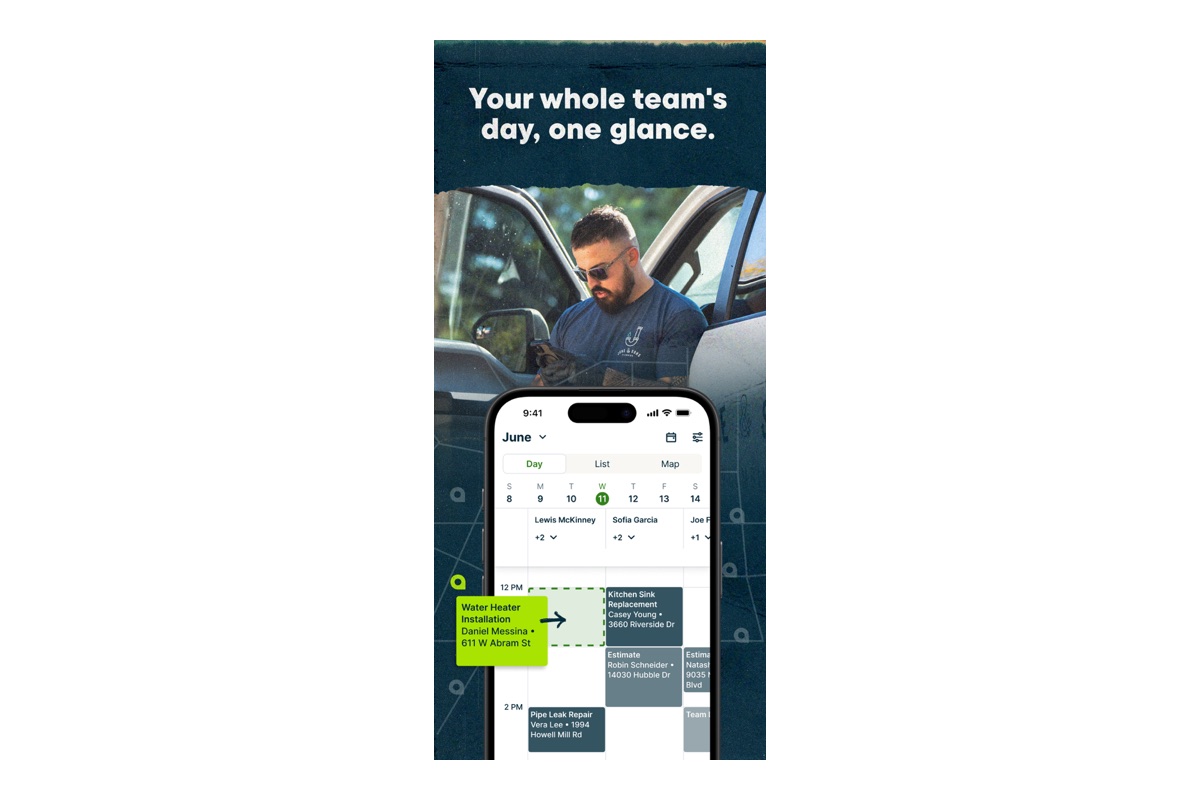
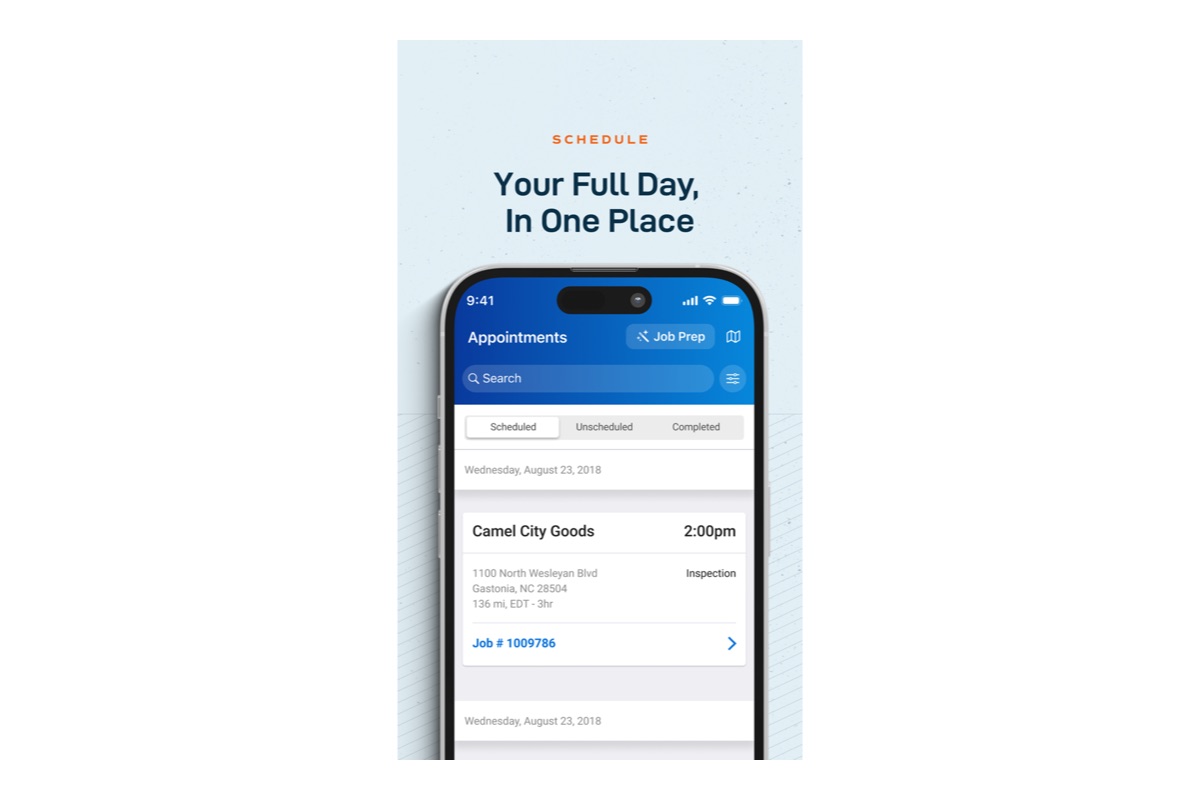
Every one of these will show you a schedule. We checked what the technician's phone actually does with it, and what the plan that runs real dispatch costs.
By Kyo Zapanta
· Reviewed by Rouselle Isla
· Last updated 23 September 2026 • Published 29 July 2025
TL;DR
If you only read one section, read this one.
Best for crews on multi-day jobs: Workyard. Dispatch and GPS-verified labor cost run on the same record, so the assignment and the arrival that satisfied it are one entry. Dispatch requires the Pro plan, not the $6 entry tier.
Best for a small residential service shop: Jobber. The only tool here that publishes every price, and the highest-rated field app in the category at 4.81 stars from 20,691 ratings. Budget for the $199 Grow plan if you need GPS.
Best for large trade shops: ServiceTitan. The most capable dispatch board and the only real capacity planning. Check the technician app first: it holds 3.42 stars across 4,711 ratings.
Disclosure: Workyard competes directly with several of the platforms in this guide. This review reflects our honest assessment of each product based on our research, and we've flagged where we're not the right fit.
Most dispatch decisions get communicated twice. Once in whatever system holds the schedule, and again by phone or text when the day changes. The second version is the one the crew acts on, and it usually never reaches the office.
Field service dispatch software exists to remove that second version. It holds one schedule, pushes it to the phones that need it, and records what actually happened. The office stops rebuilding the week from memory.
We can put numbers on how common the problem is. We recorded 1,441 things contractors said they needed from scheduling and service dispatch, across 336 sales and onboarding calls. The most frequent request was not routing, and it was not automation. It was a live view of who is where, raised by 61 separate accounts.
The second finding was blunter. We asked 108 contractors what they currently run scheduling on. Forty named a whiteboard, a spreadsheet, a paper calendar or a group text. That is more than named any single software product.
One thing to settle before the list. If your day is one technician, one call, a quote and an invoice, your primary system is ServiceTitan, Jobber or Housecall Pro. It is not Workyard. Workyard is built for contractors sending crews to jobs that run for days. We have ranked ourselves first on that basis only.
What is field service dispatch software?
Field service dispatch software, also called service dispatch software, assigns work to the people who will do it, then gets that assignment onto their phones. At minimum it holds a calendar or board and a list of who is available. It also holds a job record with an address and a scope.
The useful ones do three more things. They carry day-of changes without a phone call. They show where crews actually are, not where the plan says they should be. And they hand the finished visit to whatever system bills or pays for it.
That last step is where most buyers get caught. A tool can run a beautiful dispatch board and still leave the office typing job numbers into accounting by hand. One contractor told us their service jobs never reached their accounting system at all. The office reverse-engineered job numbers out of timesheet notes, then hand-created duplicate jobs before anything could be costed or paid.
Dispatch software is also not one category. Tools built for one technician on one service call are built around routing, price books, memberships and customer invoicing. Products aimed at crews on multi-day jobs are built around cost codes, phases, drive time and payroll feeds. Buying across that line is the most expensive mistake in this market.
Key features to look for
A board or calendar you can change by dragging, with the change reaching the crew's phone without a follow-up call.
Live crew or technician location, so the office can answer "who is closest" without ringing round.
Multi-visit and multi-day job support, including a scheduled return visit against the same job.
A record of what happened that someone can defend six weeks later, with times and locations attached.
A path from the completed visit into payroll and accounting that does not involve re-keying.
A mobile app the crew will actually open, which is worth checking on the app stores before you buy.
Treat the last one as a real criterion, not a footnote. The office buys dispatch software and the field lives in it. Those two groups often rate the same product very differently, and the app stores are where that shows up.
Dispatch software or field service management software?
Dispatch is one function inside field service management. A dispatch tool answers who goes where and when. A full field service management platform adds the customer side: booking, quoting, price books, invoicing, payments and service agreements.
Field operations software is the wider umbrella again. It covers everything the field does, including forms, safety, daily reports and equipment, with dispatch as one module among several.
Every tool on this list does more than dispatch. The distinction still tells you what a product is optimized around. That tells you which parts will feel like an afterthought.
What's changed in this update (September 2026)
This page was rebuilt from the ground up. What moved:
Per-tool scores are gone. The old version rated each platform out of 10 on eight weighted factors. Those numbers were ours, unverifiable by you, and they flattened real differences into one digit.
Four tools were dropped: Dispatch, Smart Service, FieldConnect and mHelpDesk. Dispatch appeared on one of the three top-ranking editorial pages we benchmarked. The other three appeared on none of them.
Five were added: ServiceTitan, Jobber, Housecall Pro, FieldPulse and FieldEdge. ServiceTitan and FieldPulse appear on all three benchmarked pages. Jobber, Housecall Pro and FieldEdge appear on two of the three. The old lineup contained none of them.
Workiz pricing was removed. The previous version quoted $225 per month for up to five members plus $45 per extra member. Workiz no longer publishes any prices, and its old pricing URL now returns a 404.
Workyard's own price was corrected. The old page said dispatch starts at $6 per user per month. It does not. The $6 tier has no office-to-field scheduling at all. Dispatch begins on Pro.
Every price, plan gate and app rating on this page was re-verified on 1 September 2026.
Field service dispatch software compared
Prices are the lowest publicly published figure for each vendor. Where a vendor publishes nothing, we say so rather than quoting a third-party estimate.
QuickBooks Online and Desktop on every tier; service agreement management
Quote only, no free trial
Pricing verified 1 September 2026. Five of these eight vendors publish no prices at all and require a sales conversation. Check the vendor's own page before you buy, since plans change.
How we chose these apps
We compared 20+ field service dispatch apps and chose the 8 best for contractors and field service teams.
Technician app rating: What the crew holding the phone actually rates the field app, not the office view.
Dispatch plan gate: Which tier switches on dispatch, GPS and routing, and what that really costs.
Multi-visit work: Whether a job can span days and carry a scheduled return visit.
Day-of reassignment: What happens when a dispatcher moves someone after the day has started.
Handoff to accounting: Whether a completed visit becomes a costed, payable job without re-keying.
Evidence quality: What the dispatch record can prove six weeks later, in a dispute.
We read each app's product documentation and help-center behavior docs, re-verified every live pricing page, and captured App Store ratings and dated reviews for all eight field apps, alongside anonymized analysis of Workyard research conversations where available. See our review methodology.
Workyard is the only app here we have used hands-on. Four of the other seven offer no free trial, so nothing in this guide is written as first-hand testing of a competitor.
G2 and Capterra are both behind bot protection we chose not to work around. Cited review evidence comes from the Apple App Store, where ratings are public and dated.
8 best field service dispatch platforms
1. Workyard — Contractors dispatching crews to multi-day jobs
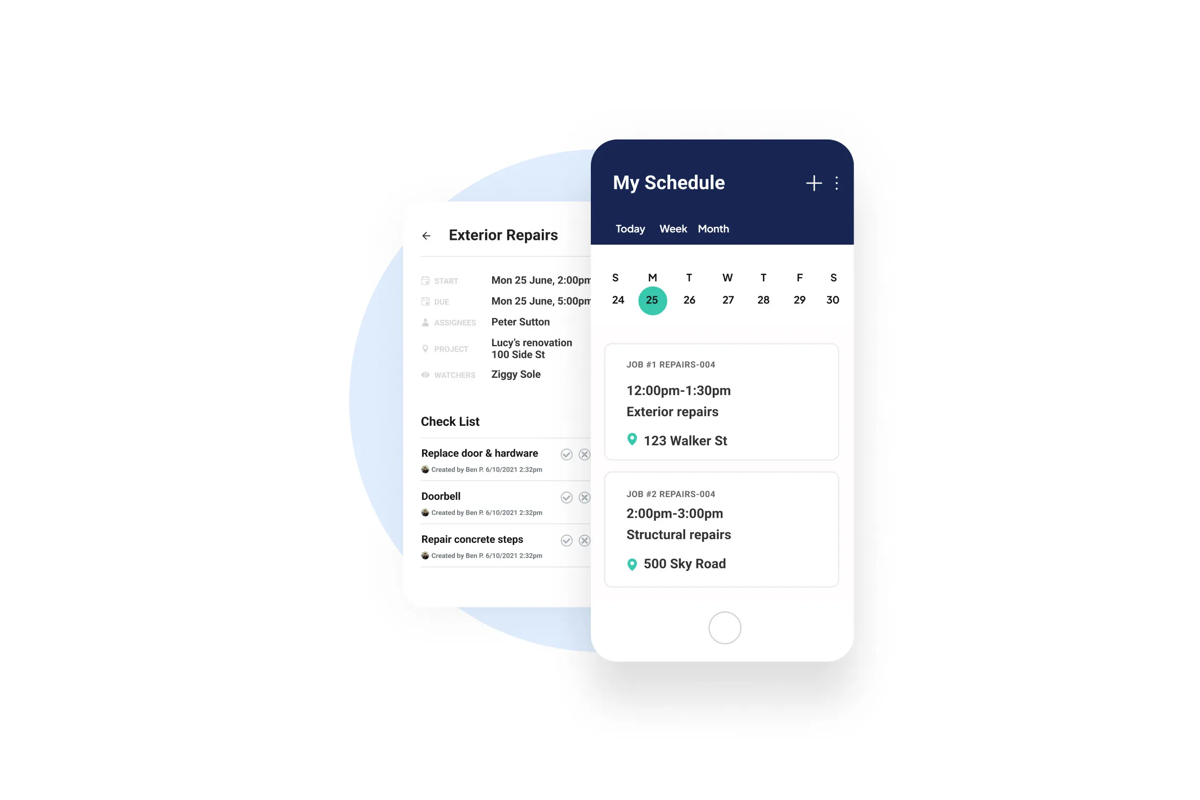
The task the office builds, and the same day as the crew receives it.
A dispatch item is a task. Creating one takes a title, the people assigned to it, and a start date and time. Tasks attach to a project as well as to people, so the schedule and the job record are the same thing.
When the office is ready, it selects a day or a week on the Schedule page and sends notifications. Every assignee gets a push notification and an email. It is a deliberate send, not a silent sync, which means the office knows the crew was told.
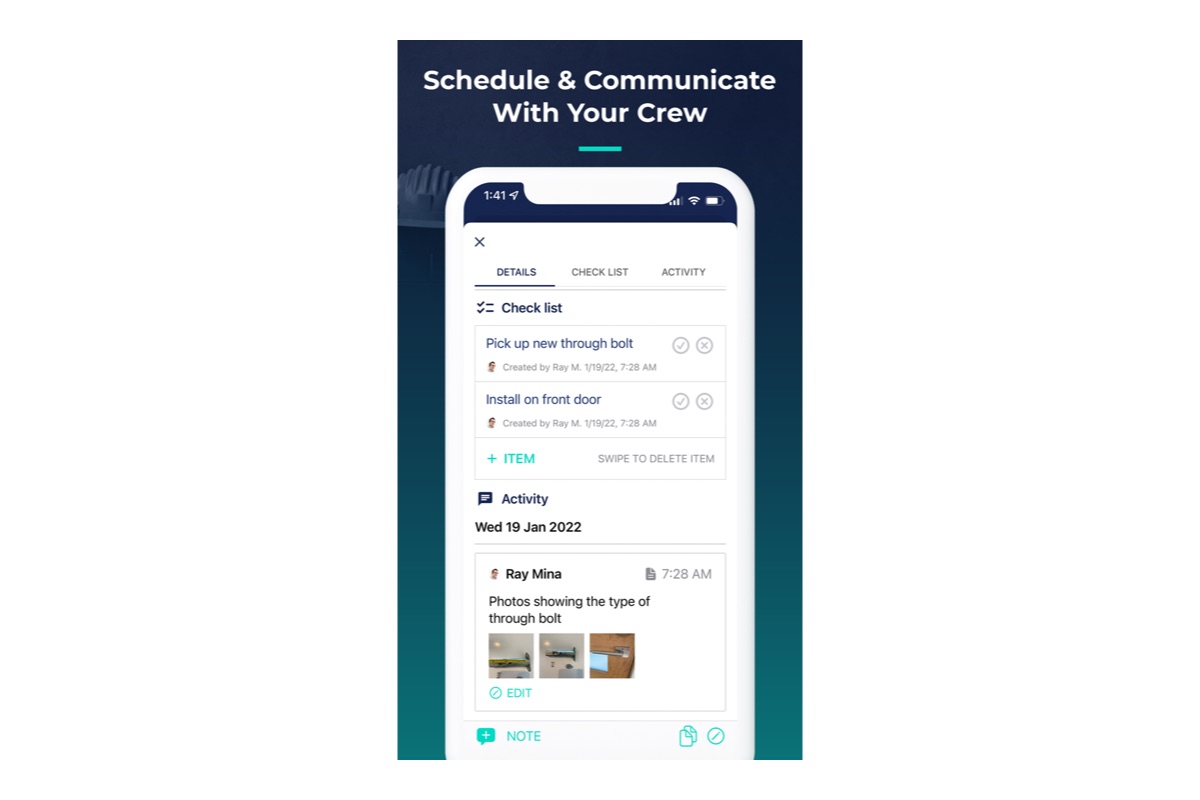
The crew opens the task in the mobile app, works through its checklist, attaches photos, and leaves notes. Arrival is handled by geofence rather than by memory. On the Autopilot plan the clock-in disappears entirely. Workyard detects the site visit and allocates the time. A forgotten clock-out is trimmed back to the last verified location.
It fits contractors running 15 to 500 field workers across several active jobs with cost codes. Skip it if your day is one technician, one call, a quote and an invoice. Workyard has no customer booking, no price book, no invoicing and no memberships.
The same task on the crew's phone: checklist, activity and photos attached to the assignment.
Key features
Office-to-field scheduling with sortable views by day, work week, employee or project, and an explicit send that pushes the schedule to assignees by push notification and email.
Tasks that carry a checklist, notes, photos and documents, and that attach to a project and a geofence address rather than floating free.
Geofenced arrival detection with live crew locations, driving and travel time detection, and mileage reporting on every plan including the entry tier.
Automatic clock-in, auto-trimmed clock-out and automatic time allocation on the Autopilot plan, so the record does not depend on the crew remembering anything.
More than 20 payroll, accounting and ERP integrations including Sage, QuickBooks Online and Desktop, ADP, Gusto, Paychex, Foundation and Deltek ComputerEase.
Pros
Cons
Dispatch and verified labor cost are one record, so the assignment and the arrival that satisfied it cannot drift apart.
Live crew locations, travel detection and mileage reporting are on the entry plan, not gated behind an upgrade.
Autopilot removes clock-in from the crew's list of things to remember, which is the usual reason time apps fail.
More than 20 payroll, accounting and ERP integrations, including Sage and Foundation, which most field service tools do not touch.
A 14-day trial with no credit card, so you can test dispatch against your own jobs before talking to anyone.
Continuous location permission is required. Workers must set location access to "always", and app reviewers say so plainly. One describes auto clock-in triggering at their own home.
Dispatch is not in the $6 entry plan. Office-to-field scheduling starts on Pro, so the headline price is not the dispatch price.
No per-tier prices are published, so sizing a Pro or Autopilot budget means a sales conversation.
No customer-facing booking, quoting, price book, invoicing or memberships. A residential service shop would still need a second system.
US only, so labor rules, payroll integrations and compliance features assume US contractors.
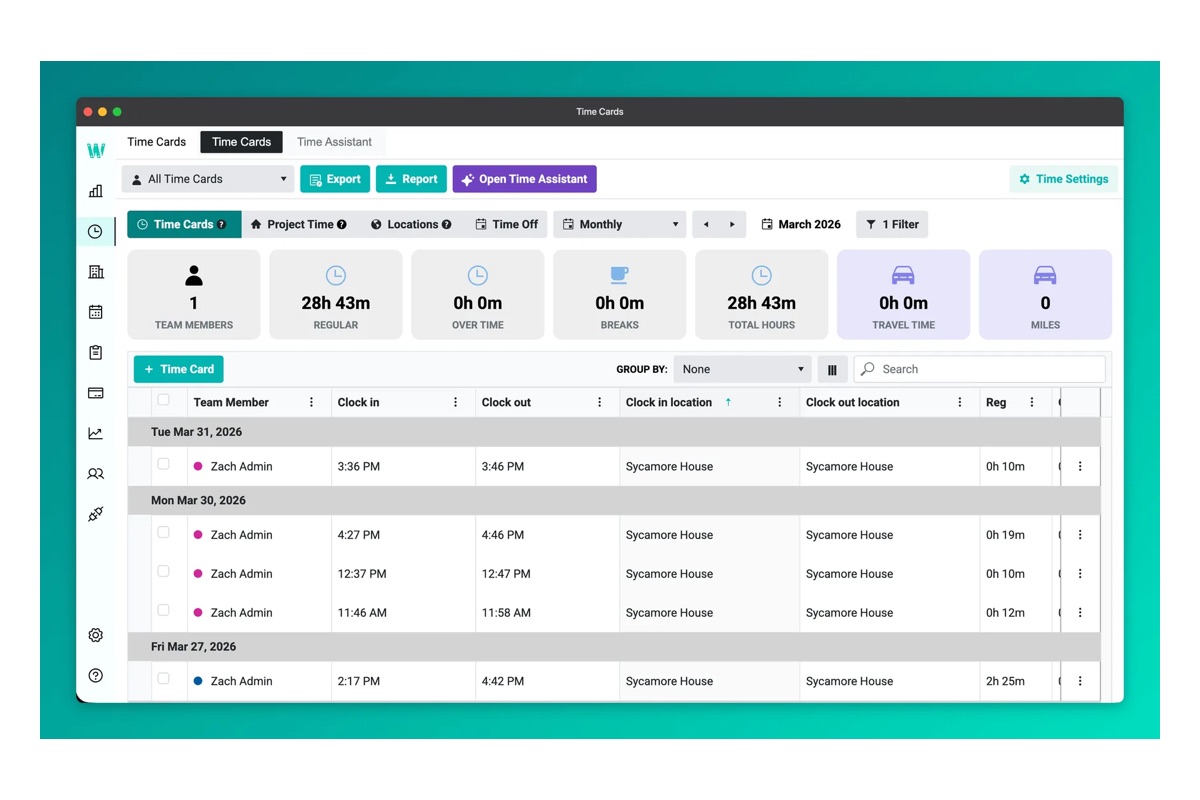
Every punch carries a clock-in and clock-out location, which is what turns an assignment into evidence.
Pricing
Free trial or free plan: Yes, a 14-day free trial.
Starter: $6 per user / month, billed annually. Monthly billing also available.
Pro, Autopilot, and Enterprise: Office-to-field scheduling available on these plans. Contact our sales team for pricing.
Workyard handles are everyday needs for our company. It keeps track of our employees time and the geofence is excellent for making sure everyone is where they say they are going to be on the jobs
Timl0ng · Contractor, App Store reviewer · Apple App Store · 2026-09-01
”
It's frustrating to have to switch tracking off each time. "Location only when using" doesn't work. You have to select "always" in order to use. I don't like the idea of constantly being tracked and having to remember to switch tracking off after each use.
03Amigos · Field worker, App Store reviewer · Apple App Store · 2026-09-01
What our customers say about us
These are published, cleared customer quotes from our own site, not anonymised call notes.
Service crews running 5 to 12 jobs a day
The closest match to this page's reader: a service company using Workyard for high-volume daily dispatch, and using the GPS data to tell customers when the crew will arrive.
”
We're a service company and crews may have 5-12 jobs a day. With the GPS tool I can let customers know ETAs in real-time.
Ian Cota, Owner, IC Electric
Seeing the trip from shop to site
The visibility need we heard most often, described by the person who felt its absence.
”
I can see exactly when an employee leaves our shop and arrives at a project site. Before Workyard, I had no way of knowing that.
Brenda Tait, Office Manager, Pro Home and Sunrooms
Reporting across simultaneous jobs
Dispatch across several live jobs is only useful if you can see all of them at once.
”
I like that I can instantly run a report in Workyard to show me how we're doing across any of the five projects we've got running at the same time.
It answers the question contractors asked us most. Across 336 recorded calls, the single most common need was a live view of who is where. Workyard puts crew locations, travel detection and mileage reporting on every plan, including the cheapest one.
It ranks first for crew work for one reason. The dispatch record and the cost record are the same record.
The assignment says who should be at 500 Riverside Drive on Friday. The geofence says who actually arrived, and when. Those two facts live together, coded to the job. From there they move into Sage, QuickBooks, ADP or one of about 20 other systems. Nobody re-keys anything.
That matters because of a failure we heard repeatedly. Workers get shuffled between crews mid-week, nobody records the move, and the paycheck comes up short. One office had to call three or more people just to establish who was on which job. Another was scheduling 100 field workers one day at a time, alerting anyone who moved by text around 2pm.
We use Workyard daily, so treat the ranking accordingly and read the disclosure above. The honest limit is scope. If your revenue comes from booked appointments and invoices raised on completion, this is not your system of record.
2. ServiceTitan — Large trade shops with 15 or more technicians
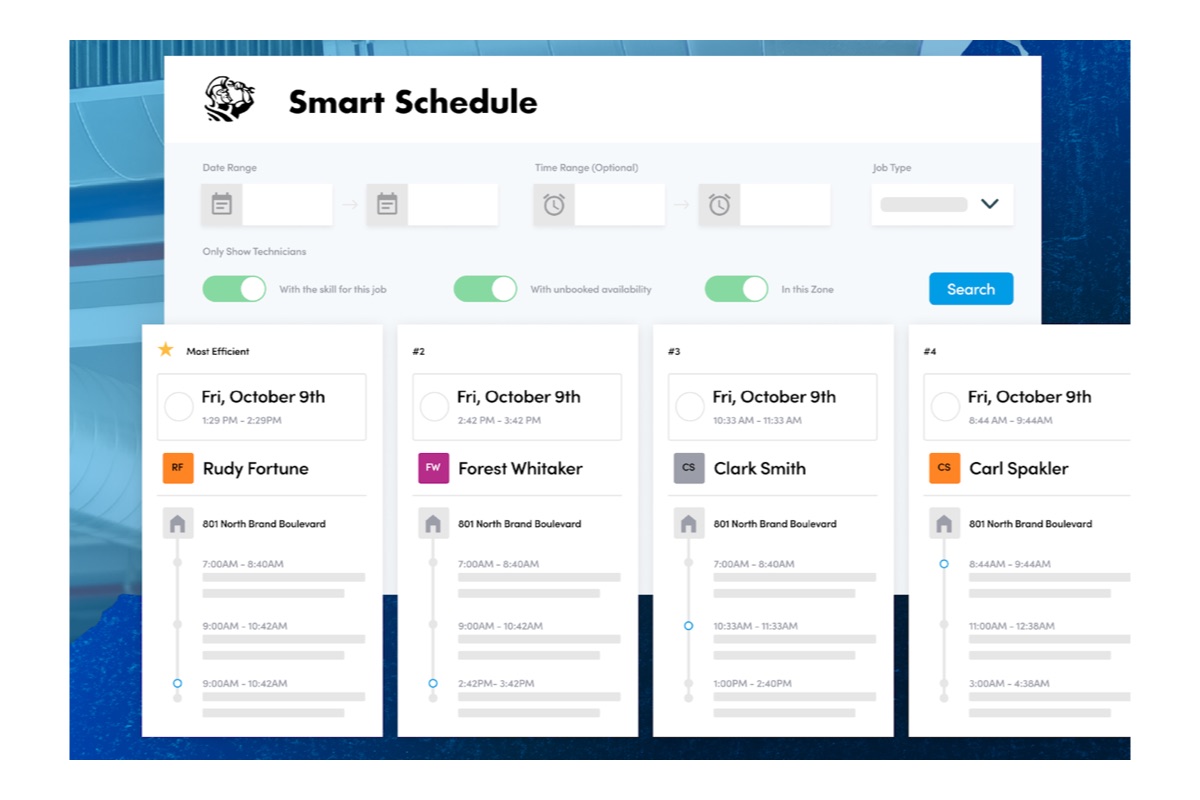
Smart Schedule ranks technicians by skill, availability and zone, then offers the most efficient slot. Source: ServiceTitan
ServiceTitan is the heavyweight of residential and commercial trade service software. Dispatch is genuinely its strongest area, and no other tool here matches it on capacity control.
The dispatch board works by dragging a job onto a technician. What makes it useful is what travels on the job card: customer contact details, property data, service history, previous invoices, membership status and notes. A dispatcher can match the right tech to the right call on value, not just availability.
Map 2.0 adds routing. Adjustable Capacity Planning lets managers cap the labor hours the business will accept. Only ServiceTrade offers anything comparable, and only on its Enterprise suite.
Same-day changes are handled in the product. Jobs can be extended, shortened or rescheduled, and dispatchers push updates by SMS or call from a notification center in a couple of clicks.
It suits HVAC, plumbing and electrical shops of scale, typically 15 or more technicians. Call booking, price-book selling and service memberships drive their revenue. Crew-based project contractors are a poor fit. Cost codes, phases, prevailing wage and job-site safety forms are not its native language.
Key features
A drag-and-drop dispatch board that carries customer history, property data, previous invoices and membership status on the job card.
Adjustable Capacity Planning, which limits the labor hours the business can accept so dispatchers cannot overbook the week.
Map 2.0 for route information and route optimization across the technician fleet.
A notification center that mass-texts or calls the field in two clicks when the day changes.
Technician mobile workflows covering price books, parts ordering, estimates and card payments on site.
Pros
Cons
The most capable dispatch board here, with customer and property history on the job card.
Adjustable Capacity Planning is a genuine differentiator, matched only by ServiceTrade's Enterprise-tier capacity planner.
Dispatch, scheduling, call booking and invoicing are all in the entry tier.
Deep technician workflows, including price books, parts, estimates and payment capture on site.
Technicians who do get on with the new Field app single out time stamps, job history and customer-facing presentation.
The technician app is rated 3.42 stars across 4,711 ratings, the second lowest field-facing app in this comparison.
Reviewers repeatedly report the app flipping between online and offline in weak signal, then failing to load estimates or photos.
No published pricing and no free trial, so evaluation requires a sales cycle.
Built around one technician on one service call. Cost codes, phases and prevailing wage are not native concepts.
Cost and implementation weight make it hard to justify below roughly 15 technicians.
Pricing
Free trial or free plan: No free trial. ServiceTitan offers a demo only, so evaluating it means booking a call and working through a sales process.
Three tiers are published (Starter, Essentials and The Works) and all three show "Request Pricing" with no figures. Pricing is per technician. Contract length, base fees and implementation costs are not disclosed. Third-party trackers commonly quote figures around $250 per technician per month, but ServiceTitan does not publish that and we will not present it as fact. Dispatching, scheduling, call booking and invoicing are all in Starter, so the dispatch board itself is not the upsell.
What real reviews say
”
Very useful tool , presentation worthy - for customers to see information and charts, dispatching technicians photos creates a customers first piece of mind. Time stamps and history for the specific jobs.
SlyDizzy · Service technician, App Store reviewer · Apple App Store · 2026-04-06
”
When you have 2 bars of signal it will constantly say you are offline then online, then won't load estimates, and won't let you load no pictures and makes it a pain to fill paperwork out.
Repairgamerguy · Service technician, App Store reviewer · Apple App Store · 2026-09-01
”
If ur a business owner its great for calling out your techs if your a tech it's garbage !!! I'm both so im screwed
Jimmy John 69 · Owner and technician, App Store reviewer · Apple App Store · 2026-09-01
Why we picked it
It earns second place on capability and loses first place on scope, not on quality. For a service shop of size, this is the most complete dispatch operation you can buy.
There is one finding we could not ignore, and it is the reason to read this entry carefully. ServiceTitan is ranked first or near first on essentially every comparison page in this category. Its technician-facing app holds 3.42 stars from 4,711 App Store ratings. The older ServiceTitan Mobile app scores 2.95 stars from 1,645 ratings.
The recurring theme in recent reviews is connectivity. One technician describes the app flipping between offline and online at two bars of signal, then refusing to load estimates or accept photos. For a dispatch tool, behaviour in weak signal is not a cosmetic complaint. Several reviewers also rate the current Field app below the one it replaced.
To be fair to it, the picture is not uniformly bad. Technicians who prefer the new app say so clearly, praising the time stamps, the job history and how the photos present to a customer. The split runs by role and by signal strength, not across the whole user base.
An owner review captured the split better than we could. The app is great for calling out your techs if you are the owner. It is much worse if you are the tech. Being both, the reviewer said, leaves you stuck. Buy it for the office and the board. Pilot it with two or three technicians on the worst-signal route you run before you commit the fleet.
Jobber's day view, one column per team member, rescheduling by drag. Source: Jobber
Jobber is the most straightforward tool on this list. It is also the only vendor here that publishes every price without a sales call.
Scheduling runs on a customisable calendar with day, week and month views, colour coding and filters. It flags conflicts and overlaps before they reach the crew. You reschedule by dragging, and a map can open alongside the calendar.
Find a Time proposes openings using both team availability and drive time. It schedules against travel, not just an empty calendar slot. Crews get real-time alerts for new work, reschedules and cancellations, plus a daily overview.
Where it goes further than dispatch is the customer side. Online booking, quotes, invoices, payments, automated client reminders and two-way SMS all live in the same product. For a small shop, that consolidation is the real draw.
It fits home and field service businesses of roughly 1 to 15 technicians who want one system end to end. It is not built for crews on multi-day jobs, and it has no cost-code, prevailing-wage or certified-payroll concepts.
Key features
A drag-and-drop calendar with day, week and month views that surfaces conflicts, overlaps and unbooked time before the crew is affected.
Find a Time, which proposes calendar openings based on both team availability and drive time.
Route generation for the whole crew across a single day or an entire week at once, on the Grow plan and above.
Live vehicle tracking showing real-time location, speed and direction, also on Grow and above.
Online booking, quotes, invoices, payments, automated client reminders and two-way customer SMS in the same product.
Pros
Cons
The only vendor here that publishes complete pricing for every tier, with no request-a-quote wall.
The highest-rated field app in this comparison, at 4.81 stars from more than 20,000 ratings.
Find a Time schedules against drive time, not just against an empty calendar slot.
The 14-day trial opens the Grow feature set, so you can test GPS and routing before buying them.
Booking, quoting, invoicing and payments in one product, which suits a shop replacing three tools.
GPS tracking and route optimization require the $199 Grow plan. The $49 headline price includes neither.
Core is a single user, so any crew starts at Connect or above.
One contractor reported geofence readings placing workers miles from the job site, which is worth testing in the trial.
No cost codes, phases, prevailing wage or certified payroll, so commercial and public work is poorly served.
Reviewers report limited offline capability and difficulty finding work orders when one client has several properties.
Pricing
Free trial or free plan: A 14-day free trial with no credit card required, and it opens the full Grow feature set rather than the entry tier, so you can test GPS and routing before paying for them.
Core: $49/mo monthly, or $21/mo billed annually. One user only. No GPS and no route optimization.
Connect: $139/mo monthly, or $70/mo billed annually. Includes 5 users, then $29/mo per additional user.
Grow: $199/mo monthly, or $105/mo billed annually. The first plan with GPS and routing. Includes 5 users, then $29/mo each.
Plus: $499/mo monthly, or $280/mo billed annually. Includes 15 users, then $29/mo each.
What real reviews say
”
We have been using Jobber for our painting business for 4-5 years now, it is hands down the greatest tool
BB Painting · Painting contractor, App Store reviewer · Apple App Store · 2025-12-17
”
The pricing plan structure of the tiers ultimately made us cancel
MadchillN · Former subscriber, App Store reviewer · Apple App Store · 2023-05-13
What contractors told us about Jobber
Paraphrased from our own recorded sales and onboarding calls. These are reported experiences, not verbatim quotes, and no account is identified.
Geofence precision
One account reported location data they could not defend. They visited job sites early to compare real arrival times against what the system logged, and the mismatch is what convinced them to look elsewhere.
”
A contractor reported that Jobber's reports showed workers clocking in miles from the job site, even when they had physically confirmed the crew was on site and on time. Their concern was that it made a worker look like they were stealing time, which made accountability conversations impossible.
Specialty trade contractor
No integration path to Workyard
Worth disclosing because we compete with Jobber and this affects anyone considering running both.
”
An account evaluating Jobber for their work-order layer noted that no integration exists between Workyard and Jobber, and asked what the workaround would be.
Commercial contractor
Why we picked it
Two facts put Jobber third. It is the highest-rated field app in this comparison at 4.81 stars from 20,691 App Store ratings. That is a large base and a genuinely good score, and it means crews open it without being chased.
The second fact is a warning. Dispatch starts on the $49 Core plan, but Core is a single user. GPS tracking and route optimization do not appear until Grow at $199 a month. If you are buying dispatch software because you want to know where your people are, your real entry price is four times the headline. Competing pages quote Jobber from $29 or $49 and do not mention this. No error in this category gets repeated more often.
A two-star reviewer put the consequence plainly, saying the pricing plan structure of the tiers is what made them cancel. The product was not the problem. The gates were.
One more thing worth knowing, from our own calls. A contractor told us Jobber's geofence data showed workers clocked in miles from the job site. They had physically visited sites early to check arrival times. They concluded the location data could not be trusted and started looking to switch. That is one account's experience, not a verdict, but geofence precision is worth testing yourself during the trial. Jobber also has no Workyard integration, which we should disclose since we compete with them.
4. Housecall Pro — Residential shops selling on customer experience
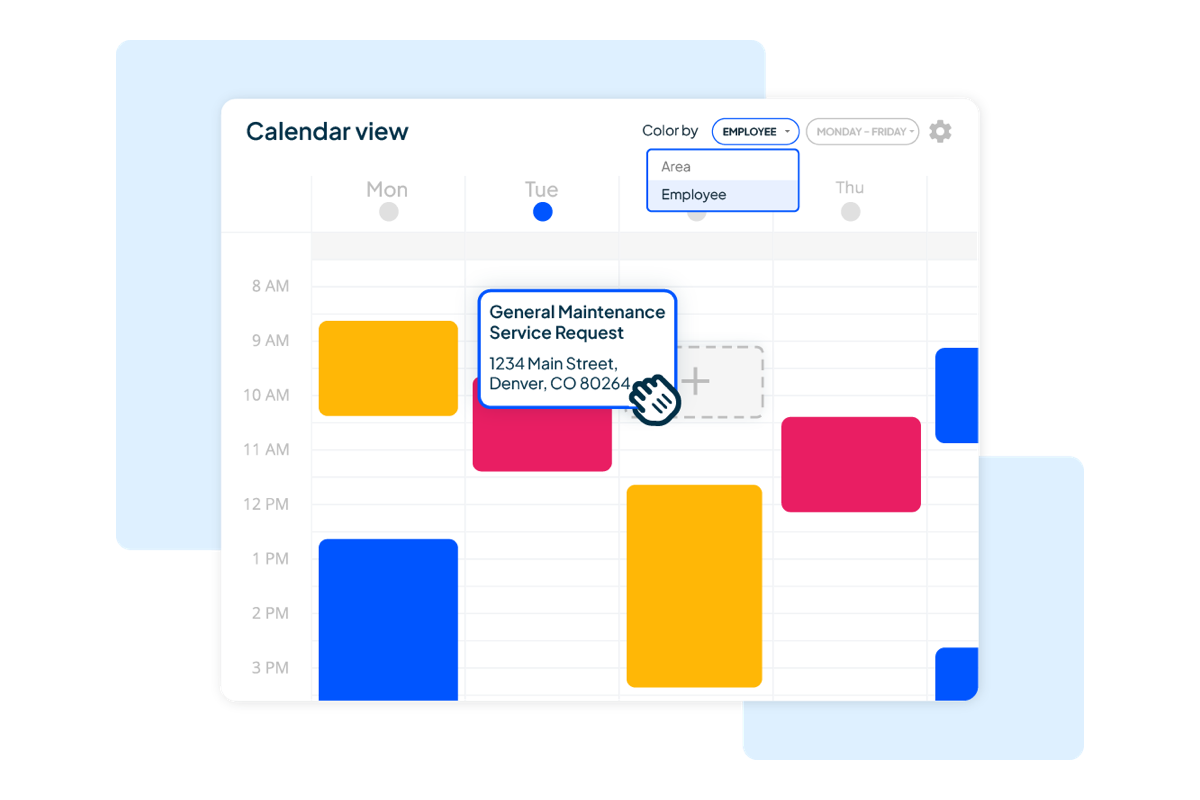
Housecall Pro's calendar, coloured by employee, with a job being dragged to a new slot. Source: Housecall Pro
Housecall Pro is built around the homeowner's experience of your business, and dispatch is one step inside that loop.
The sequence runs from online booking to dispatch to invoice to review request, with heavy automation on customer communication. Review management is a first-class feature rather than an afterthought, which tells you exactly who the product is for.
Dispatching is available on the entry Basic plan. Employee GPS tracking arrives on Essentials, and route optimization only on Max.
Recurring service plans, aimed at maintenance-agreement businesses, are also Max-tier. So is open API access, which means pushing dispatch data into a wider stack costs $329 a month at minimum.
It fits small residential home service businesses, roughly 1 to 15 technicians, competing on responsiveness and reputation. Commercial and crew-based contractors are poorly served. There are no cost codes, no prevailing wage, no certified payroll and no ERP feed.
Key features
Dispatching on the entry Basic plan, alongside online booking, quotes, invoices, payments and job costing.
Employee GPS tracking and route lists from the Essentials plan.
Route optimization, recurring service plans and open API access on the Max plan.
Automated customer communication with built-in review management to drive online reputation.
Photo reports and checklist automations from Essentials, useful for documenting a completed visit.
Pros
Cons
The largest field-app rating base in this comparison, 29,199 ratings at 4.65 stars.
Dispatching, booking, quoting, invoicing and job costing all included from the entry plan.
Review management is built in, which matters for shops that win work on reputation.
No long-term contract, stated explicitly by the vendor.
Extra seats on Max cost less per user than on Essentials, which rewards growing into the top tier.
Route optimization and open API are both locked to the $329 Max plan.
Extra users cost $100 a month on Essentials, more than the $75 they cost on Max.
Reviewers report inconsistent behaviour between areas of the product, such as deleting an event versus a job.
One reviewer reports invoices repeatedly failing to send by email, which delays payment.
No cost codes, prevailing wage, certified payroll or ERP integration, so commercial work is out of scope.
Pricing
Free trial or free plan: A 14-day free trial with no credit card required, and no long-term contract afterwards. Housecall Pro states plainly that it does not require long-term contracts.
Basic: $79/mo monthly, or $59/mo billed annually. One user. No GPS tracking.
Essentials: $189/mo monthly, or $149/mo billed annually. Includes 5 users, then $100/mo per additional user.
Max: $329/mo monthly, or $299/mo billed annually. Includes 8 users, then $75/mo each, which is cheaper per seat than Essentials.
What real reviews say
”
Made everything easy for me thank you
CONAN AFG · Service technician and owner, App Store reviewer · Apple App Store · 2026-09-01
”
It was very challenging to get the hang of. There are many common functions that are different for when working in different areas so it can be very difficult to do simple tasks, like deleting an event vs how you delete a job.
paver seal · Paving and sealing contractor, App Store reviewer · Apple App Store · 2026-09-01
Why we picked it
The field verdict is strong and worth taking seriously. Housecall Pro has 29,199 App Store ratings at 4.65 stars, the largest rating base of any tool in this comparison. Technicians use it and do not complain about being made to.
One more thing counts in its favour on a page where five of eight vendors publish nothing. Housecall Pro publishes every tier price and offers a 14-day trial with no credit card. It also states outright that it does not require long-term contracts. Only Jobber matches that on transparency.
The pricing has an oddity nobody else seems to have noticed. An extra user costs $100 a month on Essentials but only $75 a month on Max. Adding a sixth user to Essentials brings you to $289 a month. Max costs $329 and includes eight users, route optimization and API access. If you are about to add a seat on Essentials, price the upgrade first.
The criticisms in recent reviews are specific rather than vague, which makes them useful. One reviewer struggled with functions that behave differently in different areas of the product. Their example: deleting an event works nothing like deleting a job. Another reports invoices repeatedly failing to send by email, delaying payment. A cluster of 2026 reviews says an update round made the app less approachable than before.
Treat those as themes to probe on a trial rather than settled defects. Test the invoicing complaint first. It touches the part of the loop that gets you paid.
5. Workiz — Trades where the phone is the front door
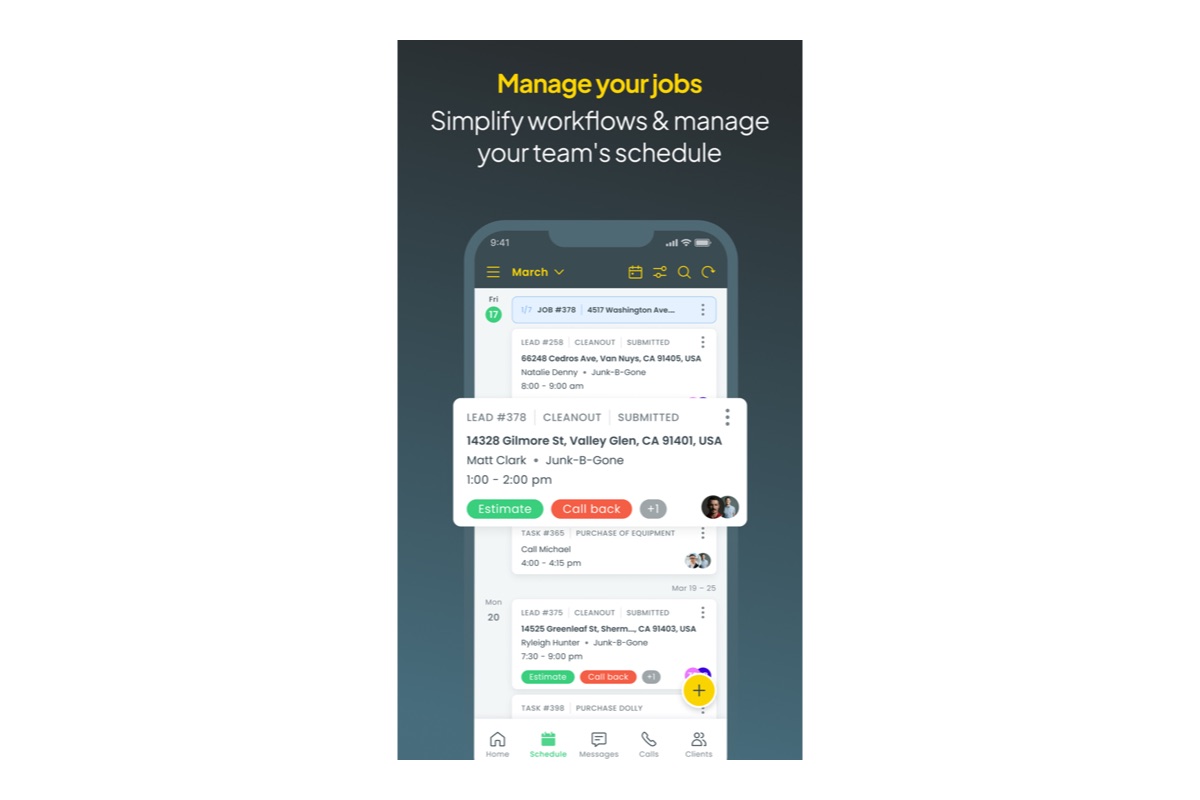
Workiz stacks jobs, leads and tasks on one schedule, with call-back actions inline. Source: Workiz
Workiz is built for trades that live on inbound calls. Its center of gravity is the phone system, not the dispatch board.
Scheduling, jobs, estimates, invoices, online payments, client management and QuickBooks sync are all on the entry Standard plan. Fleet tracking and team location tracking are also on every tier, which is more generous than most tools here.
Automations are rationed by plan: five on Standard, ten on Pro, thirty on Ultimate. The paid Genius add-ons are where the product's identity really lives. They cover an integrated phone system, call insights, call masking and two-way texting. AI answering handles English, Spanish and French.
One plan gate matters more than the rest. Multi-day jobs are Ultimate only. Below that tier the product does not model work that spans more than one visit.
It fits locksmiths, garage door companies, junk removal, appliance repair and similar trades where the call is the job. Its own testimonial wall is full of them. Crew-based contractors needing cost codes should look elsewhere.
Key features
Scheduling, jobs, estimates, invoices, online payments and client management on the entry Standard plan.
Fleet tracking and team location tracking included on all three tiers rather than gated to the top plan.
An integrated phone system with call insights, call masking, ad tracking and two-way texting, sold separately as Genius Phone.
AI answering for calls, email and SMS in English, Spanish and French, sold separately as Genius Answering.
Multi-day jobs, flat-rate pricing, inventory, equipment tracking and open API on the Ultimate plan.
Pros
Cons
Fleet tracking and team location tracking are on every tier, including the entry plan.
The integrated phone system is the best call-handling setup here for trades that win work by phone.
AI answering covers English, Spanish and French, which matters for a lot of US service markets.
A solid field rating at 4.57 stars from more than 2,000 App Store ratings.
Scheduling, estimates, invoicing and QuickBooks sync are all available from the entry tier.
No published pricing at all. All three tiers say "Request pricing", and the old pricing URL now 404s.
The free Lite plan for up to two users has been withdrawn.
Multi-day jobs are Ultimate only, so any work spanning more than one visit forces the top tier.
Automations are capped by plan at five, ten and thirty, so automation depth is a pricing decision.
A cluster of recent reviews raises billing and cancellation disputes, and one notes mobile access to customer records ends without an active subscription.
Pricing
Free trial or free plan: No free plan. The Lite tier that was free for up to two users is no longer offered, and the current pricing page advertises no trial.
Three tiers (Standard, Pro and Ultimate) all show "Request pricing" with no dollar amounts published anywhere on the page. Note the URL: the old /pricing/ address now returns a 404 and the live page is /pricing-plans/. Genius Phone, Genius Answering and Genius Marketing are add-ons priced separately, and card readers are sold separately. Subscription prices exclude sales tax where applicable. Third-party trackers quote conflicting figures for the same tiers, which is why we quote none of them.
What real reviews say
”
Enjoying using the app for our fire protection business, however when I click on the clients icon, the app gets stuck on that page and I can't go back to the home screen , so I have to close out of the app entirely.
Robynntroy · Fire protection business owner, App Store reviewer · Apple App Store · 2026-09-01
”
My only complaint is how so slow the app is adding products to jobs. It takes 10-20 seconds to search a part.
Rem95843 · Field technician, App Store reviewer · Apple App Store · 2026-09-01
Why we picked it
Workiz ranks fifth because the product is capable and the buying experience has moved backwards. Since this page last ran, three things changed, and all three are documented rather than inferred.
The pricing page moved. The old address now returns a 404, which quietly breaks links from most comparison articles. On the current page all three plans (Standard, Pro and Ultimate) show "Request pricing" with no figures anywhere. And the free Lite plan for up to two users is gone. Our own previous version of this page quoted $225 a month for up to five members plus $45 per extra member. We have removed it because it is no longer verifiable. Other pages still advertising a Workiz free plan are out of date.
The field rating is solid at 4.57 stars from 2,139 App Store ratings. The useful reviews are the specific ones. One owner reports the client screen freezing, needing a full app restart. Another reports 10 to 20 seconds to search for a part.
There is also a cluster of recent one-star reviews about billing and cancellation. They describe annual charges after a cancellation request, and disputed contract terms. We are not in a position to verify individual accounts. We would treat it as a prompt to read the contract carefully. Confirm in writing what happens to your customer data if you leave. One reviewer notes mobile access to customer records stops without an active subscription.
6. FieldPulse — Small mobile teams wanting guided field capture
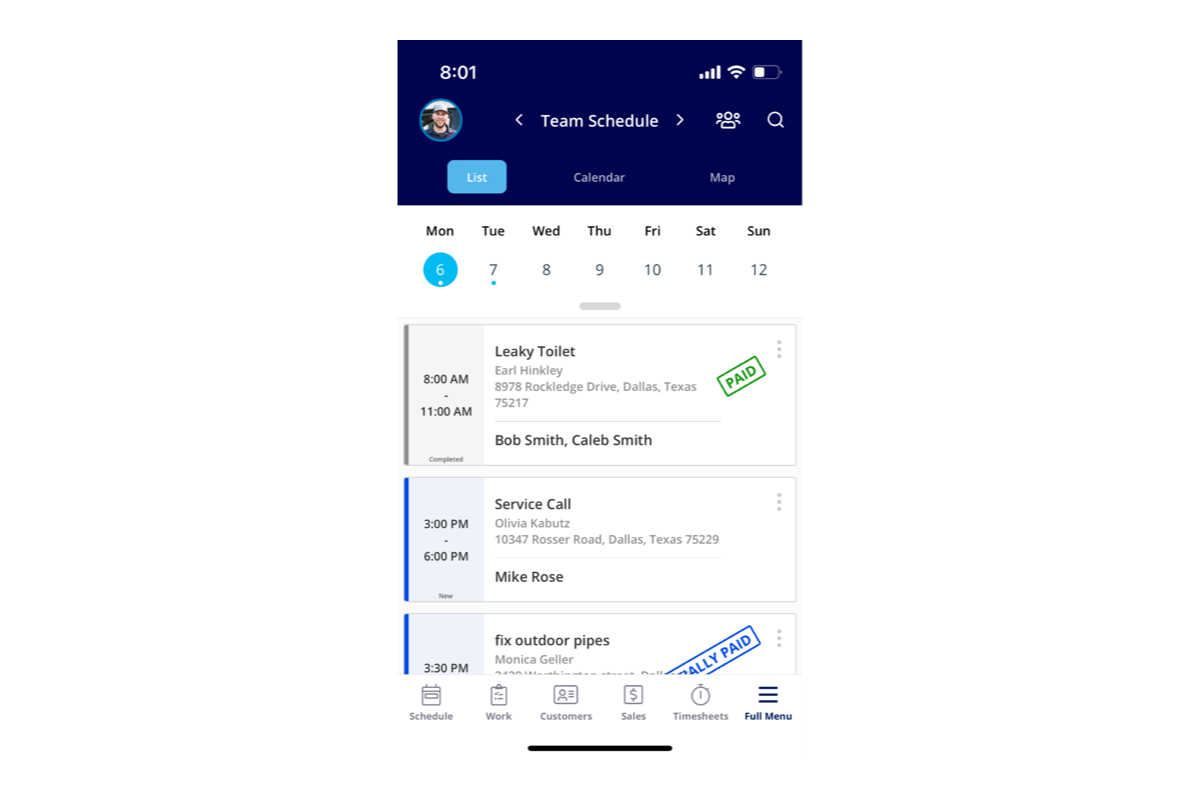
FieldPulse's Team Schedule, with List, Calendar and Map on the same screen. Source: FieldPulse
FieldPulse positions itself as one system for commercial and residential field service. It covers live GPS, real-time job calendars, work orders, estimates and invoices.
Its most interesting idea is Clear Path. The office builds a workflow. The app then presents a focus view. It walks the technician through capturing job and customer information in sequence. It answers the oldest problem in field software. How do you get complete information back from the field without nagging anyone?
Pricing is seat-based across three tiers. Professional adds project management and QuickBooks sync. Enterprise adds multi-location management and open API. A set of modules is priced separately, including VoIP, AI, price book, payments, custom forms and fleet tracking.
That last one deserves attention. Fleet tracking is an add-on, not part of any base tier. For a dispatch buyer, the capability you came for is a separate line item.
Key features
Clear Path, which lets the office define a workflow and gives technicians a guided focus view for capturing job and customer information.
Customer management, scheduling, work orders, estimates, invoices and workflow automation on every tier.
Project management and QuickBooks sync from the Professional plan.
Multi-location management and open API access on the Enterprise plan.
Separately priced modules for VoIP, AI, price book, payments, custom forms and fleet tracking.
Pros
Cons
Clear Path is a genuinely distinct approach to getting complete job information back from the field.
Commercial and residential work are both supported in one product.
Owners consistently praise the support team in recent public reviews.
Project management arrives at the mid tier rather than being reserved for enterprise.
Only 116 iOS ratings, against 20,691 for Jobber and 29,199 for Housecall Pro. Independent field evidence is thin.
Fleet tracking is a paid add-on rather than a tier feature, so the dispatch capability is a separate cost.
No published pricing and no advertised free trial, so you cannot self-serve an evaluation.
A reviewer reports addresses with suite numbers routing technicians to the wrong location.
One of the three comparison pages ranking it highly is its own company blog.
Pricing
Free trial or free plan: No free trial is advertised on the pricing page. A demo request is the only route to a price.
Three seat-based tiers (Essentials, Professional and Enterprise) with no published figures. The page states that pricing is customised to team size and setup and asks you to contact sales. Budget separately for the add-on modules, and check whether fleet tracking is in your quote, because it is not part of any base tier.
What real reviews say
”
The feature lets my office team create our own workflows and then a "focus view" in the app makes it sooo easy for the techs to know capture all job and customer info
Randy HVAC · HVAC contractor, App Store reviewer · Apple App Store · 2026-09-01
”
If there is a suite in the address, it takes you to the wrong address in maps. Whereas Google calendar opens maps to the correct address. I have already called about this problem
Dguerra123!! · Field service user, App Store reviewer · Apple App Store · 2026-09-01
Why we picked it
FieldPulse ranks sixth for one reason, and it is a matter of scale rather than quality. It appears on all three top-ranking comparison pages we benchmarked. In editorial presence that puts it alongside Jobber and ServiceTitan. Its iOS app has 116 ratings.
For comparison, Jobber has 20,691 and Housecall Pro has 29,199. The companion Engage app has 18 ratings. One of the three pages ranking FieldPulse so highly is FieldPulse's own blog. None of that makes the product bad. It does mean less independent field evidence than the alternatives offer. A 3.97 average across 116 ratings moves on a handful of reviews.
The reviews themselves split cleanly along role lines. Owners are enthusiastic, and one specifically credits Clear Path with making capture easy for techs. The critical reviews are operational and precise. One reports that an address containing a suite number sends the technician to the wrong place in maps. Google Calendar opens the correct address. For dispatch software, sending a tech to the wrong door is not a minor bug.
The harshest review warns that the product needs two years of workaround processes to cover its shortcomings. That is one voice, and the enthusiastic reviews are equally real. Get a trial or a sandbox before committing, and test address handling with your own worst addresses.
7. ServiceTrade — Commercial maintenance agreements and inspections
ServiceTrade's appointment list, carrying drive time and a job number per visit. Source: ServiceTrade
ServiceTrade is the most specialised tool here, and the only one with a purpose-built track for a regulated trade.
It is built around the recurring commercial service agreement and the dated inspection visit rather than the one-off residential call. The core loop is deficiency tracking: find a fault during an inspection, quote the repair, schedule the return visit against the same asset.
Both a dispatch board and a map scheduler ship in the entry Select suite. Most tools on this list hold one of those back. A customer portal on the Premium suite lets commercial property managers see their own asset and inspection history.
Suites are sold separately for Commercial and Mechanical Service and for Fire Protection. Pricing is driven mainly by technician count.
It fits commercial mechanical and fire protection contractors managing scheduled maintenance across a portfolio of customer sites. Residential one-off service businesses will find the agreement and deficiency model to be overhead they never use.
Key features
A dispatch board and a map scheduler both included in the entry Select suite, alongside the mobile app, quoting and QuickBooks integration.
Deficiency tracking that turns a fault found on an inspection into a quote and a scheduled return visit against the same asset.
A dedicated Fire Protection suite with inspection and compliance workflows for a regulated trade.
A customer portal on the Premium suite, giving commercial property managers visibility of their own asset and inspection history.
A technician capacity planner, multi-region operations and recurring contract pricing on the Enterprise suite.
Pros
Cons
A dispatch board and a map scheduler are both in the entry suite, not held back for a higher tier.
The deficiency-to-return-visit loop is the best handling of recurring commercial service work here.
A dedicated Fire Protection suite, which no other tool in this comparison offers.
The customer portal gives commercial property managers self-service visibility of their own sites.
Actively maintained, with the field app updated at the end of August 2026.
A long-tenured technician reports the app failing to log clock-ins on full signal, corroborated by a second reviewer.
A contractor reported completed service jobs never reaching their accounting system, forcing manual duplicate job creation.
No free trial and no published pricing.
The agreement and inspection model is overhead for residential one-off service work.
The capacity planner and multi-region support are Enterprise only.
Pricing
Free trial or free plan: No free trial and no free plan. Evaluation runs through a sales conversation.
Three suites (Select, Premium and Enterprise) all show "Request pricing", offered separately for Commercial and Mechanical Service and for Fire Protection. The vendor states that pricing is based on team size, driven mainly by the number of technicians you support plus the suite that fits your operational needs. Dispatch, scheduling and mobile all start at Select, so the dispatch board is not the upsell. The capacity planner and multi-region operations are Enterprise only.
What real reviews say
”
There's so much you can do on this app. Storing Organizing Communicating etc Its like having an assistant between you and the client and that brings peace of mind at a jobsite .
El Lobo 4555 · Field inspector, App Store reviewer · Apple App Store · 2026-09-01
”
Ive been using this app against my will for the last 6 years to clock my time at the various companies I've worked for. 1) This app is not dependable, my phone will have full bars, every other app will be working fine and yet service trade will NOT log my cl[ock-in]
Dryroasted99 · Service technician, six years across multiple employers, App Store reviewer · Apple App Store · 2026-09-01
What contractors told us about ServiceTrade
Paraphrased from our own recorded sales and onboarding calls. These are reported experiences, not verbatim quotes, and no account is identified.
The finished visit does not reach accounting
The most consequential thing we heard about ServiceTrade. The visit runs well and then stops short of the finance system, leaving the office to rebuild it by hand.
”
An account reported that service and inspection jobs opened in ServiceTrade never reached their accounting system. Their office reverse-engineered job numbers out of timesheet notes, then hand-created duplicate jobs in their ERP before any of that work could be costed or paid.
Commercial mechanical contractor
No bulk path for site data
Relevant if you manage a large portfolio of customer sites and expect to move that list between systems.
”
The same account managed its customer locations in ServiceTrade and could not identify a bulk import path for them.
Commercial mechanical contractor
Why we picked it
ServiceTrade ranks seventh on breadth, not on quality. For the specific work it targets it is arguably the best tool in this comparison. The narrowness is the point of the product.
The field rating is 4.15 stars from 584 App Store ratings, with the app updated as recently as 31 August 2026. The office-side reviews are genuinely warm. One inspector describes it as having an assistant between you and the client. Another notes that documents, photos and comments uploaded from the field reach the office staff with everything they need.
The most valuable review we found anywhere in this research is a critical one. One technician has used the app across several employers for six years. They report it failing to log a clock-in on full signal, with every other app working. A milder four-star review corroborates it, saying the app occasionally glitches and fails to clock you in.
That pattern matters because of something a contractor told us directly. Their service and inspection jobs opened in ServiceTrade never reached their accounting system. The office reverse-engineered job numbers out of timesheet notes, then hand-created duplicate jobs before any of that work could be costed or paid. Put those together and the read is clear. ServiceTrade is strong at running the visit. It is weaker at proving the visit and handing it to finance. Ask hard questions about the accounting integration before you sign.
8. FieldEdge — Service shops running QuickBooks Desktop
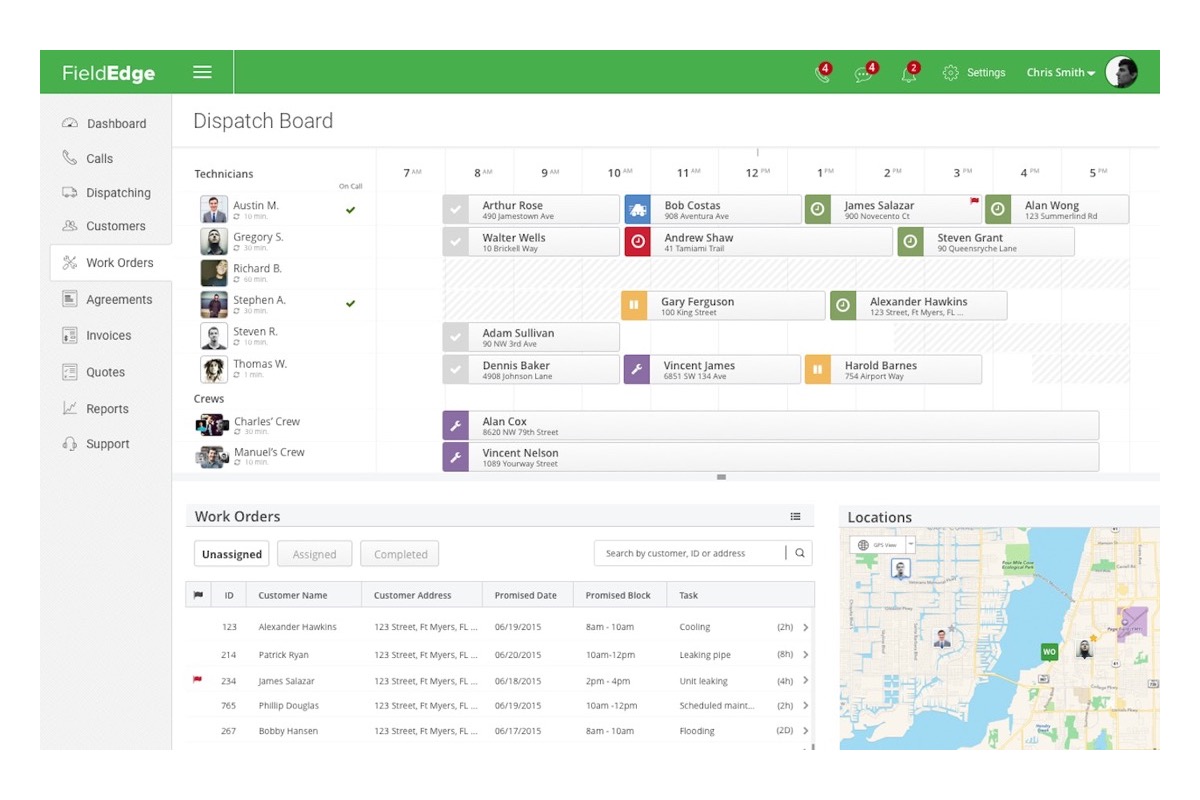
FieldEdge's dispatch board, with the unassigned work order queue underneath it. Source: FieldEdge, via Software Advice
FieldEdge is the QuickBooks shop's field service system, and that is both its strength and its whole argument.
It integrates with QuickBooks Online and QuickBooks Desktop on every tier. That is the strongest Desktop story here, and the main reason established shops still choose it.
The architecture is office-first: customer record, service agreement, dispatch, invoice, back to QuickBooks. Dispatching itself is tiered, described as basic on Select and advanced on Premier, so the dispatch board is a paid upgrade rather than a baseline.
The plan structure carries a constraint no competing page mentions. Mobile app licenses are capped by tier: two on Select and four on Premier. A dispatch product that limits how many technicians may hold the app is a hard ceiling on your crew size, not a soft preference.
It fits established HVAC, plumbing and electrical service shops running QuickBooks as the system of record. Service agreements drive their revenue. Anyone who wants to try before buying should look elsewhere, as should crew-based project contractors.
Key features
QuickBooks Online and QuickBooks Desktop integration on all three tiers, the deepest Desktop support in this comparison.
Service agreement management, described as basic on Select and advanced on Premier, aimed at maintenance-driven revenue.
Dispatching on every tier, upgraded from basic to advanced at the Premier plan.
Performance and commission tracking from Premier, with unlimited saved reports on Elite.
Warehouse inventory management on Elite, available only to shops running QuickBooks Desktop Enterprise with Advanced Inventory.
Pros
Cons
QuickBooks Online and Desktop integration on every tier, the strongest Desktop support in this comparison.
Service agreement management is mature, which suits shops where maintenance contracts drive revenue.
The new Mobile 2.0 app is drawing positive early reviews from users who disliked the old one.
Guided onboarding is included rather than sold as an add-on at the top tier.
Three apps are live at once, rated 1.78, 3.47 and 1.25 stars. Most technicians are still on the 1.78-star version.
Mobile app licenses are capped at 2 on Select and 4 on Premier, which limits how many technicians can use it.
No free trial at all, stated as company policy, so you cannot evaluate it without a sales process.
A technician on the entry tier reports weekly hours that are never accurate, and keeps paper records as a backstop.
No published pricing, and warehouse inventory requires a specific QuickBooks Desktop Enterprise configuration.
Pricing
Free trial or free plan: No free trial, and FieldEdge states this as deliberate policy: it says new members have the most success when its team walks them through onboarding.
Three tiers (Select, Premier and Elite) with no published figures, varying by technician and employee count. The detail to pin down before you sign is the mobile app license cap: Select includes 2 licenses and Premier includes 4. If you have more technicians than that, confirm in writing what additional licenses cost. Note also that warehouse inventory on Elite requires QuickBooks Desktop Enterprise with Advanced Inventory.
What real reviews say
”
Much better than the old app, can't wait to see the whole thing released
JenMercer412 · Office user on FieldEdge Mobile 2.0, App Store reviewer · Apple App Store · 2026-09-01
”
I have field edge basic that allows me to clock in and out. I able to do that, but when I view my hours for the week it is never accurate. Often times I've been working for 100 hours plus for the week. I have to keep track on paper and pencil of my hours for t[he week]
Koz man · Service technician on the entry tier, App Store reviewer · Apple App Store · 2026-09-01
What contractors told us about FieldEdge
Paraphrased from our own recorded sales and onboarding calls. These are reported experiences, not verbatim quotes, and no account is identified.
Verification happens in a second system
The clearest example we have of a dispatch tool that schedules the work without carrying the evidence that the work happened.
”
An account books all of its service appointments in FieldEdge for its service-tech team, then cross-checks the technicians' days against a separate vehicle-tracking GPS program, pulling a report from the vehicle system to reconstruct the day.
Mechanical contractor
The crew was never the problem
Worth stating fairly. In this account the technicians' own records held up well. What was missing was the system's ability to prove it.
”
The same account reported that its service technicians were used to filling out time cards as they went, and that for the most part those time cards matched the vehicle GPS exactly.
Mechanical contractor
Why we picked it
FieldEdge ranks eighth because of what the app stores currently show. It is the most concerning finding in our research.
Three FieldEdge apps are live at the same time. FieldEdge Mobile 1.0, the version most technicians are still on, holds 1.78 stars from 423 ratings. FieldEdge Mobile 2.0 holds 3.47 stars from 34 ratings. A third app, ESCByFieldEdge, holds 1.25 stars from 96 ratings. All three were updated within the last few months. The migration is genuinely in progress, and a buyer today lands in the middle of it.
The reviews on the new app are encouraging and honest about being unfinished. One reviewer likes the new design and says they cannot wait to see the whole thing released. Another raised their rating from zero to four but notes daily history still jumps back to the first call ever recorded.
The review that should decide it for most buyers comes from the entry tier. A technician on FieldEdge basic reports weekly hours that are never accurate, sometimes showing over 100 hours. They keep paper and pencil records as a backstop. A contractor also told us they book every service appointment in FieldEdge and then cross-check technicians' days against a separate vehicle-tracking GPS program. FieldEdge schedules the visit. Something else proves it happened.
Seven checks, in the order we would run them. Most of these came out of what contractors told us went wrong, not out of a feature list.
1. Decide whether your work is a call or a job
This one decision eliminates half the market, and getting it wrong is the most expensive mistake in this category.
A call is one technician, one visit, a price, an invoice, done. The software that serves it optimizes for booking, routing, price books, memberships and getting paid on site. ServiceTitan, Jobber, Housecall Pro, Workiz and FieldEdge are all built this way.
A job is a crew, several days, phases and cost codes. The software that serves it optimizes for who was where, for how long, coded to what. Workyard is built this way.
Mixed shops are common and there is no shame in running two systems. Plenty of contractors keep a service platform for the service division and something else for project labor.
2. Price the tier that actually does dispatch
Headline prices in this category are close to meaningless, and every vendor here does it, including us.
Jobber starts at $49 a month. GPS tracking and route optimization start at $199.
Housecall Pro starts at $79 a month. GPS arrives at $189 and route optimization at $329.
Workyard starts at $6 per user per month. Office-to-field scheduling is not in that plan at all. It begins on Pro.
Workiz publishes nothing, and multi-day jobs are locked to its top tier.
ServiceTitan, FieldPulse, ServiceTrade and FieldEdge publish nothing.
Write down the three capabilities you are actually buying, whether that is GPS, route optimization or multi-day jobs. Then find the tier where all three switch on at once, and price that. Five of these eight vendors will make you ask, so budget time for the calls.
3. Test what happens when jobs and crews shift mid-day
Ask the salesperson this, in exactly this form. I dispatched a technician this morning. Something came up. I need to pull them to another job. I am not at my desk. What happens?
We asked contractors the same thing. The honest answer today, at most shops, is a phone call, and the system is never updated. One dispatcher was moving 100 field workers one day at a time, alerting anyone affected by text around 2pm the day before. Another told us mid-day reassignments still travel by text even though they already own dispatch software.
The follow-up question is the one that matters for payroll. When you move someone, does the time that person books afterwards land against the new job automatically? One contractor described workers shuffling between crews all week, nobody recording the move, and paychecks coming up short as a result.
4. Check it can schedule the return visit
A surprising number of tools model a job as a single event on a calendar. Real work is not shaped that way.
A roofing and waterproofing contractor told us their previous system allowed only one scheduled date per job. Roofing means coming back for the pipe boots on a different day. Because the tool could not represent that, nobody on the team used its scheduling feature at all. The feature existed and was abandoned.
So test it directly. Create a job, schedule a visit, then schedule a second visit against the same job two weeks out. If that forces a duplicate job, a workaround, or a higher plan, you have found a real constraint. Workiz, for example, restricts multi-day jobs to its top tier.
5. Ask how the finished visit reaches accounting
Dispatch that ends when the technician taps complete has moved the work, not removed it.
One contractor told us their service and inspection jobs never reached the accounting system. The office pulled job numbers out of timesheet notes and hand-created duplicate jobs in the ERP before anything could be costed or paid. A software boundary had created a full-time job.
Get specific in the demo. Which fields cross over. Whether cost codes and phases survive the trip. Whether it is a native integration, a middleware product, or a CSV someone exports on Friday. One commercial account needed the work order on the technician's device within minutes of the request. Theirs came out of an ERP through middleware, so latency was a live concern.
6. Look up the technician's app before you buy
This takes four minutes and it is the most useful thing in this guide.
Search the vendor on the App Store or Google Play. Read the rating, the number of ratings, and the most recent reviews. The office buys dispatch software and the field lives in it, and those two groups often disagree sharply.
Be careful which app you are looking at. Several vendors ship more than one. FieldEdge currently has three live, rated 1.78, 3.47 and 1.25 stars. ServiceTitan has a current Field app at 3.42 stars and a legacy Mobile app at 2.95. Make sure you are reading the app your technicians will actually hold, not a companion, admin or legacy version.
Rating count matters as much as the score. FieldPulse averages 3.97 stars from 116 ratings. Housecall Pro averages 4.65 from 29,199. The second number is evidence. The first is a sample.
7. Check what the schedule can prove in six weeks
Dispatch records get read long after the day they describe, usually when something has gone wrong.
A customer disputes that anyone attended. A worker disputes their hours. An auditor asks for documentation you did not know you needed. The question is what your system can produce at that point.
Ask what is attached to a completed visit. Arrival and departure times. Location. Who was assigned versus who actually attended. Photos, notes, a signature. Whether a supervisor can edit any of it after the fact, and whether that edit leaves a trail. A schedule that only records what was planned cannot answer any of those questions.
More about field service dispatch software
Our schedule lives on a whiteboard. Is dispatch software overkill?
You are in the largest group, not the smallest. Of the 108 contractors who told us what they run scheduling on, 40 named a whiteboard, a spreadsheet, a paper calendar or a group text. The whiteboard usually fails in one way first: nobody outside the room can see it. One contractor had to call three or more people to establish who was on which job. If that sounds familiar, start with the cheapest tool that puts the day on a phone. You do not need routing or automation yet.
Can one system handle both service techs and install crews?
Sometimes, and it depends on which side dominates. Most tools here treat a multi-day install as an exception to the single-visit model, and several charge for it. Workiz restricts multi-day jobs to its top tier. Crew-focused products handle install work natively but have no customer booking or invoicing. If your service department and install department are both substantial, running two systems is a legitimate answer. What does not work is forcing one model to pretend to be the other.
Do I need GPS, or is a schedule enough?
A schedule tells you the plan. GPS tells you what happened. If you only need to communicate the plan, skip GPS and save the money. It is usually the expensive upgrade. Jobber puts it on a $199 plan and Housecall Pro on a $189 one. You need GPS when the plan and reality routinely disagree. Or when you pay for travel time. Or when customers want arrival windows and a dispute needs evidence. One contractor put the reason plainly. They could finally see when an employee left the shop and arrived on site. Before that, they had no way of knowing.
Do I need one app for scheduling and another for work orders?
Usually not, but check which one the product treats as primary. Tools built around the service call make the work order the record and the schedule a view of it. Tools built around crews make the schedule the record and attach work to it. Both can carry the other, and the weaker side is where you will notice the compromise. Ask to see a work order raised, dispatched, completed and invoiced in one sitting. If any step leaves the product, that is your second app.
It depends on the shape of your work. For contractors dispatching crews to jobs that run for days, Workyard, because dispatch and GPS-verified labor cost share one record. For a small residential service shop, Jobber. It publishes every price and has the highest-rated field app at 4.81 stars. For trade shops with 15 or more technicians, ServiceTitan. It has the strongest dispatch board and the only real capacity planning.
How much does field service dispatch software cost?
Published entry prices run from $6 per user per month (Workyard) to $79 per month (Housecall Pro), but entry prices rarely include dispatch essentials. Jobber's GPS and routing start at $199 a month. Housecall Pro's route optimization starts at $329. Workyard's scheduling starts on its Pro plan, not its $6 tier. Five of the eight platforms here publish no pricing at all and quote per technician after a sales call.
Is there free field service dispatch software?
Not among serious options as of September 2026. Workiz previously offered a free Lite plan for up to two users. It has been withdrawn. Comparison pages still advertising a Workiz free plan are out of date. What you can get is a free trial. Workyard, Jobber and Housecall Pro all offer 14 days with no credit card required. ServiceTitan, FieldPulse, ServiceTrade and FieldEdge offer no trial at all, and FieldEdge states that as deliberate policy.
Does field service dispatch software work offline?
Coverage varies, and weak signal causes more trouble than no signal. ServiceTitan reviewers repeatedly report the app flipping between offline and online at around two bars, then refusing to load estimates or accept photos. Jobber reviewers report limited offline capability in the mobile app. Test this on your worst route rather than trusting a feature list. Ask what happens to a punch or a form submitted on partial connectivity.
What is the difference between dispatch software and field service management software?
Dispatch is one function inside field service management. Dispatch software answers who goes where and when, and gets that to the crew. Field service management adds the customer-facing loop: online booking, quoting, price books, invoicing, payments and service agreements. Every tool on this page does more than dispatch. The distinction still tells you what a product is optimized around. That tells you which parts will feel like an afterthought.
Which dispatch software is best for HVAC, plumbing and electrical contractors?
It splits by whether the trade runs service calls or installs. An HVAC shop doing both will feel it most. For service work, ServiceTitan suits shops of 15 or more technicians. FieldEdge fits shops on QuickBooks Desktop, and Housecall Pro fits smaller residential teams. Workiz suits trades that win work by phone. For the install side, where a crew stays on one job for days, Workyard is the better fit. Contractors running both departments often keep two systems.
Kyo Zapanta
Construction technology writer, 10+ years covering workforce management & SaaS
Kyo Zapanta is a B2B technology writer with more than 10 years of experience covering workforce management and SaaS. At Workyard, she writes about construction labor compliance, GPS time tracking, job costing, and crew scheduling. She has personally tested and reviewed more than 30 construction technology platforms, combining hands-on product research with a family background in carpentry and construction to connect software capabilities with the realities of field work.
The Business Research Company, Service Dispatch Software Global Market Report: market valued at $3.32 billion in 2025, projected to reach $4.91 billion by 2030 — 2026