


 (650) 332-8623
The 6 Best Employee GPS Tracking Apps for Contractors in 2026
Compare 6 employee GPS tracking apps for construction. See how Workyard, Buddy Punch, and Timeero stack up for contractor crews, pricing, and jobsite accuracy.


Quick Answer
Best overall for construction crews: Workyard – polygon geofencing, automatic job costing, offline sync, and the deepest construction payroll integration set in this category (Sage, Foundation, Procore). From $6/user/mo + $50 base.
Best for construction crews that need fast onboarding: ClockShark – job costing and offline tracking included, fastest onboarding in this comparison. From $40/mo base + $9/user/mo.
Best for contractors already running QuickBooks payroll: QuickBooks Time – native QuickBooks sync, free with QB Payroll Elite; GPS accuracy limitations apply in field conditions. From $20/mo base + per user.
Workyard is included in this comparison. This article is published by Workyard and reflects our honest assessment of each product based on hands-on testing, feature research, and user review analysis. We don’t accept payment for rankings. Our scoring methodology is explained here.
Workyard’s analysis of 280 contractor discovery calls found that 55% of construction businesses have no reliable way to verify whether crews are actually on-site when they clock in. I tested six employee GPS tracking apps and employee location tracking software for contractors, including Workyard, which is built specifically for construction, against that specific problem: how to track time for construction workers across multiple sites reliably.
“If they show up at like 8:15, they’re saying they’re getting there at 8… And if they leave at 1:30, they’re saying they left at 3.” – HVAC and mechanical contractor, Owner, 51–200 employees
I evaluated each app using a multi-site construction scenario. The criteria that mattered most: GPS accuracy in real jobsite conditions, contractor-specific fit, and whether pricing holds up at 10, 25, and 50 workers.
What’s changed in this update (June 2026)
- Brand lineup updated: Connecteam, ClockShark, and QuickBooks Time replace three apps that weren’t relevant to contractor businesses
- Buddy Punch pricing updated: Starter is $5.49/user/month, not $4.99
- Buying Guide added: how to choose by contractor type, polygon vs. circular geofencing explained, and real pricing at 10, 25, and 50 workers
- FAQ expanded: 10 questions covering legality, contractor-type fit, offline tracking, and drive-time separation
- G2 ratings added for all six apps
How we chose these apps
Each app is scored against a consistent set of criteria weighted by what matters most to contractor businesses. See our full scoring methodology for details.
Top employee GPS tracking apps for contractor businesses at a glance
| App | Score | Best for | Key features | Starting price |
| Workyard | 9.3 | General contractors (GCs) and specialty trades (electrical, plumbing, HVAC), multi-site crews with job costing needs | Live GPS + polygon geofencing; offline sync; full job costing | $6/user + $50/mo base |
| ClockShark | 7.0 | Small construction and field service crews that need fast setup and basic job tracking | Live GPS + geofencing; offline sync; basic job costing | $40/mo base + per user |
| QuickBooks Time | 6.3 | Contractors already on QuickBooks payroll who want time tracking without a separate data bridge | GPS tracking (geofencing = Elite only); no offline; job costing on Elite | $20/mo base + per user |
| Buddy Punch | 6.4 | Small contractor businesses needing simple clock-in controls and attendance records | GPS at punch events only; no continuous tracking; no job costing | $5.49/user + $19/mo base |
| Timeero | 6.0 | Field service contractors with fixed-route territory (HVAC, plumbing, landscaping) where mileage accuracy and route logging matter most | Breadcrumb GPS + mileage; offline sync; no job costing | $4/user/mo |
| Connecteam | 6.0 | Mixed-trade contractor businesses needing scheduling, chat, and time tracking in one low-cost app | Breadcrumb GPS (Advanced plan only); no offline; no job costing | Free plan available; GPS requires Advanced plan ($49/mo base) |
Workyard: Best employee GPS tracking app for construction contractor businesses
I put Workyard at the top of this list because it’s purpose-built for construction contractors. Testing it against the others confirmed what GPS time tracking for contractors needs most: location data tied to jobs, not just punches.
Key features
- GPS time tracking: Locks every clock-in to GPS location and ties hours to the correct job automatically.
- Polygon geofencing: Draws to the actual property line; blocks off-site clock-ins without manual review.
- Flexible clock-in: Mobile, foreman-led, or kiosk. Crew goes live without forcing a phone install on day one.
- Live crew map: Shows which site each worker is on, when they arrived, and when they left. Updates in real time.
- Drive time separation: Splits on-site time from travel automatically; logs mileage for time-and-materials (T&M) billing and bid sharpening.
- Prevailing wage and certified payroll: Automates certified payroll reporting for Davis-Bacon and state prevailing wage jobs; no manual weekly adjustments required.
Save hours of payroll cleanup with GPS-verified time tracking
The polygon geofence tool draws to the actual property line, not a 500-foot radius. That distinction matters more than the spec sheet suggests.
On dense urban lots or subdivisions where multiple crews work adjacent plots, circular geofences bleed into the street or the next lot, and a worker standing 30 feet from the entrance can trigger a valid clock-in. I drew the boundary for a test site in about two minutes and it held exactly where I put it.
AV Decking ran into this problem at scale. Project managers had been submitting default 10-hour timesheets: an estimate, not a record. When GPS verification came in, the gap was immediate. Their administrative assistant to the CEO described what happened:
“We’ve had at least a solid six weeks now with all of our guys fully on the app, and in six weeks, we actually over exceeded that $150,000 that we had originally estimated for an entire year.” Six weeks of GPS-verified time tracking recovered more than a full year’s projected savings.


Catch payroll gaps before they reach your books
The live map also catches a subtler problem: workers clocked in but not showing at the expected location. That flag surfaces before payroll goes out, not after.
D&S Electric had the same problem at a smaller scale. Workers were arriving at 7:20 and reporting 7:00. Kathi Smith, VP, did the math:
Let’s say an $18/hour employee is off an hour each week. Once you factor in overtime, you’re looking at more than $1,500 per employee each year just from those little mistakes.
Multiply that across a crew and it compounds fast. GPS verification caught the gap without anyone having to audit a timesheet. D&S eliminated $10,000 in annual payroll costs after switching. “I would have never known without Workyard.”
Drive-time separation proved most useful for T&M billing. Workyard timestamps arrival at the geofence boundary, so there’s no dispute over when on-site time started versus when the worker was still in the truck. For fixed-price jobs, the same data shows how much of a day was productive versus in transit. That data sharpens future bids.

Make it easy for every crew setup to track time correctly
Job costing auto-assignment is the feature that surprised me most. With three active jobs running simultaneously, every punch landed on the correct job by GPS location: no worker input, no cost code selection.
Sage 300 CRE and Foundation Software are Workyard-exclusive integrations. For contractors running construction accounting rather than generic small-business payroll, that’s the difference between a system that fits and one that needs a workaround.
Kiosk mode addresses the adoption barrier common in early GPS rollouts: not every worker will install a personal app on day one. With kiosk or foreman-led clock-in, a contractor can go live without forcing that step, then move to individual tracking as the crew gets comfortable.


Stay on top of crews with real-time visibility
Workyard shows where every crew is through real-time GPS tracking during clocked-in hours: which site, when they arrived, when they left. That crew visibility replaces a morning of check-in calls across every active site. The live map also flags when someone is clocked in but not showing at the expected location. That surfaces the problem before payroll, not after.
Track mileage and travel time with less manual effort
Offline sync held up when I switched a device to airplane mode mid-shift; the clock-out registered locally and synced the moment signal came back.
Workyard and ClockShark were the two I found dependable in dead zones. If offline reliability is a priority, test it specifically during any free trial. For crews on rural sites or inside metal buildings, that reliability is what keeps time records complete.
Pricing
| Plan | Price | What’s included |
| Starter | $6/user/month + $50 base | GPS time tracking, location and mileage tracking, payroll integrations |
| Pro | $13/user/month + $50 base | Time clock rules, advanced reporting, and accounting integrations |
| Autopilot | Custom pricing | Automated project time tracking, time card sign-offs, and more advanced features |
Free trial: Workyard offers a 14-day free trial, no credit card required.
Pros and cons
| Pros | Cons |
| Built for construction and field service | More feature-dense than crews that only need simple punch-in/out |
| Polygon geofencing enforces real jobsite boundaries | Requires location permissions |
| Live GPS with offline sync | Base fee adds cost for very small teams |
| Strongest construction payroll integration set in this category; native Sage 300 CRE and Foundation Software integrations not available in any other app here | |
| Supports gradual crew adoption |
Ratings
Our score
- App Store: 4.1/5
- Google Play: 3.7/5
- Capterra: 4.7/5
- G2: 4.8/5
Who should use Workyard?
Workyard is best for:
- General contractor (GC) and specialty trade contractors (electrical, plumbing, HVAC) running multiple jobs simultaneously who need GPS-verified time tied to specific cost codes automatically
- Contractors burned by payroll errors or timesheet disputes who need an audit trail that holds up, not just clock-in dots on a map
- Teams rolling out GPS tracking for the first time who need gradual adoption support: voluntary clock-in, kiosk mode, and foreman-led clock-in before full enforcement.
ClockShark: Built for small construction crews that need fast onboarding
ClockShark is purpose-built for construction and field service. Its strongest signal in user reviews: quick onboarding is cited in 169 reviews as the standout strength, with contractors consistently noting crews are up and running in under a day.
ClockShark was acquired by Simpro Group, a PE-backed construction software company, in 2023. Note that ClockShark has no prevailing wage automation (contractors running Davis-Bacon projects must track certified payroll manually).
For any employee GPS tracking app construction crews use, the GPS picture is mixed with ClockShark. User reviews split almost evenly: 54 negative mentions cite GPS failures, while 51 positive mentions cite reliable GPS as a strength. One Capterra reviewer noted that clocking in showed a location three miles from where they were actually sitting. If GPS precision is your top priority, that split is the key factor to weigh before you commit.
See how Workyard stacks up against ClockShark.
Key features
- GPS tracking and geofencing: Tracks crew location throughout the workday; geofences tie automatically to jobsites.
- Job costing: Assigns hours to jobs and cost codes; manual cost code selection required.
- Offline mobile tracking: Captures time and location without a signal and syncs when connectivity returns.
- Kiosk mode: Lets crews clock in from a shared on-site device without a personal phone install.
- Scheduling: Builds and assigns shifts within the app; included on Standard plan. Employee-based, not crew-based.

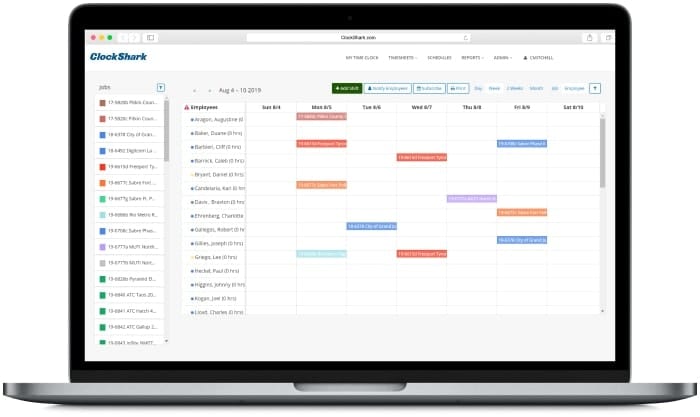


Pricing
| Plan | Price | What’s included |
| Standard | $40/mo base + $9/user/mo | GPS, geofencing, job costing, scheduling, kiosk |
| Pro | $60/mo base + $11/user/mo | Paid time off (PTO), advanced job costing, departure tracking |
Free trial: 14 days; no free plan
ClockShark bills only active users. Inactive team members don’t count toward the per-user charge. Pricing current as of June 2026. Check clockshark.com for the latest rates.
Pros and cons
| Pros | Cons |
| Fast onboarding | GPS tracking can be unreliable; location errors require manual correction |
| GPS, job costing, and kiosk mode included without add-ons | Pricing increases steeply at 20+ workers |
| Job costing and offline tracking included on the Standard plan (no upgrade required) | Scheduling is per employee, not per crew; doesn’t match how most construction teams assign work |
| Integration with Simpro field service software for teams already in that stack | No prevailing wage support |
| Hours assigned to specific jobs and cost codes across simultaneous projects | Customer support response times inconsistent; some users report extended waits for resolution |
Ratings
Our score
- App Store: 2.9/5
- Google Play Store: 3.4/5
- Capterra: 4.7/5
- G2: 4.6/5
Who should use ClockShark?
ClockShark is ideal for:
- Small to mid-size construction and field service crews that need to go from zero to working time tracking in a day
- Contractors who prioritize onboarding speed and ease of use over GPS precision, especially if crews are resistant to new tech
- Businesses already in the Simpro ecosystem that want a construction-focused time tracking app without switching platforms
.Not sold on ClockShark? Check out our list of ClockShark alternatives instead.
QuickBooks Time: Built for contractor businesses already using QuickBooks payroll
QuickBooks Time’s dominant advantage is its QuickBooks integration. It’s the top reason contractors choose it, cited more than twice as often as any other strength in user reviews. If your payroll already runs through QuickBooks, QB Time removes the need for a separate data bridge.
QB Time Elite is free with a QuickBooks Payroll Elite subscription, which is a hard argument to beat on price alone.
On the downside, GPS drift in field conditions appears in 72 separate user reviews, the most frequently flagged issue in QB Time’s dataset. Contractors report spending 30+ minutes per week manually correcting location errors as a result. Geofencing requires Elite tier, and the 1,000-foot minimum radius is too large for many jobsites.
See the full comparison: Workyard vs. QuickBooks Time
Check out our list of QuickBooks Time alternatives too.
Key features
- QuickBooks integration: Syncs hours directly to QuickBooks payroll without a third-party data bridge
- GPS tracking: Captures employee location during clock-ins and shifts. Geofencing available on Elite only with a 1,000-foot minimum radius.
- Scheduling and kiosk: Creates schedules and assigns shifts; kiosk and mobile/web access included on both plans.
- Job costing: Project tracking and job costing available on Elite; manual tagging required.


Pricing
| Plan | Price | What’s included |
| Time Premium | $20/mo base + $8/user/mo | GPS tracking, scheduling, kiosk, mobile/web app, 1 free admin |
| Time Elite | $40/mo base + $10/user/mo | Everything in Premium + geofencing, project tracking, mileage tracking, timesheet signatures |
| Time Elite + Payroll Elite bundle | $134/mo base + $12/employee/mo | Everything in Time Elite + full-service payroll, automated taxes, same-day direct deposit, tax penalty protection, personal HR advisor |
Free trial: 30 days, no credit card required
Pricing verified as of June 2026. Rates subject to change. Verify current pricing at quickbooks.intuit.com before purchasing.
Pros and cons
| Pros | Cons |
| Hours sync directly to payroll without a manual data bridge | GPS drifts in rural/field conditions |
| Free with QuickBooks Payroll Elite subscription | Geofencing requires Elite; 1,000-foot minimum radius |
| Mature feature set; scheduling, kiosk, job costing, and mileage tracking all available | Clock-in/out bugs and missed time entries reported; requires manual review to catch errors |
| Extensive third-party help content and community resources available | Manual project tagging can add time to weekly payroll review |
Ratings
Our score
- App Store: 4.6/5
- Google Play Store: 4.7/5
- Capterra: 4.7/5
- G2: 4.5/5
Who should use QuickBooks Time?
QuickBooks Time is ideal for:
- Contractors whose payroll already runs through QuickBooks and want time tracking that feeds it without a separate data bridge
- Urban and suburban crews on QuickBooks Payroll Elite, where QB Time Elite is effectively free as part of the bundle
- Businesses that don’t need live GPS or tight geofencing and where the payroll integration value outweighs the GPS limitations
Buddy Punch: Suited for simple attendance tracking with basic GPS proof
Buddy Punch is an attendance and time tracking app that handles scheduling, overtime alerts, payroll integrations, and biometric clock-in reliably. For contractors who need basic time records and don’t require GPS verification at the jobsite level, it delivers at a competitive price.
The limitation to understand before buying: GPS records location only at punch events. There’s no continuous tracking between punches, no geofencing to enforce jobsite boundaries, and no job costing to tie hours to specific projects.
One G2 reviewer described the GPS gap directly: “The moment we move we don’t know where they at.” For contractor businesses that need continuous location tracking, that limitation is the key factor to weigh.
See how Workyard stacks up against Buddy Punch.
Key features
- GPS at clock events: Records location at punch-in and punch-out only; no continuous tracking, no geofencing, no breadcrumb trail between events.
- Biometric verification: Facial recognition clock-in available; reduces buddy punching without GPS dependency.
- Scheduling and alerts: Builds shifts and sends overtime alerts; includes time-off calendar management.
- Payroll integrations: Syncs with QuickBooks, ADP, and Gusto; QuickBooks integration has documented bugs.


Pricing
| Plan | Price | What’s included |
| Starter | $5.49/user/mo + $19 base | GPS punch-in/out, scheduling, overtime alerts, basic integrations |
| Pro | $6.99/user/mo + $19 base | Facial recognition, advanced scheduling, job codes |
| Enterprise | $11.99/user/mo + $19 base | Single sign-on (SSO), advanced permissions, dedicated support |
Free trial: 14 days
Pricing verified as of June 2026. Rates subject to change. Verify current pricing at buddypunch.com before purchasing.
Pros and cons
| Pros | Cons |
| Competitive pricing | GPS records location at punch events only; no continuous tracking/geofencing/breadcrumb trail between punches |
| Facial recognition clock-in reduces buddy punching without requiring GPS verification | No job costing; you can’t assign hours to jobs or cost codes |
| Clean user interface | No offline sync; workers on rural sites or in dead zones can’t punch in without a signal. |
| Simple to set up | Not built for construction field workflows |
Ratings
Our score
- App Store: 4.9/5
- Google Play Store: 4.4/5
- Capterra: 4.8/5
- G2: 4.8/5
Who should use Buddy Punch?
Buddy Punch is ideal for:
- Small contractor businesses that need basic clock-in proof and attendance records without a complex setup
- Teams where buddy punching is the core concern and biometric facial recognition clock-in is the preferred solution
- Contractors who don’t need continuous GPS tracking or job costing, and want a clean, simple app with strong online reviews
Timeero: Built for service routes and mileage-heavy field teams
Timeero tracks GPS location and mileage for field service routes. Customer support is its standout strength, cited in 47 reviews as the most responsive in this roundup. For contractors who need mileage logging and route history more than jobsite-enforced clock-ins, it’s the lowest-price entry point in this comparison.
Timeero has a documented GPS accuracy issue worth knowing before you commit: route history is occasionally recorded as straight lines rather than actual roads (23 mentions in user reviews). That “crow-flies” routing affects mileage accuracy for any contractor billing travel time.
Geofencing is the bigger concern for construction contractors. Clock-in boundary enforcement failed in 19 documented cases in user reviews. One Capterra reviewer put it plainly: “It just doesn’t quite work like it’s advertised. Employees have clocked in from their house with no geofence alert.” If jobsite-enforced clock-ins are a requirement, verify this in your trial before committing.
Android users have flagged two reliability issues: 23 reviews cite crashes after updates (requiring force-close and restart), and 15 reviews report battery drain severe enough to deplete a full charge during a workday. If your crew runs Android, test on your actual devices during the free trial before rolling out.
One pricing note: teams with more than 10 employees are automatically moved from the Basic plan ($4/user) to Pro ($8/user). This threshold isn’t prominently disclosed upfront. Factor it into your cost estimate before signing up if your crew is at or near 10.
Compare Workyard and Timeero side by side.
Key features
- GPS breadcrumb and mileage: Records location at intervals and logs route history for mileage billing
- Offline tracking: Captures punches/location without a signal; syncs when connectivity returns
- Geofencing: Sets clock-in boundaries by location
- Mileage reimbursement reporting: Generates IRS-rate mileage reports for reimbursement; exports directly to payroll
- Scheduling: Builds and assigns shifts; available on Pro plan and above


Pricing
| Plan | Price | What’s included |
| Basic | $4/user/mo | GPS breadcrumb, mileage, offline tracking (10-employee limit; Pro required above this) |
| Pro | $8/user/mo | Geofencing, scheduling, routes |
| Premium | $11/user/mo | Advanced reporting, integrations |
| Enterprise | Custom | Custom features and support |
Free trial: 14 days
Pricing verified as of June 2026. Rates subject to change. Verify current pricing at timeero.com before purchasing.
Pros and cons
| Pros | Cons |
| Lowest entry price in this comparison; $4/user/mo with no base fee for teams under 10 | Geofencing can be unreliable; employees have clocked in from outside the boundary with no alert triggered |
| Highly rated customer support in this roundup; cited as responsive and helpful in user reviews | Android app instability; crashes after updates reported; requires force-close and restart |
| Records punches and location without signal; syncs automatically when connectivity returns | Excessive battery drain on Android; some users report a full charge depleted within a workday |
| Mileage logging; tracks driven routes and generates IRS-rate reimbursement reports | No job costing or construction accounting integrations; you can’t allocate hours to jobs or cost codes. |
| Clean, simple interface |
Ratings
Our score
- App Store: 4.7/5
- Google Play Store: 4.6/5
- Capterra: 4.5/5
- G2: 4.8/5
Who should use Timeero?
Timeero is ideal for:
- Field service contractors with fixed-route territory (HVAC, plumbing, landscaping) where field employee location tracking, mileage reimbursement accuracy, and route logging are the primary tracking need
- Very small teams (under 10) that want the lowest per-user price in this category with no base fee
- Operations where customer support responsiveness matters more than construction-specific features like job costing or geofence enforcement
Connecteam: Ideal for budget-conscious mixed field teams
Connecteam is the most affordable employee location tracking app in this roundup and is built for general deskless teams, not construction-specific GPS workflows. For mixed-field crews that need scheduling, messaging, and forms alongside basic time tracking, it bundles those in one app without add-ons.
GPS tracking is available on the Advanced plan. For contractors whose crews work regular routes or fixed locations, the breadcrumb model can be enough. It confirms a worker was in the right area and logs location at intervals throughout the shift.
Where it falls short is jobsite verification: location is recorded at intervals (breadcrumb trail, not continuous), so you can’t confirm a specific clock-in at a defined boundary. One G2 reviewer noted: “I cannot see where my employees are in real time.”
Connecteam also bills each feature module (Operations, Communications, HR) as a separate hub, so a team using all three pays more than the listed base price suggests.
For multi-site construction contractors, the gaps are more significant. Breadcrumb tracking doesn’t verify which specific jobsite a worker was on or confirm exact arrival times, which matters when you’re managing crews across several active sites.
There’s no job costing, no cost code allocation, and no construction accounting integrations with Sage, Foundation, or Procore. If your primary need is payroll accuracy and GPS-verified clock-ins tied to specific jobs, Connecteam isn’t the right fit.
For a small mixed-trade crew that needs scheduling and messaging more than GPS precision, Connecteam covers the basics.
Key features
- Scheduling and communication: Scheduling, chat, forms, and training in one app
- GPS breadcrumb tracking: Records location at intervals, not continuously
- Geofencing: Clock-in enforcement available on Advanced


Pricing
| Plan | Price | What’s included |
| Basic | $29/mo base | Core features, no GPS (min. 30 seats per hub; +$0.50/user after 30) |
| Advanced | $49/mo base | GPS breadcrumb tracking; +$1.50/user after 30 |
| Expert | $99/mo base | Full platform access (+$3.00/user after 30) |
Free plan available.
Pricing verified as of June 2026. Rates subject to change. Verify current pricing at connecteam.com before purchasing.
Pros and cons
| Pros | Cons |
| Free plan for teams under 10 includes time tracking, scheduling, and messaging | GPS breadcrumb only; can’t verify which jobsite a worker was on |
| Scheduling, chat, forms, and training included | No job costing or cost codes; not suitable for construction payroll |
| Easy to use; field workers pick it up quickly without training | Geofencing enforcement is unreliable |
Ratings
Our score
- App Store: 4.9/5
- Google Play Store: 4.8/5
- Capterra: 4.6/5
- G2: 4.6/5
Note: App Store and Google Play ratings reflect overall averages across all user types. Admin-side and field worker scores can diverge significantly. Check field worker reviews specifically before rolling out to crews.
Who should use Connecteam?
Connecteam is ideal for:
- Mixed-trade or general field teams (cleaning, maintenance, light field service) that prioritize scheduling, messaging, and low cost over GPS accuracy
- Small businesses under 10 users that want a free plan covering time tracking, scheduling, and team communication
- Contractors looking for GPS tracking software for field service businesses who don’t need live GPS or job costing, and are comfortable with breadcrumb-only location on the Advanced plan
How to choose the best employee GPS tracking app for your contractor business
Start with tools built specifically for construction and test GPS accuracy on real jobsites before pricing. Any app in this roundup will clock your crew in and out. The question is whether it ties those punches to specific jobs, verifies the crew was actually on-site, and feeds your payroll without anyone re-entering the data.
What to look for in employee GPS tracking apps for contractors
Workyard’s research found that more than half of construction businesses have no reliable way to confirm crew location at clock-in, which means most contractors have no GPS-verified record of where their crew was when they clocked in. The seven criteria are listed below.
1. GPS accuracy and jobsite verification
Does the app prove the crew was on-site, not just clocked in? GPS time tracking for contractors needs to go beyond recording a location at punch time. Without continuous tracking and polygon geofencing, you get a timestamp, not verification. In testing, I drew the boundary for a multi-site construction scenario in about two minutes; the polygon geofence held exactly where I placed it and blocked off-site clock-ins without any manual review.
What to look for:
- Continuous GPS tracking and field employee location tracking throughout the shift, not just at clock-in and clock-out
- Polygon geofencing (boundaries drawn to the actual parcel line, not a fixed circular radius that bleeds onto adjacent properties)
- Real-time alerts when a worker clocks in outside the jobsite boundary
- GPS breadcrumb trail for mileage and travel-time allocation between sites
Questions to ask:
- Does this geofencing time clock app for contractors track GPS continuously while on the clock, or only at punch events?
- Can I draw custom geofence shapes per jobsite, or is the radius fixed?
- What happens if a worker clocks in outside the boundary — blocked, flagged for review, or let through?
2. Contractor-specific fit
Purpose-built for construction versus adapted from a general workforce tool: this distinction determines whether the app fits your workflow or forces workarounds. Workyard’s analysis of 280 contractor discovery calls found that 55% of construction businesses have no reliable way to verify whether crews are actually on-site when they clock in — a gap that generic workforce apps weren’t designed to close.
A construction crew location tracking app needs job costing, multi-site crew handling, and construction payroll integrations. A generic workforce tracking app has none of those.
What to look for:
- Job costing with automatic cost code assignment at the time entry level, not just project level
- Multi-site crew tracking: live GPS map showing which site each worker is on across simultaneous projects
- Construction accounting integrations: Sage 300 CRE, Foundation Software, Procore, not just QuickBooks
- Kiosk and foreman-led clock-in for crews who won’t install a personal app on day one
Questions to ask:
- Was this app built for construction, or is construction one of many supported industries?
- Can cost codes be auto-assigned by GPS location, or does the worker have to select them manually?
- Which construction accounting systems does it integrate with natively?
3. Drive time vs. jobsite time separation
For time-and-materials contractors, the travel time vs. on-site time question generates more payroll disputes than almost any other line item. If the app doesn’t separate drive time from jobsite time automatically, someone on your team is correcting entries every week.
What to look for:
- Automatic separation of drive time and on-site time using GPS geofence arrival and departure timestamps
- Mileage logging tied to the route, not just start and end points
- Drive-time data exported to payroll and job cost reports without manual re-entry
Questions to ask:
- Does the app automatically distinguish drive time from on-site hours, or does the worker have to log it?
- How is mileage calculated, actual route or straight-line distance?
4. Payroll integration
The back-office administrator re-entering field hours into QuickBooks every Friday is a bottleneck that costs real money, not just in admin hours, but in transcription errors that cause payroll disputes and incorrect job cost reports. The American Payroll Association reports payroll error rates between 1–8% for U.S. companies [American Payroll Association, via LiftHCM, November 2024]. GPS-verified time entries eliminate the single largest driver of those errors: inaccurate manual time reporting.
What to look for:
- Native integrations with QuickBooks (Desktop and Online), Sage, ADP, Gusto, and Paychex.
- Two-way sync: job and employee data flows from accounting into the time clock app, not just outward.
- One-click export that includes cost codes, job names, overtime, and mileage
Questions to ask:
- Is the integration native or via a connector like Zapier?
- What data syncs automatically: hours, cost codes, overtime, mileage?
- Are there extra fees for premium integrations or connecting to multiple payroll systems?
5. Offline and low-signal reliability
Construction sites lose signal. A basement pour, a metal-roof warehouse, a rural site past cell tower range, these are the dead zones that break manual punch records. If the app requires a connection to clock in, your crew either can’t punch or reverts to paper.
What to look for:
- Full clock-in/out functionality without any cell signal.
- Automatic data sync when connectivity returns (no manual action needed from the worker)
- GPS timestamps and cost codes queued locally and uploaded intact.
Questions to ask:
- Can workers clock in with zero cell signal?
- Does offline data sync automatically, or does the worker need to trigger it?
- Do geofencing and photo verification work offline?
6. Adoption ease for crews
An app with every feature on the list is useless if the crew won’t open it. Construction workers wearing gloves on a site that starts at 5 a.m. can’t afford to spend two minutes navigating a clock-in screen. Field worker App Store ratings are a cleaner signal than admin-side scores; check them before committing.
What to look for:
- One or two-tap clock-in from opening the app.
- Reliable performance on budget Android devices, not just new iPhones
- Kiosk mode for shared devices when workers won’t install a personal app
- Gradual rollout support; voluntary clock-in first, geofence enforcement added as trust builds
Questions to ask:
- How many taps does it take to clock in from opening the app?
- What is the minimum Android version and device spec the app supports?
- Is the app available in Spanish or other languages your crew speaks?
7. Pricing transparency and value
Per-user cost, base fees, and what’s locked behind higher tiers determine whether the pricing model stays viable as your crew scales. A good example of a hidden pricing trap: Timeero automatically moves teams past 10 employees from the $4/user Basic plan to the $8/user Pro plan — a threshold that isn’t prominently disclosed upfront. An app that’s affordable at 8 workers can cost twice as much at 11.
What to look for:
- Clear, publicly listed per-user pricing
- Transparent base fees and add-on costs with no hidden charges post-sign-up
- Pricing that doesn’t jump steeply past a user threshold
- Free trial of at least 14 days to test on real crews and real jobsites
Questions to ask:
- What is the total monthly cost for 10, 25, and 50 users including base fees and required add-ons?
- Does the per-user price change if I scale past a certain threshold?
- Is there a long-term contract, or can I cancel monthly?
Pricing considerations
Always calculate total cost at your actual crew size, not the headline per-user rate. Most apps charge a per-user monthly fee plus a base fee, and the gap between them widens fast as your crew grows. Across the six apps in this roundup, per-user rates run $4–$13/user/month, with base fees of $19 to $60/month depending on the app.
Timeero is the lowest-cost entry at $4/user with no base fee (up to 10 employees). Workyard starts at $6/user + $50 base. Buddy Punch at $5.49/user + $19 base. Connecteam has a free plan for teams under 10, with GPS requiring the Advanced plan ($49/mo base).
Feature depth drives the price differences. Basic time tracking is cheapest. Polygon geofencing, job costing, construction accounting integrations, and offline sync typically require mid or higher tiers.
Pricing at real crew sizes:
| App | 10 workers | 25 workers | 50 workers |
| Workyard (Starter) | $110/mo | $200/mo | $350/mo |
| ClockShark (Standard) | $130/mo | $265/mo | $490/mo |
| QuickBooks Time (Elite) | $140/mo | $290/mo | $540/mo |
| Timeero (Pro) | $80/mo | $200/mo | $400/mo |
| Buddy Punch (Starter) | $74/mo | $156/mo | $294/mo |
| Connecteam (Advanced) | $49/mo | $49/mo | $79/mo |
Integration requirements
GPS tracking produces value only when verified hours sync directly to payroll and job cost reports. For contractor businesses, that means native connections to the systems your back office already runs, not a Zapier workaround that breaks when an API changes.
Accounting software: QuickBooks Online and Desktop, Sage 300 CRE, Sage 100 Contractor, Xero. Sage integrations are critical for mid-to-large general contractors (GCs). Workyard is the only app in this roundup with native Sage 300 CRE and Foundation Software support.
Payroll systems: ADP, Paychex, Gusto, Rippling. Native payroll integration means approved, classified hours flow directly from the field to payroll without a manual export step.
Project management: Procore, Buildertrend, Viewpoint. For mid-to-large contractors, feeding labor hours directly into project budgets eliminates the manual handoff between time tracking and project reporting.
Manual time tracking creates errors and overhead across every system handoff. A single hour error for an electrician can trigger payroll corrections, compliance issues, and worker disputes. Native integrations eliminate those steps.
Best employee GPS tracking app for contractors by use case
Workyard is the strongest overall pick for most contractor businesses. For crews where a different tool fits better by trade type or budget, the recommendations below break it down by size and primary need.
For small contractors (1-10 employees)
Workyard (Top Pick): The Starter plan ($6/user + $50 base) gives small contractors GPS time tracking, geofencing, scheduling, and basic reporting, enough to replace paper timecards and verify jobsite presence from day one.
Timeero (Runner-up): Lowest entry price in this comparison at $4/user with no base fee. For very small crews that need basic GPS and mileage logging without job costing, it’s the most affordable starting point.
For mid-size contractors (11-50 employees)
Workyard (Top Pick): The Pro plan adds job costing, advanced reports, and deep payroll integration. For contractors managing multiple active sites, Workyard’s live GPS map, automatic cost code assignment, and construction accounting integrations pay for themselves in admin hours saved.
QuickBooks Time (Runner-up): A solid option if your payroll already runs through QuickBooks and your crews work suburban or urban sites where GPS accuracy is less critical. QB Time Elite is free with a QuickBooks Payroll Elite subscription.
For large contractors (50+ employees)
Workyard (Top Pick): Scales from 50 to 200+ workers with consistent per-user pricing and native integrations with ADP, Sage 300 CRE, Foundation Software, and Procore.
ClockShark (Runner-up): Purpose-built for construction with offline tracking and job costing included. Works well for large crews that prioritize onboarding speed and don’t need Sage or Foundation integrations.
By primary need
Best for GPS tracking: Workyard. Continuous GPS, polygon geofencing, and automatic jobsite verification built for construction.
Best for fast onboarding: ClockShark. Purpose-built for construction; most crews are clocking in within a day.
Best for QuickBooks integration: QuickBooks Time. Native two-way sync with QuickBooks payroll; free on Payroll Elite subscription.
Best for mileage tracking: Timeero. The right GPS tracking software for field service businesses with fixed-route territory; IRS-rate mileage reports and route logging included.
Best for scheduling and communication: Connecteam. Strongest non-GPS feature set for general field teams that need more than just time tracking.
Final recommendation: Best employee GPS tracking app for contractor businesses
Workyard is the best employee GPS tracking app for contractor businesses. Polygon geofencing and automatic job costing are the two features that put it ahead of every other tool in this review. Native Sage 300 CRE and Foundation Software integrations are also Workyard-exclusive.
Best overall: Workyard
Most accurate GPS, deepest construction features, smoothest payroll workflow. Polygon geofencing and automatic cost code assignment are Workyard-exclusive. Native Sage 300 CRE, and Foundation Software integrations are also only available here (no other app in this roundup supports all three).
“Ever since Workyard has been implemented and we’ve been utilizing it to track job costing, our accounting department has been able to break down all of that information and give us more realistic numbers.”
Synaptic Solar, running 40-60 field employees across Texas, tracked time in QuickBooks until repeated system crashes wiped payroll records. Their HR Field Manager calculated $4,800/day in payroll losses per outage. After switching to Workyard, they recovered $5,000/week and the accounting team gained job-level cost clarity they had never had.
Best for fast onboarding: ClockShark
Built for construction with job costing and offline tracking included, and faster to get running than anything else in this comparison. The right call for crews that need to go from zero to clocking in within a day.
Best for contractors on QuickBooks payroll: QuickBooks Time
Contractors running QuickBooks Payroll Elite get QB Time Elite at no additional cost. For teams whose accounting lives in QuickBooks and whose crews work predictable suburban routes, that integration removes more friction than any other tool in this comparison.
Our Scoring System Explained
Our 8-part scoring system was created to help you understand the potential value of any software we review simply and fairly.
We created it after reviewing dozens of software products, which we covered in depth, but without providing a direct and simple way for readers to compare products on their merits – without spending a lot of time looking through our articles for the information they needed to make an informed decision.
Every app we review will include Customer Support and Company scores, which we’ll explain in more detail below. Many of the factors reviewed in this article will also be consistent across most (or all) of our software reviews, with some differences:
The 8 factors assessed and their contribution to a product’s overall score may differ slightly from product to product based on various factors, such as the use case we’re reviewing for, the type of business these products are tailored to, and other considerations. However, all reviews will feature an 8-part score, weighted and combined to calculate each product’s overall score.
How We Score Software
All factors in our reviews are scored on a 10-point scale – technically 11 points – from 0-10. However, we only give products a score of 0 if it does not include an essential feature at all, and we try to avoid giving out 0 scores if a product can demonstrate any functionality in line with the specific factor being reviewed.
In general, the 0-10 range translates as:
- 9.0 – 10 – One of the absolute best in its category (amazing).
- 7.5 – 8.9 – Very good, but with some minor issues (very good).
- 6.0 – 7.4 – Mediocre performance with notable shortcomings (average).
- 3.0 – 5.9 – This feature is not ready for prime time (borderline).
- 1.0 – 2.9 – This feature actually makes its product worse (unacceptable).
- 0 – The product doesn’t include this important feature at all.
How We Calculate Overall Scores
The 8 factors reviewed are weighted based on an overall total of 100%:
- Ease of Use: 20%
- Time Tracking Accuracy: 20%
- Scheduling Features: 15%
- Job Tracking: 15%
- Integrations: 10%
- Customer Support: 15%
- Company: 5%
Methodology for Each Factor
Ease of Use
We evaluate a product’s ease of use based on three main considerations:
- How easy is it to set up this app?
- How easy is it for managers to use the backend dashboard?
- How easy is it for frontline workers to use the (mobile) app?
These three considerations cover the main ways you and your team would use the software being reviewed – when you first obtain it, when someone (a manager, executive, team leader, or similar role) needs to use it to manage people, money, data, and other things, and when workers you’re tracking use the app (usually a mobile version of the software designed for frontline and/or field team members) to clock in, clock out, record time worked, or address other day-to-day needs.
Time Tracking Accuracy
Every minute matters when you’re trying to control payroll costs. This factor accounts for various features and common needs in time-tracking apps, such as…
- How accurate or precise is its GPS tracking capability?
- How accurate – and how customizable – is its geofencing feature?
- How accurate is its travel and mileage tracking (if available)?
- Can it automatically clock workers in and out based on the above?
- Can you set and/or restrict rules for clocking in and out?
- Can the app continue tracking workers while offline?
- How easy is its mobile app and/or kiosk for frontline workers?
Scheduling Features
Many construction businesses prefer to manage as many aspects of employee labor activity as possible in a single app, which is why many time-tracking apps also include worker scheduling as a core feature.
When we consider a product’s scheduling features, we look at:
- Its dashboard customizability (daily, weekly, or monthly views).
- Its project-based scheduling and visibility.
- Its real-time updates and notifications for workers.
- Its real-time map views of worker locations for best-fit scheduling.
- Its recurring schedule (copies to subsequent weeks, etc.) functionality.
Job Tracking
This factor helps you understand if the software can also provide insight into specific projects, which is particularly handy when your business deals with many customers or clients who generally need shorter-term work. Effective job tracking typically also includes accurate job costing functionality for construction companies.
We assess several things when calculating a product’s job tracking score:
- Its project-based tracking for multiple projects per day/week/etc.
- Its ability to track multiple / many projects simultaneously.
- Its use of (and your ability to customize) construction cost codes.
- Any built-in job costing views.
- Any integrations for cost coding (QuickBooks etc.)
Integrations
No business can operate on a single app, which is why integrations with other apps and tools are such important aspects of modern business software.
To calculate a product’s integration score, we’ll examine:
- How many native integrations (the simplest connection) does it offer?
- How effective and easy-to-use are its integrations with payroll software?
- Does it have robust data import and export features?
Customer Support
Learning how to use a new app can be frustrating, even if it’s meant to be the most user-friendly app around. That’s why great customer support is so essential when considering which time-tracking app to use.
Customer support scores are calculated based on:
- Live support channels available (phone, email, chat, etc.).
- Live support hours (business hours only, 24/7, etc.).
- The strength of the product’s online help center and/or FAQs.
- What other users say about support in online reviews.
Company
A great company with a highly customer-friendly approach can often make up for shortcomings in their software products – at least up to a point.
When assessing this score, we’ll examine:
- Transparency (easy-to-find pricing, etc.)
- Trial period (duration, feature availability, credit card requirements, etc.).
- Subscription flexibility (contracts, required durations, etc.).
- Ease of cancellation or pausing subscriptions.
- Customer perceptions (online product reviews).
- Website (a minor consideration, but great companies tend to have great websites).
Any questions about our scoring system? Have any suggestions on how we could make it even better? Click here to send us your feedback – we’d love to hear from you!
References
- 1
American Payroll Association. “Payroll Error Rate Data.” Via LiftHCM, November 2024. https://lifthcm.com/article/common-payroll-errors-how-to-avoid-them
- 2
National Conference of State Legislatures (NCSL). “State Employee Monitoring Laws.” https://www.ncsl.org/labor-and-employment/employee-monitoring
Workyard is the best employee GPS tracking app construction businesses should evaluate first. It’s built specifically for construction, with polygon geofencing, live GPS tracking, offline sync, job costing, and integrations with Sage 300 CRE, Foundation Software, and Procore.
For small crews that prioritize ease of onboarding over GPS accuracy, ClockShark is a viable alternative.
Yes, GPS tracking employee location is legal in the United States with proper notice. No single federal law governs employee GPS tracking; laws vary by state.
California (Penal Code §637.7) requires written consent even for company vehicles. Connecticut, Delaware, New York, Oregon, Georgia, Illinois, and Washington require notification or consent. Indiana, Nevada, and New Jersey require advance disclosure.
In most other states, tracking company-owned vehicles with notice is broadly permitted. The safest practice for any contractor: limit tracking to work hours, provide written disclosure, and obtain signed acknowledgment [NCSL State Employee Monitoring Laws, verified March 2026].
Yes, with proper notice and a written policy is the safest way to do it. The practical steps: notify all employees in writing before tracking starts, limit tracking to scheduled work hours only, and confirm your app stops collecting location data when workers clock out.
For company-owned vehicles, most states permit tracking with notice. California requires signed consent even for company vehicles. The simplest approach for any contractor is a one-page GPS tracking policy signed at onboarding. It satisfies most state requirements and gives you documentation if a dispute ever surfaces.
If you’re in California, Connecticut, New York, or Delaware, have an employment attorney review the policy before you roll it out [NCSL State Employee Monitoring Laws, verified March 2026].
The most reliable method for contractor businesses to track employee location: a GPS employee tracking app on worker phones or company tablets. Workers clock in through the app. The app records their location.
More advanced tools like Workyard go further: continuous GPS tracking, automatic geofence enforcement, and offline sync for jobsites with poor signal.
Before enabling tracking, give written notice to all employees and limit it to scheduled work hours. Most states require written disclosure; California requires signed consent.
For construction and field service, the most widely used GPS employee tracking apps and workforce tracking apps are Workyard, ClockShark, QuickBooks Time, Connecteam, Buddy Punch, and Timeero. For contractor businesses specifically, the critical differentiator is whether the app provides GPS verification at the jobsite level and whether time data integrates cleanly with construction payroll and job costing.
Workyard and ClockShark include polygon geofencing and job costing. Connecteam and Buddy Punch offer GPS but lack construction-specific features like cost code auto-assignment.
GPS tracking prevents buddy punching by attaching a location record to every clock-in. Any geofencing time clock app for contractors adds a second layer: workers must be inside the actual site boundary to clock in. A worker cannot clock in for a colleague remotely if the GPS shows them off-site at that moment. One interior finishing contractor described the problem before GPS:
“I have installers that will say, hey, you’re going to this address. And you need to install carpet today, and then at the end of the day, every single day, oh, yep. I’m leaving that job and I’ve got 8.5 hours. We record it. We pay them, then I might talk to a superintendent a week later and find out they actually left at noon.” GPS verification closes that gap before payroll runs.
More advanced worker tracking apps add photo verification, polygon geofence enforcement, and biometric authentication. Workyard’s polygon geofencing proves not just that the worker was near the site, but that they were inside the actual jobsite footprint.
Yes, and for most contractors it should be. GPS tracking employee location outside work hours creates legal exposure and erodes crew trust. Workyard limits its ability to track employee location to clocked-in time only; location data isn’t collected when a worker is off the clock.
Geofencing can further restrict tracking to the jobsite footprint. Before deploying any worker tracking app, confirm two things: that the app stops tracking when workers clock out, and that your written notice policy makes this clear to crews.
California, Connecticut, New York, and several other states have specific notification requirements that apply regardless of how the app is configured [NCSL State Employee Monitoring Laws, verified March 2026].
Workyard and ClockShark. Those are the two you can rely on in dead zones. Both record punches locally when GPS or cellular signal drops, then sync automatically when connectivity returns.
Timeero has offline tracking too, though with documented Android reliability issues. QuickBooks Time and Connecteam have limited offline capability — verify this during your trial if crews work in low-signal areas. If your crews work in basements, remote sites, or inside metal buildings, verify offline sync with any vendor before you sign.
Most employee GPS tracking apps for contractors cost between $4 and $13 per user per month, plus a monthly base fee of $19 to $60.
Timeero starts at $4/user with no base fee (Pro at $8/user above 10 workers). Buddy Punch is $5.49/user + $19 base. Workyard is $6/user + $50 base. Connecteam has a free plan for teams under 10, with GPS requiring the Advanced plan at $49/month base. ClockShark and QuickBooks Time both charge a base fee plus a per-user rate; check each vendor’s pricing page before budgeting.
At 25 workers, real monthly costs run: Timeero $200, Buddy Punch $156, Workyard $200, Connecteam $49 (Advanced, under 30-seat minimum). Always calculate total cost at your actual crew size, not the headline per-user rate.
For a full breakdown of what’s included at each price point, see our guide on how much GPS tracking costs.
As an employee location tracking app, Connecteam offers a free plan for teams of up to 10 users that includes time tracking, scheduling, and messaging, but no GPS. For GPS tracking specifically, there is no free option in this category. Most tools offer 14-day free trials: Workyard, ClockShark, Buddy Punch, and Timeero all do.
Connecteam’s free plan is the only ongoing zero-cost option, but the 10-user cap counts deactivated accounts unless they are permanently deleted. A team of 8 active workers can hit the limit if past employees are still sitting in the system. If your crew is under 10, you manage accounts carefully, and you don’t need GPS verification, the free plan covers the basics.


