6 Out of 10

Buddy Punch review:
What 24 real conversations revealed

Kyo Zapanta By Kyo Zapanta · Reviewed by Rouselle Isla · Published August 3, 2026 • Last updated August 3, 2026

The verdict: 6.0/10

Buddy Punch does what it says on the label. It is an affordable time clock, genuinely one of the cheapest options at 15, 100, or 300 workers pricing sizes, and the two-tap punch is the most-praised thing across all of the reviews we analyzed with 145 mentions. There is no setup fee and no contract.

The gaps are narrower than its reputation as our research calls suggests. Job cost reports and a live crew map both exist. What contractors described missing is the automation around them: a breadcrumb trail you can defend, and job tagging nobody has to do by hand.

If your office re-codes hours every week, you may find the savings get spent on cleanup.

Top wins

  • Crew adoption without training 9.0
  • Pricing as you grow 8.5
  • Getting help when you need it 6.5

Top gaps

  • GPS breadcrumb trail 3.5
  • Break & overtime enforcement 4.5
  • Job costing automation 5.0
Best for
Cheapest per-user cost at any crew size
Two-tap clock-in with no training
Single-site crews on simple attendance
Not ideal for
A GPS breadcrumb trail between punches
Labor tagged to jobs automatically
Punching from sites with no signal

How we reviewed Buddy Punch

Most software review sites rely on ratings from their own user base. We take a broader view. This review combines our own hands-on testing of Buddy Punch on the free trial with data from 24 real conversations speaking to contractors evaluating, using, or leaving the platform, plus deep analysis of customer reviews from five platforms.

24
Research Calls
86
G2 Reviews
726
Capterra Reviews
24
App Store Reviews
100
Google Play Reviews
32
Reddit Threads

We tested Buddy Punch hands-on by registering for the free trial on both web and mobile, working through onboarding and the core features. That testing was last refreshed on March 12, 2026.

Disclosure: Workyard competes directly with Buddy Punch. This review reflects our honest assessment of the product based on hands-on testing, extensive research-call analysis, and public research, and we've aimed to make it as balanced and data-driven as possible. Software products change frequently, so Buddy Punch's features, pricing, and plan inclusions may have changed since our research. Check out our full review methodology.

How we scored across 7 categories

Our overall Buddy Punch score (6.0/10) is computed from seven weighted categories. Here's the breakdown:

Category Weight Score Tier
Usability & Onboarding 20% 8.0 Strong
Core Features & Functionality 20% 4.0 Underdeveloped
Workflow & Task Management 15% 6.5 Adequate
Reporting, Analytics & Data 15% 5.5 Underdeveloped
Customer Support 15% 7.0 Adequate
Integrations 10% 5.5 Underdeveloped
Vendor Reliability & Value 5% 8.0 Strong
OVERALL 100% 6.0 Adequate

What matters for contractors

Our scoring starts from one belief: contractors should judge software by how it holds up on site. That means accurate GPS records, reliable payroll data, useful job-costing reports, and workflows crews will actually use. The 10 questions below are where we see the biggest differences.

Can you trust the GPS trail for payroll and disputes?
3.5/10
Does it handle prevailing wage without spreadsheets?
5/10
Can you schedule and manage crews as units?
6/10
Can you pull the reports you actually need for job costing?
5/10
How quickly can your crew start using it without training?
9/10
Does time data flow into your accounting system automatically?
5/10
When something breaks, can you get help before payroll is due?
6.5/10
Will the pricing still make sense as your team grows?
8.5/10
Does it enforce break and labor law compliance proactively?
4.5/10
Will the system hold up when you go from 20 people to 200?
6.5/10

What contractors are telling us

Across 24 real research conversations, clear patterns emerged: what contractors genuinely value about Buddy Punch, and the risk areas we'd recommend pressure-testing before you commit. Here's what they're telling us.

Pros 5 mentions
STRENGTH Price is roughly half the alternatives

Buddy Punch is like half the price

— Grounds maintenance contractor

Test This Yourself

Price your real roster on the tier you actually need. Scheduling sits on Pro at $6.99, and payroll adds $8 per user plus a $49 base. Then compare that total against the office hours you currently spend fixing job codes.

STRENGTH Photo verification at clock-in

Buddy Punch lets us do what we did before: if someone clocks in, they have to take a picture of themselves.

— Custom home builder

Test This Yourself

Turn photo verification on for a full week. Then ask two questions: who is going to review those photos every pay period, and how do your crews feel about it? Camera friction drew 12 mentions across the reviews we read.

Cons 9 mentions
CRITICAL Labor gets tagged to jobs by hand

Absolutely zero job costing

— Multi-service contractor

Test This Yourself

Run one real job for a week with crews switching between two or three sites. Job cost reports exist, and geofence-mapped codes will auto-fill where a site has only one, so the thing to count is how many hours land on the wrong code once a site carries several, and how long your office spends fixing them.

CRITICAL Punches fail when crews are out of signal

When they were out of service, they could not punch in

— Foundation repair contractor

Test This Yourself

Put a phone in airplane mode and try to clock in and out, then restore signal. Buddy Punch's documentation does not confirm offline capture either way, so this one is worth testing rather than asking about.

HIGH No automatic clock-in on arrival

Buddy Punch does not do automatic clock-in

— Mechanical contractor

Test This Yourself

Set a geofence on a real job site and have a worker arrive without touching their phone. Buddy Punch's own docs say they do not punch employees in or out on entering a zone, though an alert can remind them to. What to check is how often that reminder gets ignored on your sites.

Buddy Punch Overview

Buddy Punch is cloud-based time tracking and employee scheduling software that helps business owners track employee hours alongside scheduling and payroll management. The interface lets employees punch in and out quickly, while managers monitor attendance records and pull reports for payroll.

It was founded in 2013 by Nick Murphy and Eric Czerwonka in Grandville, Michigan. The company is bootstrapped, has taken no outside funding, and runs with a team of around 12 people serving more than 10,000 organizations.

Mobile apps arrived in 2016, geofencing and GPS between 2018 and 2020, scheduling in 2021, and a payroll add-on in 2024.

The core of the product covers time tracking and attendance, scheduling and shift management, payroll, location tracking, and reporting.

Their own framing is "Affordable Employee Time Clock Software". That is a time clock first, with everything else built alongside it rather than around a construction workflow.

Buddy Punch hands-on testing

We tested Buddy Punch hands-on with the 14-day free trial, working through sign-up and onboarding, the web and mobile apps, clock-in options, scheduling, payroll, and integrations. The walkthrough below pairs what we saw with the patterns from 24 research calls.

Sign-up & onboarding

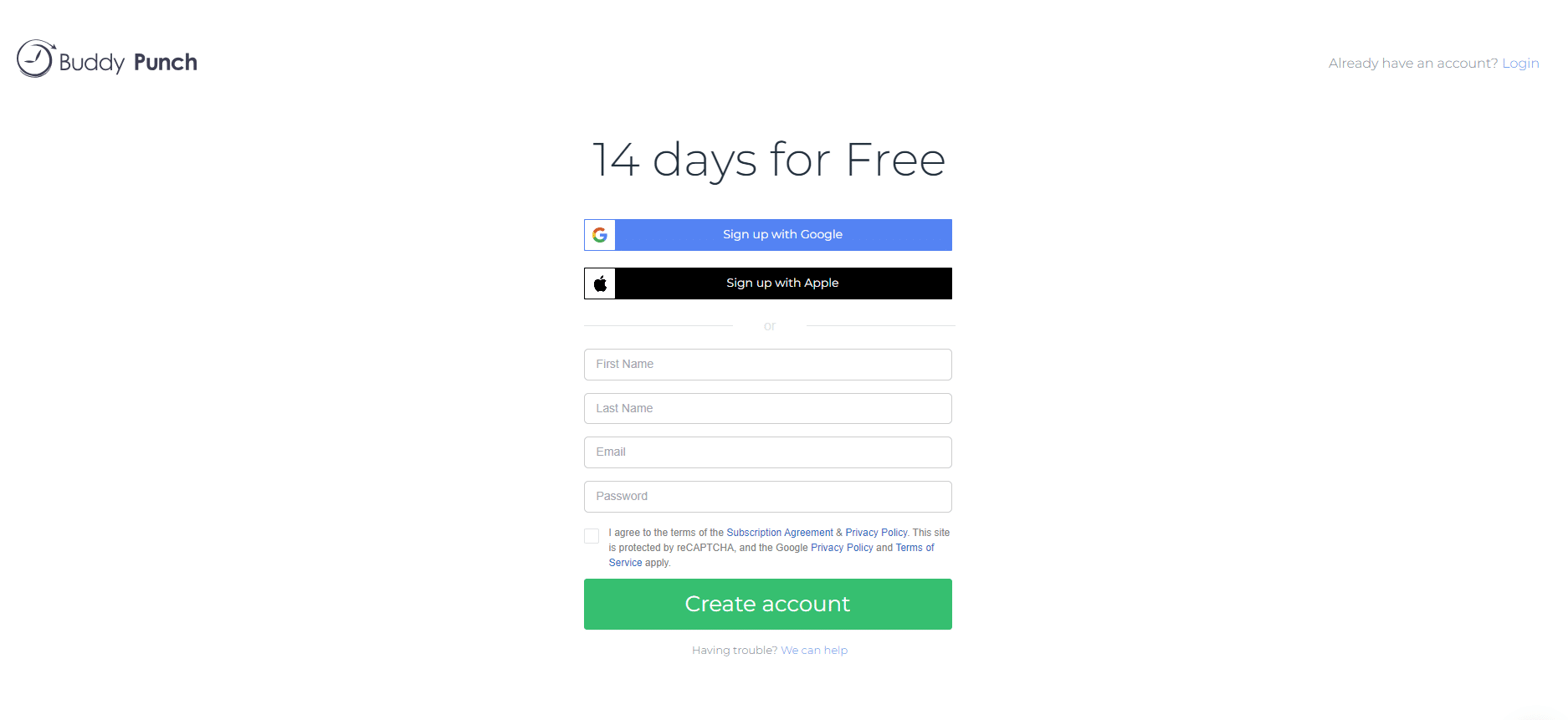
Buddy Punch offers a 14-day free trial with no credit card required. You can create your account with your Apple or Google account, or by entering your name and email address and assigning a password.

Buddy Punch asks whether you want to create a new organization for your business or join an account made by your employer. After that you fill out an online form with your company name, time zone, and number of employees.

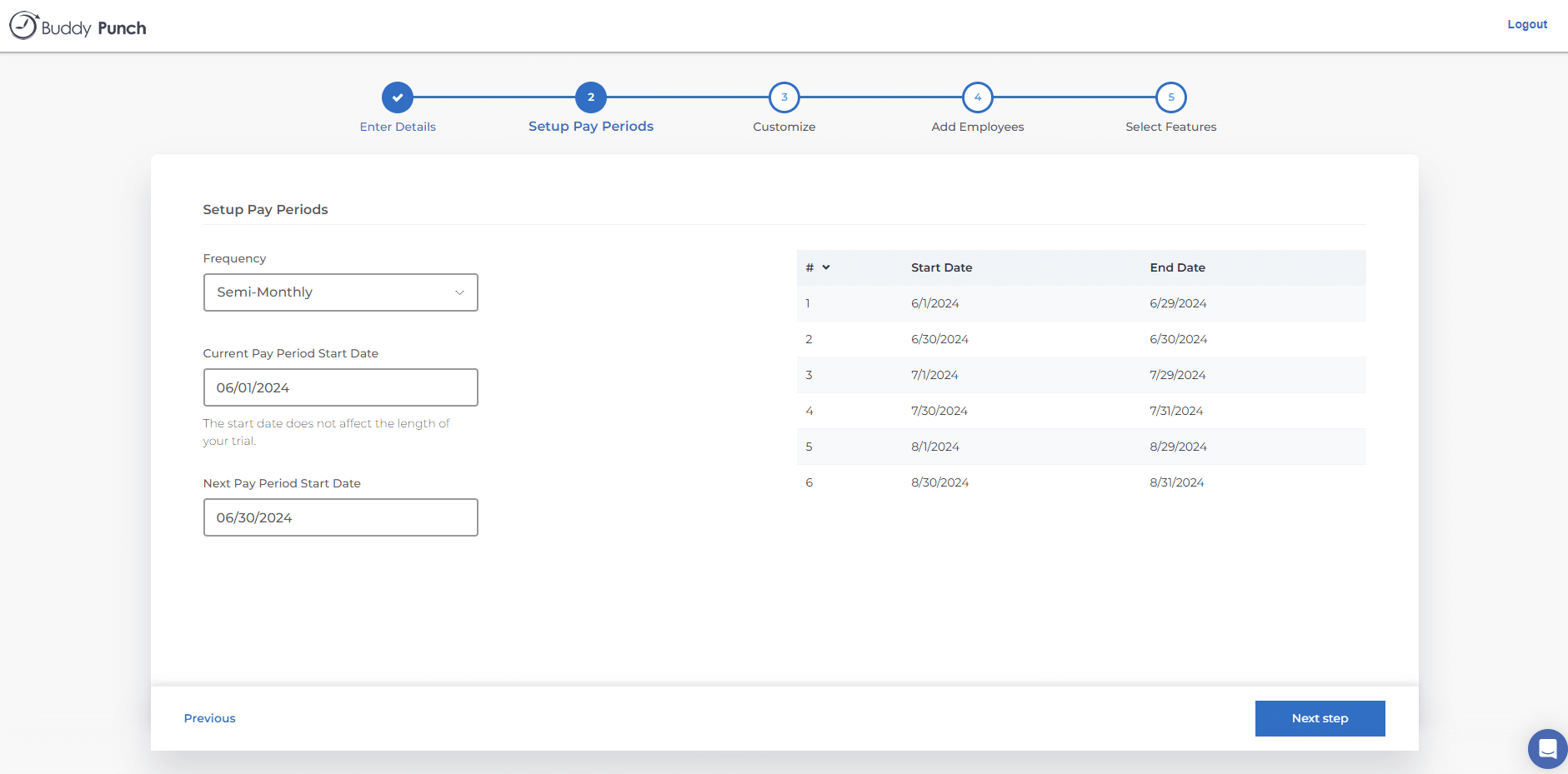
The next step is setting up pay periods. Choose a frequency from the dropdown (weekly, bi-weekly, semi-monthly, or monthly), then set the pay period start date. Once set, the pay schedule appears on the right side of the screen.

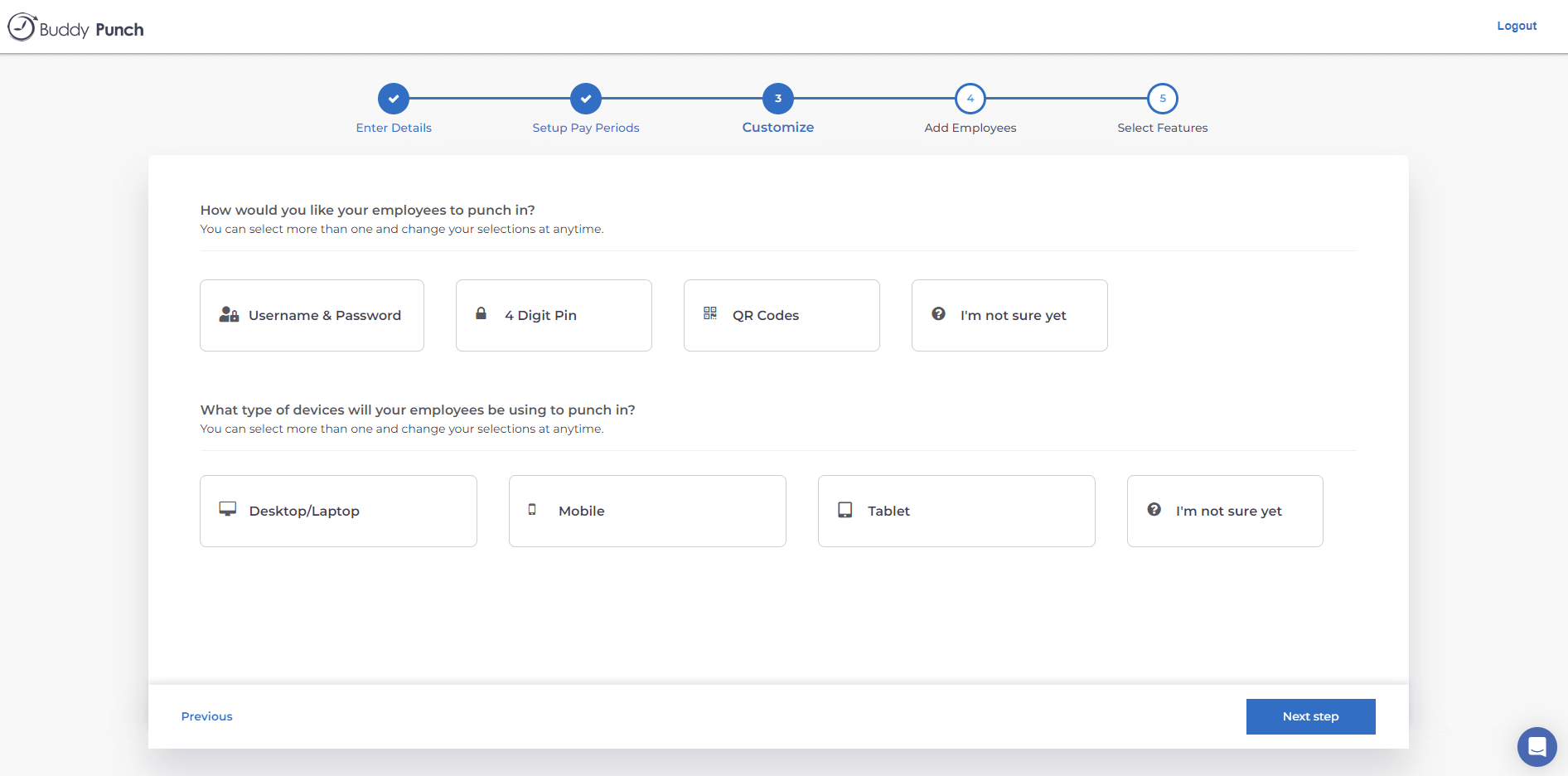
Then you select how employees punch in and on which devices: username and password, 4-digit PIN, or QR code, on desktop, mobile, or tablet. You can pick more than one. If you're unsure, click 'I'm not sure yet' and change it later.

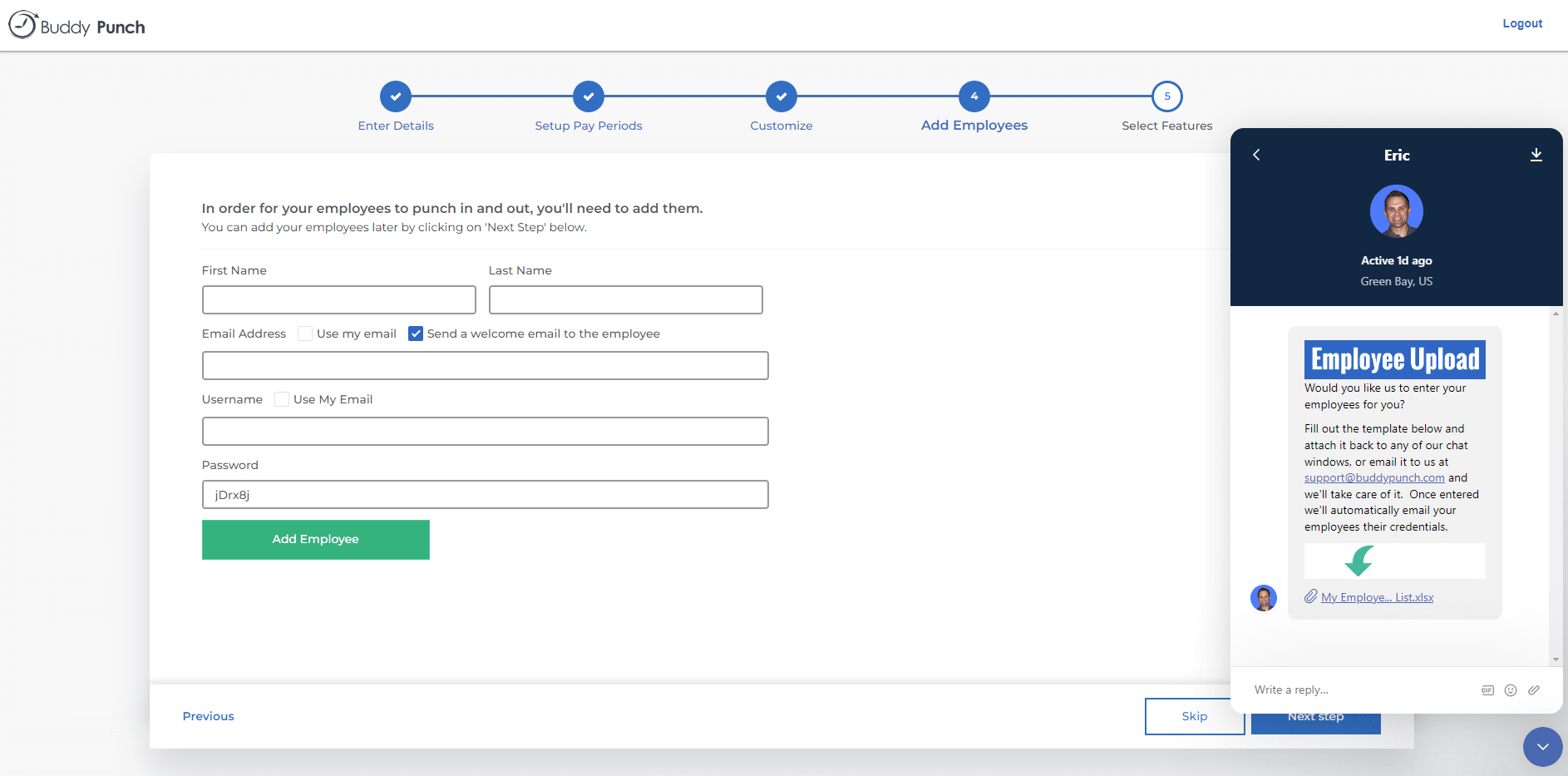
Next you add employee names and email addresses. You can tick a box to assign their email as username and send a welcome email, or skip and do it later.

You can also hand this step to Buddy Punch. A chat box appears with instructions to send the completed Employee Upload template, and they email your employees their login credentials.

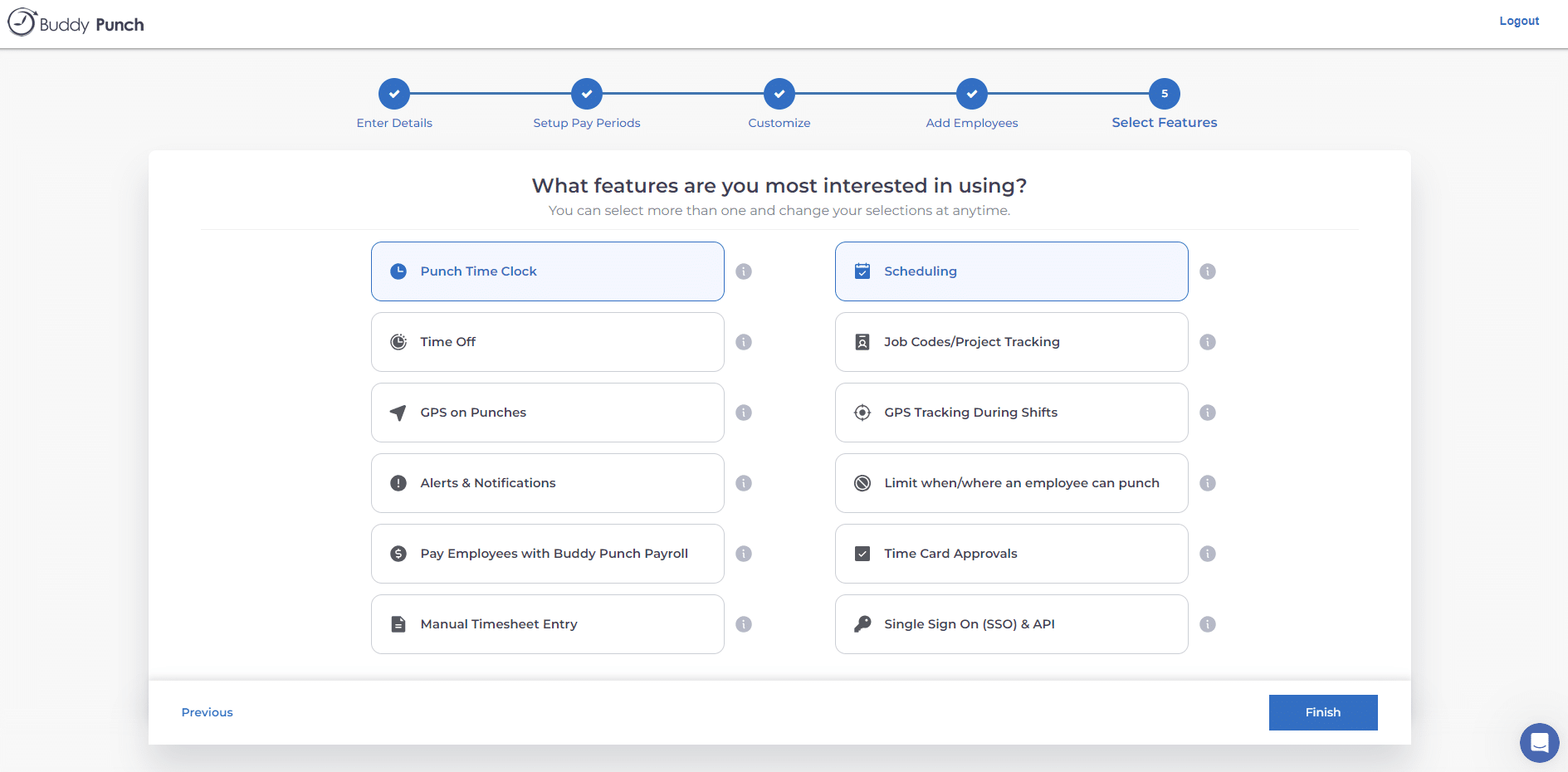
Last, you pick the features you want: punch time clock, scheduling, time off, job codes and project tracking, GPS on punches, GPS tracking during shifts, alerts, punch restrictions, payroll, time card approvals, manual timesheet entry, and single sign-on with API.

You can select more than one and change them anytime.

Before you reach the dashboard there are short tutorial videos on the core features and a welcome message you can reply to. We liked the quick, straightforward five-step process, and having Buddy Punch send employee credentials off the back of the upload template is a nice touch.

The web app experience

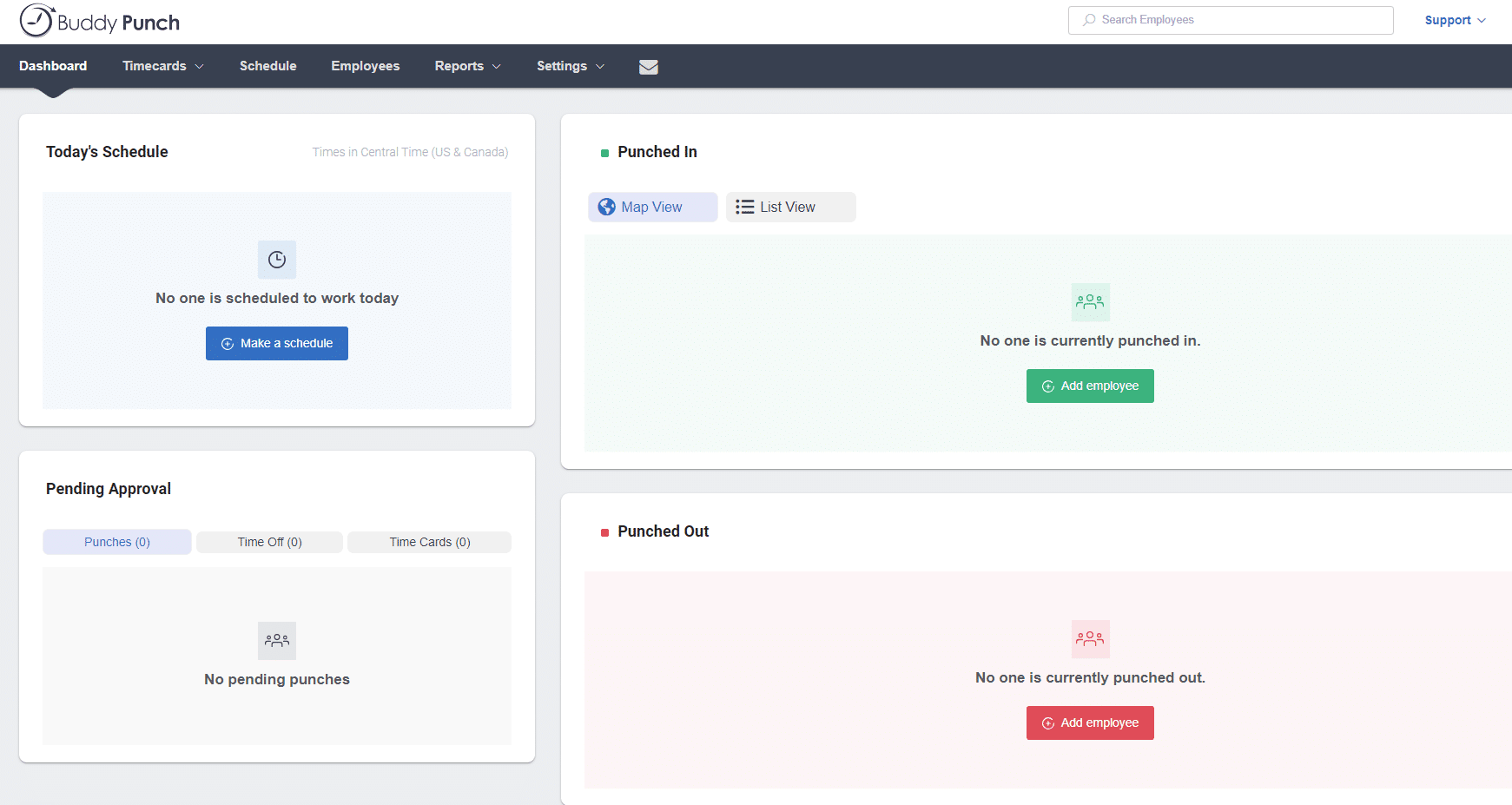
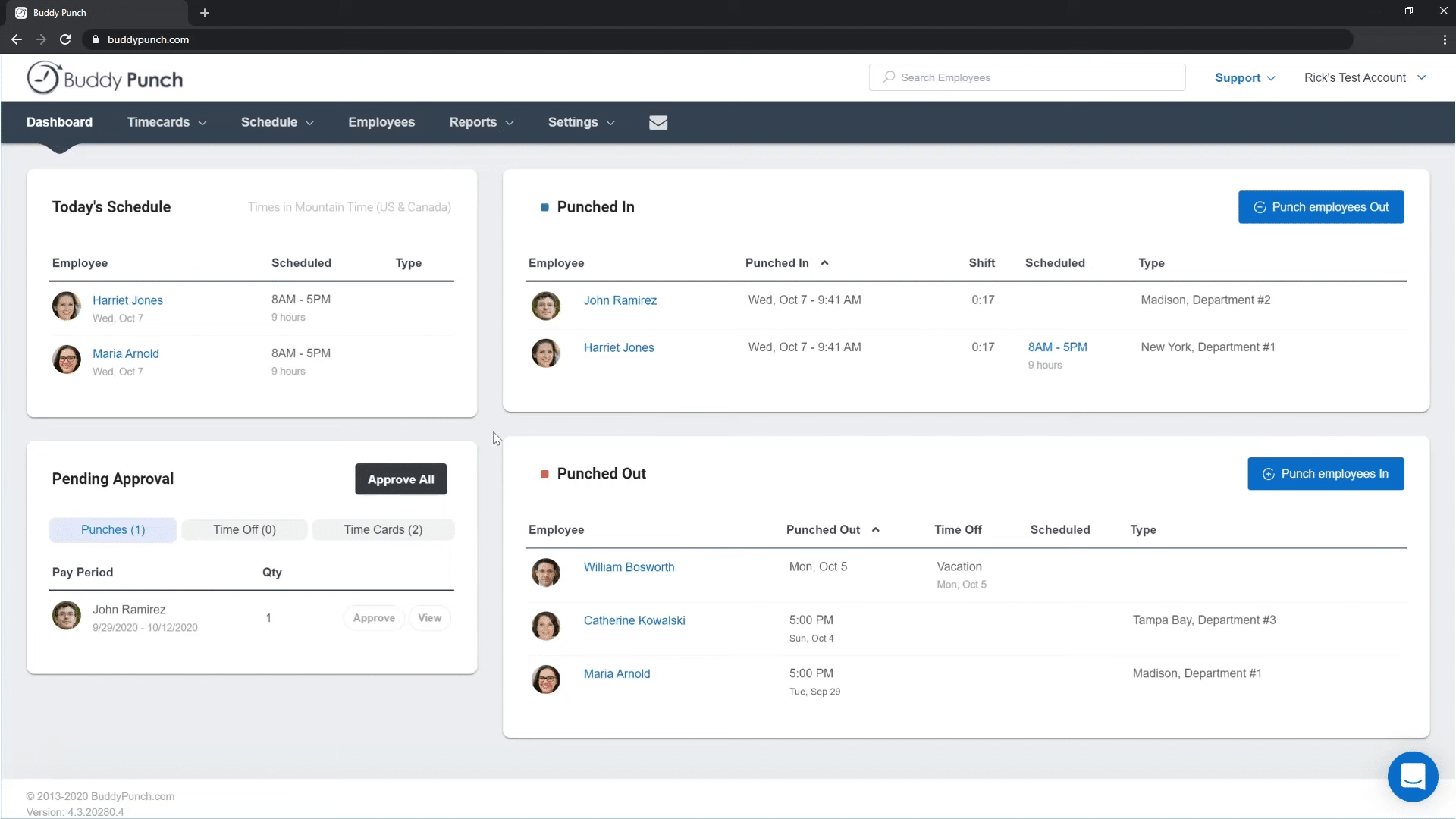
The web dashboard is straightforward. It is easy to follow, with the main time tracking data in the center and the other features discoverable from the menu tabs.

For a product whose whole pitch is simplicity, this is where that pays off. There is very little to configure before the thing is usable.

The mobile app experience

We noticed some minor lagging when scrolling or switching to new tabs. On the whole though the mobile dashboard has a clean, organized, minimalist look. The dashboard itself only displays today's schedule and which employees are in and out.

The mobile app also lets you view and approve time cards and time off, and build your team's schedules. It is a narrower version of the web app rather than a full match, which is a theme that recurs in the customer reviews we read.

Flexible clock-in and clock-out options

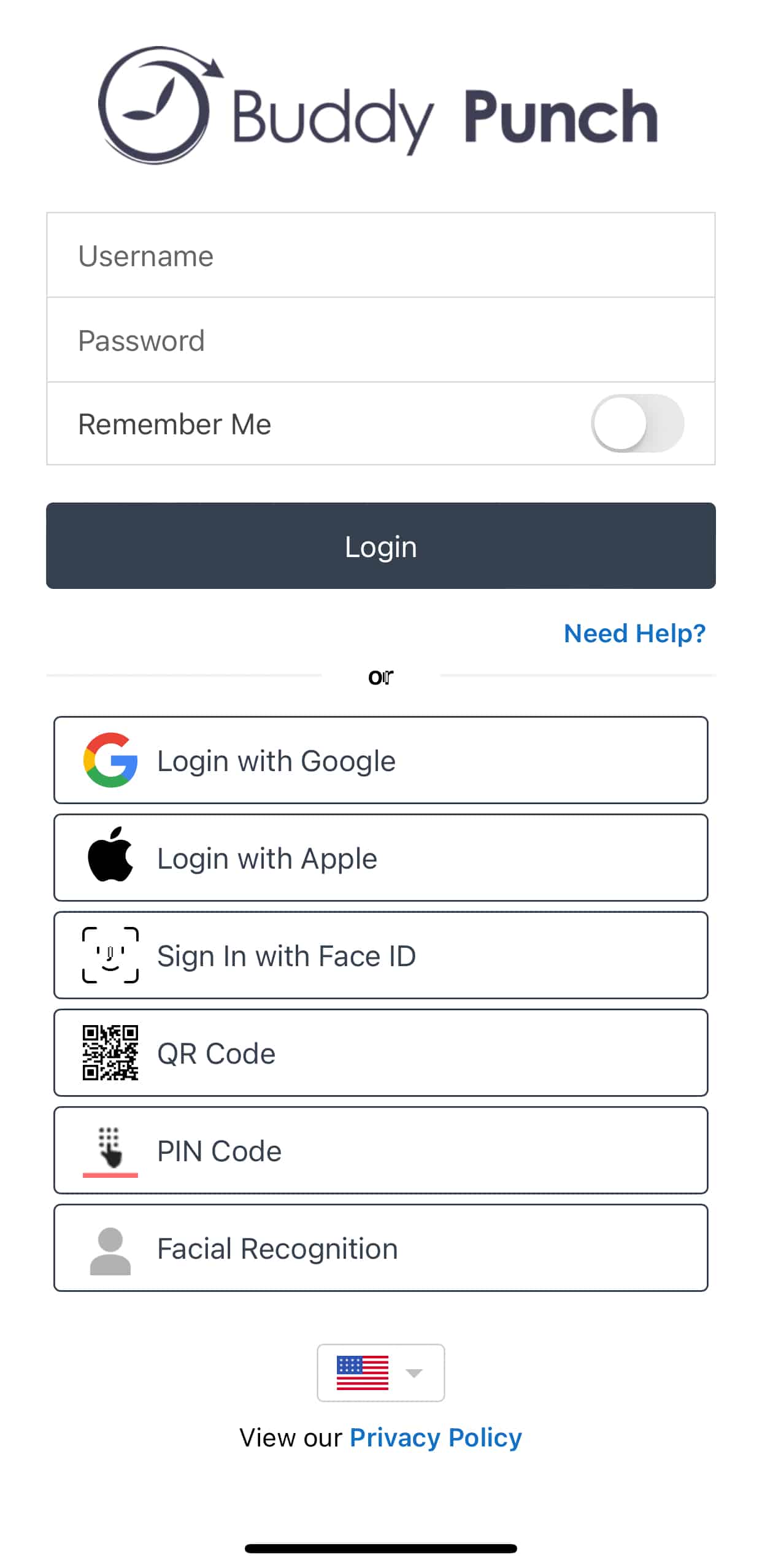
The app offers several ways to log in. Employees can use Google or Apple credentials, Face ID, a QR code, a PIN, or facial recognition.

Administrators enable the setting for a specific login method. For QR code login you send each employee their own unique code, which they save on their device.

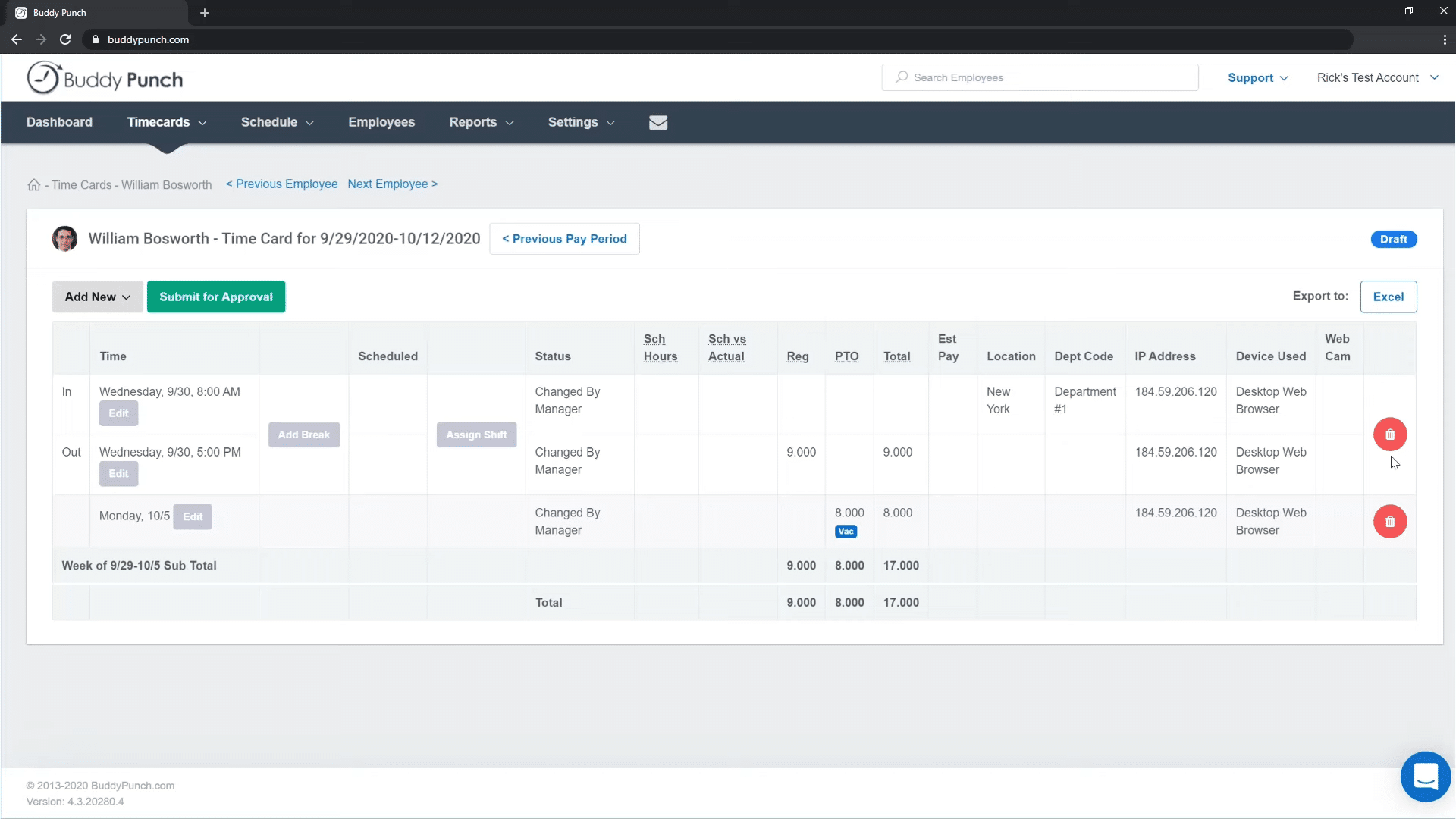
Whichever method the team uses, they log in at the start of the shift and out when it is over, then submit their time report to a manager for approval.

Facial recognition

Buddy Punch's standout feature is facial recognition for clock-ins, which makes it harder to bypass access controls. It is designed to help eliminate buddy punching, the kind of time fraud where one worker clocks in on behalf of another.

Workers scan their faces to punch in or out from the web or mobile app.

Using Face ID on an iPhone or iPad Pro, employees sign into Buddy Punch securely. This helps confirm the person clocking in is the person who is meant to be.

It removes the need for passwords or codes that get forgotten. The same goes for fingerprint scans, which do not always work for workers whose hands are dirty or wet, a real consideration in construction and kitchen work.

Worth knowing before you rely on it: across the 812 customer reviews we read, camera and photo requirements came up 12 times as a friction point, with workers describing permission prompts on every login and the photo step slowing down the punch.

Scheduling

Drag-and-drop functionality lets you build a staff schedule in minutes, on web or mobile. Once it is done you can push notifications to employees about upcoming shifts, and adjustments take a few clicks.

Two things to check against your own operation. Scheduling is a paid add-on at $1 per user per month, included from the Pro tier up rather than in the base plan.

And in our conversations, scheduling depth was where contractors pushed back hardest. One specialty contractor said flatly that "the schedule sucked completely."

Payroll

Payroll is easier when it is wired into the time tracker. Buddy Punch offers automatic payroll tax filings and payments, which saves time on complex deposits and calculations.

You review employees' hours and time off from the payroll dashboard, then sync employee time and submit it with a quick import.

Buddy Punch Payroll is a separate module at $8 per user per month plus a $49 base fee, on top of your plan. If you would rather keep your existing payroll provider, the integration route is covered below.

Integrations

Buddy Punch connects with Zapier, QuickBooks timesheets, ADP, Gusto, Paychex, Paylocity, PayPlus Software, SurePayroll, and Workday. Through Zapier it can be configured to reach a much wider set of apps.

The list is genuinely broad for a tool at this price, and it covers the payroll systems most small contractors already run. Their integrations page also lists Deltek and ViewPoint on the construction side. What is missing is Sage, Foundation, and Procore, so if your job costing lives in one of those, the data has to leave the system another way.

One reliability note from our conversations. An engineering contractor reported a defect where the QuickBooks sync corrupted vacation balances, was told to correct it by hand each cycle, and ended their evaluation over it.

Buddy Punch pricing

How much does Buddy Punch cost? Three tiers on a $19 monthly base, plus an add-on menu that matters more than the headline rate. Here's the actual math.

Starter
$4.99/user/mo + $19/month base

Plan features:

  • Free admin users
  • GPS on punches
  • Mobile apps and time tracking
  • Paid time off (PTO) tracking
  • Job tracking and alerts
  • Payroll integrations and reporting
Pro
$6.99/user/mo + $19/month base

Plan features:

  • Everything in Starter
  • Basic geofencing
  • QR code scanning and kiosk punch
  • Webcam on punches
  • Break compliance
  • API access
  • Scheduling add-on included
Advanced
$12.99/user/mo + $19/month base

Plan features:

  • Everything in Pro
  • Real-Time GPS add-on included
  • Advanced reporting
  • Single sign-on (SSO) via Okta, OneLogin, SAML 2.0
  • Manager permissions
  • Dedicated support and priority onboarding
Add-ons
$1–$4/user/mo + $0 base

Plan features:

  • Real-Time GPS at $2/user/mo
  • Scheduling at $1/user/mo
  • Onboarding, offboarding and tasks at $4/user/mo
  • Data retention at $2/user/mo
  • Buddy Punch Payroll at $8/user/mo plus a $49 base

What it actually costs at scale

Compare Buddy Punch's Starter tier against Workyard pricing across three common crew sizes. Buddy Punch figures use the $4.99 annual rate plus the $19 base. Real-Time GPS, scheduling, and payroll are extra.

15 employees
Buddy Punch
Starter plan
$94/mo ($1,128/yr)
Workyard
Starter plan
$140/mo ($1,680/yr)
100 employees
Buddy Punch
Starter plan
$518/mo ($6,216/yr)
Workyard
Starter plan
$650/mo ($7,800/yr)
300 employees
Buddy Punch
Starter plan
$1,516/mo ($18,192/yr)
Workyard
Starter plan
$1,850/mo ($22,200/yr)

Buddy Punch is the cheapest tool in this category and it stays cheapest as you grow. Three contractors named price as the reason it made their shortlist. Read the add-on menu closely. Live GPS at $2 per user and scheduling at $1 put a 100-person crew at $818 a month on Starter, not $518.

Pricing verified July 28, 2026. Visit the Buddy Punch website for current pricing.

What contractors say about Buddy Punch

Buddy Punch reviews well, and it is worth saying so plainly: 4.9 on the App Store across 706 ratings, 4.8 on G2 across 388, 4.8 on Capterra across 1,124 with 97% positive sentiment. To find what sits underneath that, we read all 812 G2 and Capterra reviews line by line.

Capterra
4.8
1,124 reviews
G2
4.8
388 reviews
iOS App Store
4.9
706 ratings
Google Play
4.4
415 reviews

Star rating figures captured as of August 3, 2026.

From G2 and Capterra we read every one of the 812 reviews individually rather than keyword-matching, then clustered them into recurring strength and weakness themes and scored each by how often it came up.

The headline ratings are genuinely strong and we are not going to argue with them. On G2, 361 of 388 reviews are five stars. What a star average cannot show you is which complaints repeat, and that is what the themes below are for.

Two findings stood out. There is no privacy backlash in this data. Where GPS comes up negatively it is about errors blocking a legitimate punch, not about being tracked.

The field rates it about as highly as the office does. Capterra's base is around 60% workers and scores it in line with manager-dominant G2.

What’s working
Two-tap clock-in, the most-mentioned theme (145 reviews)
Works on phone or desktop without thinking about it (89 reviews)
Support responsiveness (32 reviews)
What’s not
GPS errors rejecting legitimate punches (18 reviews)
Reports that cannot be customized without exporting to Excel (15 reviews)
Time-off request workflow, with no edits after submission (14 reviews)

Real Buddy Punch user reviews

We sourced verified quotes directly from the reviews, so nothing on this page is paraphrased or generalized. The result is a side-by-side view of what is working well for Buddy Punch and what doesn't.

@G2 reviewer, G2 · ★★★★★

I like how fast, easy, and simple it is to use. I don't have to click through multiple screens just to get to a punch in/out.

@G2 reviewer, G2 · ★★★★★

Sometimes I get kicked back due to GPS error even though my GPS is on.

How Buddy Punch compares to Workyard

Where Buddy Punch wins, where Workyard wins, and what that means for your crew. Scored across the 10 dimensions that came up most in 24 real conversations, then checked against our feature comparison.

Feature Buddy Punch Workyard
GPS breadcrumb trail Real-Time GPS is a $2/user add-on, included at Advanced; contractors report no path history on base plans Continuous breadcrumb trail with full route history per worker, per shift
Automatic project assignment Geofence-mapped codes filter the list and auto-fill where a site has one code; otherwise workers pick at every switch GPS assigns the job and cost code with no worker input
Ease of clock-in & adoption Two-tap punch, the single most-praised theme across 812 reviews (145 mentions) Simple punch, plus automatic capture on site arrival
Job costing reports Job cost reports and budget-versus-actual reporting both documented Auto-allocated labor costs by job and cost code; no budget-versus-actual
Auto clock-in on arrival Radius geofences restrict where you can punch; the punch is still manual Polygon geofences with automatic clock-in when a worker arrives
Field documentation & safety Time clock only; no safety checklists, incident reports, or field forms Forms and checklists triggered at clock-in or on geofence arrival
Price per user $4.99–$12.99/user plus a $19 base; cheaper than Workyard at every crew size $50 + $6/user (Starter annual); volume discounts at 50+ users
Offline punching Not confirmed either way in Buddy Punch's documentation; contractors report punches failing out of service Punches store on the phone in dead zones and sync on reconnect
Facial recognition at clock-in Face ID on iPhone and iPad, confirmed in our own testing Clock-in photo verification; facial recognition not confirmed in our comparison
Payroll sync reliability Broad payroll integration list; contractors reported a QuickBooks vacation-balance defect Two-way sync across QuickBooks, ADP, Gusto, Sage and 20+ systems

See how Workyard pricing compares

What are the key areas you should test in Buddy Punch?

Four areas where Buddy Punch's own description and what contractors reported to us pull in different directions. Each one is testable inside the 14-day trial.

The GPS location record

How Buddy Punch positions it

Buddy Punch captures a worker's location when they clock in and out and attaches it to the timesheet. A paid real-time add-on extends that to a live map, route histories, and location audit logs across the workday.

Testing approach

The punch-level capture works as described. What contractors kept raising is the space between punches. Six of our 24 conversations said they lose sight of a crew once it leaves the first site. Continuous tracking sits behind the paid add-on, so run a full day on it before you price the base plan.

The question that matters

Can you show a client where the crew was between punches?

Job codes and job costing

How Buddy Punch positions it

Workers select the appropriate job code when they clock in. Job codes can be mapped to a geofence, which filters the list to that site's codes and auto-fills the code when only one is mapped. Reports then compare actual hours and costs against your estimates, broken down by person, task, or project.

Testing approach

Those reports exist and they do compare actual against estimate. The geofence mapping is real, but it only auto-fills where a site has exactly one code, and it rides on the geofence tiers rather than the base plan. Four contractors told us tagging stayed manual in practice, so hours land on the wrong code when someone forgets to switch. Fifteen reviews wanted an Excel export before the reporting answered a real question.

The question that matters

Are the hours behind your job costs tagged correctly in the first place?

Geofences and clock-in

How Buddy Punch positions it

Geofences are circles sized from 50 to 1,500 meters. Buddy Punch checks a worker's location at the punch and blocks it with an on-screen message when they are outside the circle they were assigned. Alerts can fire when someone enters or exits a zone, on Enterprise or with the Real-Time GPS add-on.

Testing approach

Blocking off-site punches works. The circle is the constraint. It can't follow an irregular site, and 18 reviews cite GPS errors rejecting valid punches. The punch also stays manual, which is why three contractors asked about automatic detection on arrival. Size a geofence on your worst site first.

The question that matters

How much slack does the circle need before real punches stop failing?

Punching without a signal

How Buddy Punch positions it

Buddy Punch describes itself as working on any internet-connected device, across Windows, Mac, Linux, iOS, Android, and Chromebook. Its pages do not say what happens when a crew has no connection, but it does sell Text to Punch, an SMS clock-in for workers without the app or internet, alongside Group Punch.

Testing approach

Offline capture itself is documented nowhere either way, which is why we would test it first. Text to Punch covers a dead zone only where there is still cell signal, and their docs note GPS coordinates do not appear until a stable connection returns. Two contractors told us punches failed outright out of service. Put a phone in airplane mode, punch in and out, restore signal, then check which time lands: the punch, or the reconnect.

The question that matters

Does a punch made in a dead zone arrive with the right time on it?

Buddy Punch alternatives you should evaluate

If Buddy Punch's gaps are dealbreakers for your operation, here are the alternatives we'd recommend evaluating, based on which specific pain points matter most to you.

Workyard Try free

We put payroll, job costing, and compliance on autopilot.

Best for

Construction teams (15–500) whose crews move between job sites and whose office is correcting job codes every week.

What it solves that Buddy Punch doesn’t
  • GPS breadcrumb trail with full route history
  • Job and cost code assigned automatically from location
  • Automatic clock-in when a crew arrives on site
  • Punches that save offline and sync when signal returns
Honest tradeoff

More expensive than Buddy Punch at every crew size, with a $50 monthly base and no free tier. No budget-versus-actual reporting, and no built-in payroll. Workyard feeds your existing payroll system instead.

Best for

Small crews (5–25) that want simple time tracking with a strong QuickBooks sync.

Tradeoff

No prevailing wage support, interval-based GPS rather than a continuous trail, and reporting depth complaints as teams grow.

Best for

Contractors who want native job costing and materials tracking, with a free basic tier to start on.

Tradeoff

Field crews rate the app 2.57 on iOS. Circle-only geofences and manual project tagging draw the same complaints Buddy Punch does.

Buddy Punch FAQs

Questions we hear from contractors evaluating Buddy Punch every week.

How much does Buddy Punch cost?

Three tiers on a $19 monthly base: Starter at $4.99 per user, Pro at $6.99, and Advanced at $12.99, billed annually.

Add-ons sit on top. Real-Time GPS is $2 per user, scheduling $1, onboarding and tasks $4, and Buddy Punch Payroll $8 per user plus a $49 base. No setup fee, no contract, 14-day trial. Pricing checked July 28, 2026.

How much does Buddy Punch cost for a 30-person crew?

On Starter, 30 workers run about $169 per month ($19 plus 30 × $4.99), or roughly $2,024 per year. Add the Real-Time GPS add-on and scheduling and it is about $259.

Buddy Punch stays cheaper than Workyard at that headcount either way, which is worth weighing honestly against what it does not automate.

Does Buddy Punch have job costing?

Yes, more than its reputation in our conversations suggests. Job codes ship on every tier, and job cost reports and budget-versus-actual reporting are both documented. The latter is something Workyard does not offer.

What four contractors described missing is automatic allocation. Workers pick the job by hand at each switch, so hours land on the wrong code until someone fixes them. Test the tagging, not the reports.

Does Buddy Punch track GPS for the whole shift?

Only if you pay for it. Buddy Punch sells Real-Time GPS as a $2 per user add-on, included at the Advanced tier. Base plans capture GPS on the punch itself.

That gap explains what six contractors described. One general contractor put it as "the moment we move we don't know where they at." Check which tier your quote assumes before comparing it to anything else.

Does Buddy Punch work offline?

We could not confirm it. Buddy Punch's public documentation does not state either way, and our feature comparison marks it unclear rather than absent.

Two contractors reported crews being unable to punch out of cell service, with one describing time punches "disappearing into thin air." If your crews work dead zones, test it in airplane mode during the trial.

Does Buddy Punch integrate with QuickBooks?

Yes, along with ADP, Gusto, Paychex, Rippling, Viewpoint Spectrum, and Deltek ComputerEase. The integration list is genuinely broad for a tool at this price.

The friction contractors described is reliability. One engineering contractor reported a defect corrupting vacation balances on sync, was told to fix it manually, and ended their evaluation over it.

Can Buddy Punch handle prevailing wage?

Our feature comparison marks prevailing wage tracking as present on the Buddy Punch side, with project-specific rate setup, alongside weighted overtime and Fair Labor Standards Act (FLSA) calculations. Certified payroll and Davis-Bacon reporting are marked absent.

None of our 24 conversations tested any of it, so ask for a demonstration before committing government work to it.

What are the biggest complaints about Buddy Punch?

In 24 research calls: no location trail between punches (6 companies), labor tagged to jobs by hand (4), and no automatic clock-in on arrival (3).

Across 812 reviews the picture shifts to daily friction. GPS errors rejecting valid punches (18), reports that cannot be customized (15), and the time-off request workflow (14). Notably, almost nobody complains about being tracked.

Is Buddy Punch good for construction?

It depends how much construction work your software has to do. For attendance on a single site it holds up well, and it is the cheapest way to get there.

For crews moving between jobs, contractors told us the manual job tagging and the thin location record create weekly cleanup. Buddy Punch markets itself as an affordable time clock rather than construction software, and the feature set reflects that.

Is Buddy Punch better than Workyard?

Honestly, it depends. Buddy Punch wins on price at every crew size, on a two-tap punch crews learn instantly, on budget-versus-actual reporting, and on facial recognition we confirmed in testing.

Workyard wins on the GPS breadcrumb trail, automatic job and cost code assignment, auto clock-in on arrival, offline capture, and field documentation.

Disclosure: we compete with Buddy Punch.