



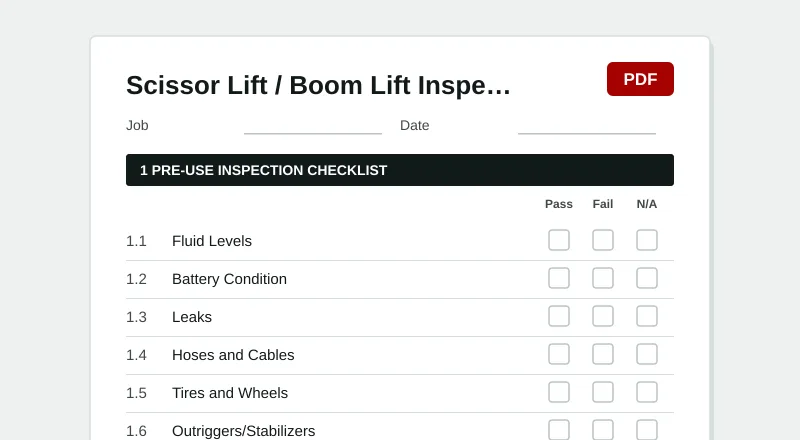
A scissor lift inspection form is the pre-use check an operator runs before taking a lift up for the shift. It records the lift's condition, the results of a powered function test and a clear call at the end: safe to operate, or do not use. The same form covers boom lifts (articulating and telescopic), vertical mast lifts and telehandlers, so a crew with a mixed fleet needs only one sheet.
What goes on a scissor lift inspection form
The form follows the order an operator actually works in: identify the machine, look it over with the power off, then power up and test every function.
General information
Job site, lift type, lift ID or asset number, make and model, serial number and the hour meter reading. The hour reading matters more than it looks. It ties the daily check to the service schedule and shows when the next mechanic's inspection is coming due.
Visual inspection, before powering on
Each item is marked Pass, Fail or NA:
- fluid levels, battery condition and leaks
- hoses and cables
- tires and wheels
- outriggers and stabilizers
- structural damage and loose or missing parts
- forks and attachments
- platform and guardrails
- safety decals and placards, and the operator's manual on board
- fall protection: harness, lanyard and platform anchorage (boom lifts)
- work area hazards: drop-offs, holes, slopes and overhead power lines
Functional tests, power on
Engine or power on, ground controls, platform controls, emergency stop, emergency descent, horn and alarms, the level or tilt sensor, drive, steering, brakes and the lift or boom itself. Test emergency descent every time. It is the function nobody uses until the day they need it.
Photos and sign-off
Attach photos of any damage, choose PASS (safe to operate) or FAIL (do not use), and the inspector signs and dates the form. A lift marked FAIL stays parked and tagged until it is repaired and checked again.
Daily checks and the scissor lift annual inspection form
Aerial lifts get inspected at different levels, and it helps to keep them straight:
| Inspection | Who does it | What it covers |
|---|---|---|
| Pre-use (this form) | The trained operator | Visual walkaround, function test and work area, before each shift |
| Frequent | A qualified mechanic | A deeper service inspection on the manufacturer's schedule |
| Annual | A qualified mechanic | A full inspection of the machine, recorded on a separate form |
The template here is the pre-use check, not a scissor lift annual inspection form. The annual is usually done by the owner's mechanic or the rental company on their own paperwork. File that record with the daily forms for the same lift, and check the manufacturer's manual and the current ANSI and OSHA rules for the intervals that apply to your machines.
Keeping a log for each lift
Daily forms are most useful when you can pull them up by machine. Use the lift ID or asset number the same way every time, and the forms for one lift become its tracking sheet: who checked it, which day, the hour meter and every item that failed. A tilt alarm that fails three days in a row shows up in that log long before it shows up in an incident report.
For rented lifts, a completed form on the day of delivery also records the condition the machine arrived in.
Get the free scissor lift inspection form
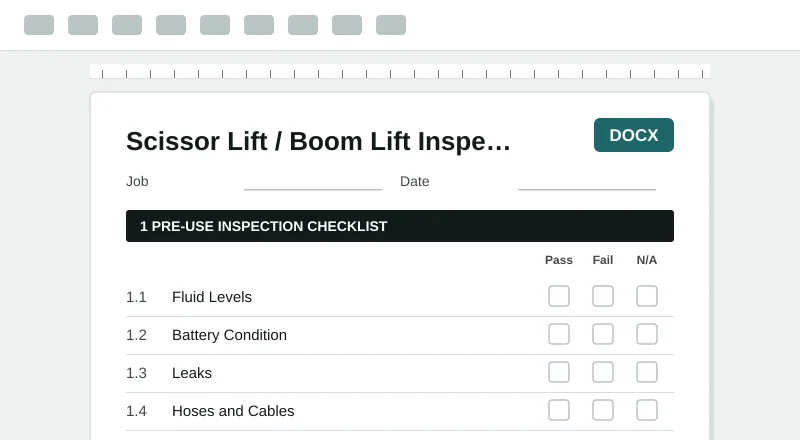
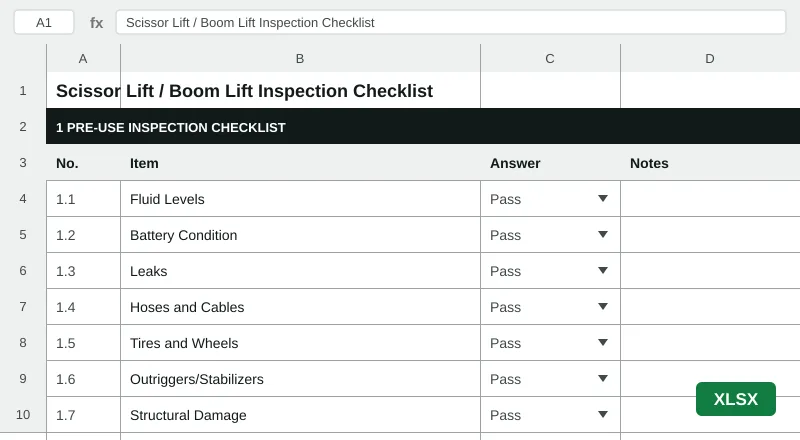
Download the form as a PDF to keep in the platform box, or as a Word or Excel file to add your own fleet details. It's free, with no sign-up. With Workyard, operators fill in the same form on their phones on the job, add photos of any damage, sign on screen, and a FAIL goes straight to the named supervisor. Every form is filed to the job and can be exported as a PDF or CSV. See equipment inspections in Workyard, the boom lift inspection checklist and more equipment pre-start checks.


