Confirm safe use of lifts and ladders per OSHA 1926.453 (aerial lifts) and 1926.1053 (ladders).
Control Function Test: All controls tested and working.YesNo
Brakes & Mobility: Drive and brakes functional.YesNo
Load Capacity Labels: Load chart present and readable.YesNo
Safety Devices: Alarms, fall arrest anchor present.YesNo
Fluid Leaks: No visible fluid leaks.YesNo
Ladder Setup: Extends 3 ft above landing, secured, rungs sound.YesNo
Comments
Enter text
General Information
Jobsite / Location
Enter text
Inspection Type
Select an option
Weather Conditions
Select an option
Comments
Enter text
Final Sign-Off
Confirm inspection outcome and record inspector credentials.
All Systems Passed: No equipment failed inspection.YesNo
Deficiencies Noted: Issues found and documented.YesNo
Equipment Tagged Out: Defective items removed from use.YesNo
Inspector Name
Enter text
Date of Inspection
Select a date
Inspector Signature
Sign here
Upload Photo
Submit
Scroll through the form
The template
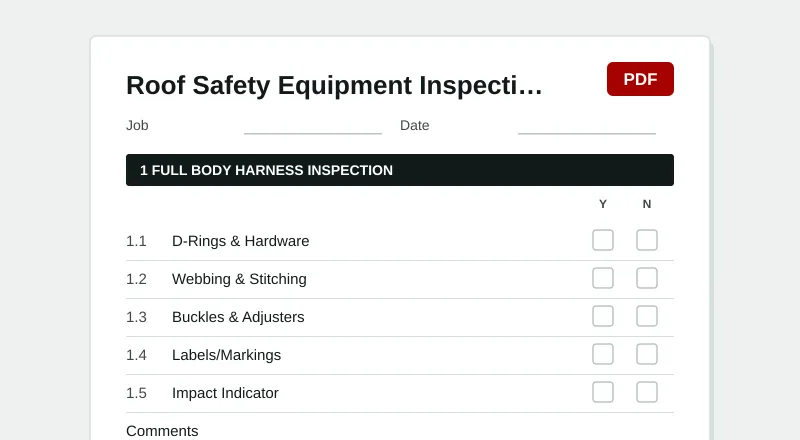
The full Roof Safety Equipment Inspection
Print it for the clipboard, or put it on your crew’s phones. Same 34 checks either way.
Your logo
Roof Safety Equipment Inspection
A Roof Safety Equipment Inspection form ensures that harnesses, lanyards, anchor points, and guardrails are functional and safe before work at height begins. Use this checklist to protect workers from fall hazards, comply with safety regulations, and reduce liability.
Job
Date
1 · Full Body Harness Inspection
1 · Full Body Harness Inspection
Y
N
1.1
D-Rings & Hardware: No deformation, corrosion, or cracks.
1.2
Webbing & Stitching: No frays, cuts, or pulled threads.
1.3
Buckles & Adjusters: Lock properly and not bent.
1.4
Labels/Markings: Tags present and legible.
1.5
Impact Indicator: Not deployed or damaged.
Comments
2 · Lanyards & Lifelines
2 · Lanyards & Lifelines
Y
N
2.1
Snap Hooks: Auto-locking, undamaged, and corrosion-free.
2.2
Lanyard Webbing/Line: No abrasion, UV damage, or fraying.
2.3
Shock Absorber: Not deployed; intact stitching.
2.4
Energy Absorber Label: Tag present and current.
2.5
Lifeline Rope/Cable: No kinks, cuts, or corrosion.
Comments
3 · Self-Retracting Lifelines (SRLs)
3 · Self-Retracting Lifelines (SRLs)
Y
N
3.1
Housing Condition: No cracks, dents, or missing labels.
3.2
Lifeline Condition: No damage or slow retraction.
3.3
Snap Hook & Swivel: Secure, functional, no binding.
3.4
Impact Indicator: Not tripped or deployed.
3.5
Brake Function Test: Locks under sharp pull.
Comments
4 · Anchors & Anchorage Connectors
4 · Anchors & Anchorage Connectors
Y
N
4.1
Permanent Anchor Condition: Secure, no corrosion or deformation.
4.2
Temporary Anchor Straps: No damage; correctly attached.
4.3
Anchor Hardware: Intact, tight, not bent or cracked.
4.4
Structural Attachment: Attached to solid surface; no damage.
4.5
Horizontal Lifeline System: Cable and anchors secure.
Comments
5 · Guardrails & Barriers
5 · Guardrails & Barriers
Y
N
5.1
Top Rail: Proper height and strength.
5.2
Midrail/Toeboard: Installed and secure.
5.3
Post Attachment: Secure at base with no movement.
5.4
Rail Surface: Smooth; no sharp edges.
5.5
Openings/Gates: Gaps protected; gates working.
Comments
6 · Lifts / Roof Access Equipment
6 · Lifts / Roof Access Equipment
Y
N
6.1
Control Function Test: All controls tested and working.
6.2
Brakes & Mobility: Drive and brakes functional.
6.3
Load Capacity Labels: Load chart present and readable.
6.4
Safety Devices: Alarms, fall arrest anchor present.
6.5
Fluid Leaks: No visible fluid leaks.
6.6
Ladder Setup: Extends 3 ft above landing, secured, rungs sound.
Comments
7 · General Information
Jobsite / Location
Inspection TypeDailyWeeklyPre-Use
Weather ConditionsClearWindyWetOther
Comments
8 · Final Sign-Off
8 · Final Sign-Off
Y
N
8.1
All Systems Passed: No equipment failed inspection.
8.2
Deficiencies Noted: Issues found and documented.
8.3
Equipment Tagged Out: Defective items removed from use.
Inspector Name
Date of Inspection
Name
Signature
Date
Upload Photo · photo refs
Roof Safety Equipment Inspection on a phone
Roof Safety Equipment Inspection
Job *
26-104 Riverside DuplexesSelect a job
Oct 14, 8:12 AM26-104 Riverside Duplexes
Full Body Harness Inspection
Inspect harness components for damage, per OSHA 1926.502(d)(21) and ANSI/ASSP Z359.11.
D-Rings & Hardware: No deformation, corrosion, or cracks.YesNo
Webbing & Stitching: No frays, cuts, or pulled threads.YesNo
Buckles & Adjusters: Lock properly and not bent.YesNo
Labels/Markings: Tags present and legible.YesNo
Impact Indicator: Not deployed or damaged.YesNo
Comments
Enter text
Lanyards & Lifelines
Inspect lanyards and lifelines for integrity, per OSHA 1926.502 and ANSI Z359.13.
Snap Hooks: Auto-locking, undamaged, and corrosion-free.YesNo
Lanyard Webbing/Line: No abrasion, UV damage, or fraying.YesNo
Shock Absorber: Not deployed; intact stitching.YesNo
Energy Absorber Label: Tag present and current.YesNo
Lifeline Rope/Cable: No kinks, cuts, or corrosion.YesNo
Comments
Enter text
Self-Retracting Lifelines (SRLs)
Verify locking, retraction, and wear per ANSI Z359.14 and OSHA standards.
Housing Condition: No cracks, dents, or missing labels.YesNo
Lifeline Condition: No damage or slow retraction.YesNo
Snap Hook & Swivel: Secure, functional, no binding.YesNo
Impact Indicator: Not tripped or deployed.YesNo
Brake Function Test: Locks under sharp pull.YesNo
Comments
Enter text
Anchors & Anchorage Connectors
Inspect anchors for strength and securement per OSHA 1926.502(d)(15) and ANSI/ASSP Z359.18.
Permanent Anchor Condition: Secure, no corrosion or deformation.YesNo
Temporary Anchor Straps: No damage; correctly attached.YesNo
Anchor Hardware: Intact, tight, not bent or cracked.YesNo
Structural Attachment: Attached to solid surface; no damage.YesNo
Horizontal Lifeline System: Cable and anchors secure.YesNo
Comments
Enter text
Guardrails & Barriers
Inspect rail systems for strength, height, and continuity per OSHA 1926.502.
Top Rail: Proper height and strength.YesNo
Midrail/Toeboard: Installed and secure.YesNo
Post Attachment: Secure at base with no movement.YesNo
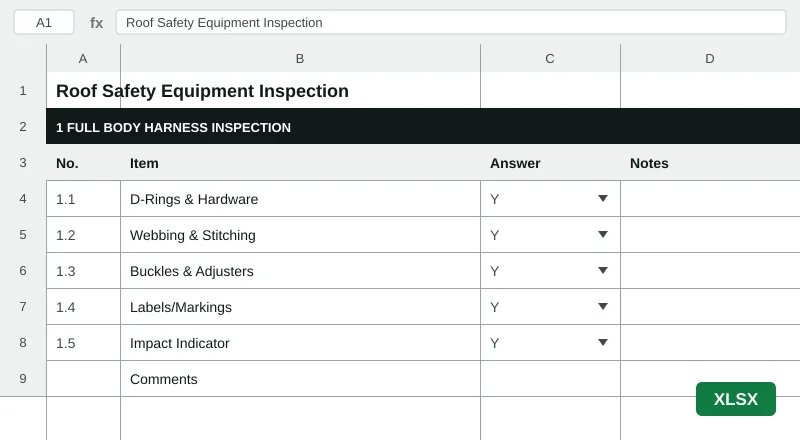
A spreadsheet with a dropdown for every answer, ready to fill in, sort and keep as a log.
Download Excel
How to use it
How to run the Roof Safety Equipment Inspection
01
Check it before the first start
Do it at the start of every shift, before the machine moves, with the operator who’ll run it.
02
Walk around, then test from the seat
Work through the 8 sections: fluids and the walk-around first, then controls, brakes and safety devices with it running.
03
A fail means it stays parked
Tag out anything that fails and report it to the shop or the super, with a photo. It doesn’t run until it’s fixed.
04
Sign it and keep it with the machine
The operator signs. Keep each day’s sheet with the machine, so the next operator and the inspector can see its history.
Why we built this
Most breakdowns give a warning first
A leak, a worn hose, brakes that feel soft. A few minutes at the start of the shift catches them before they cost a day of downtime, or someone’s safety.
Built for the field. Every check is written the way crews talk, with room for notes, photos and a signature.
Free, with no catch. No email, no account. Print it and hand it out.
On paper or on the phone. The same form runs on the Workyard app, filed to the job when it’s sent.
Workyard is the construction operations platform for specialty contractors and self-performing general contractors determined to grow without sacrificing job control or margins.
Forms like this one are what our customers’ crews fill in on Workyard every day, on the same app they clock in with.
workers on Workyard every day
100,000+
free templates, none of them gated
182
Forms & Workflows
Get every form back from every crew, every day
It shows up on its own. Attach it to a task, a job or clock-out, and it’s on the crew’s phone when it’s due.
It can’t be skipped. Make it required and the day can’t close until it’s in.
You see it the same day. Filed, flagged or missing, every job on one board, before anyone has to call.
7:02 AMToolbox talkMeridian Business ParkRay T. · 12 signaturesFiled to job
9:40 AMSite inspectionFairview Clinic · L2 eastDiego M. · 8 photosFiled to job
11:15 AMSite inspectionFairview Clinic · L2 westFirestop answered No at grid C-4Flagged · to the PM
2:14 PMPre-start checkMeridian Business ParkExcavator 3 · Dana C. · signedFiled to job
4:30 PMDaily logRiverside TowerDue at clock-outMissing
Fairview L2 west: firestop at C-4 answered No. Photo attached, PM notified at 11:15 AM. The ceiling stays open until it’s fixed, not a box ticked on a sheet in the truck.
More equipment pre-start checks templates
Free templates for the rest of the job
Fire Extinguisher Inspection Checklist
Physical Condition CheckYNN/A
No visible damage (dents, rust, corrosion)
Hose/nozzle is intact and unobstructed
Unit is clean (no dirt, grease, or leakage)
Labels and operating instructions are legible
Annual maintenance tag is current (within 12 months)
What equipment should be inspected for rooftop work?
All personal protective equipment (PPE) used for rooftop work should be thoroughly inspected, including harnesses, lanyards, lifelines, anchor points, and guardrails. Ensuring these items are in good condition is critical to preventing falls and maintaining a safe work environment.
How often should roof safety gear be checked?
Roof safety gear should be inspected before each use to identify any visible damage or wear. Additionally, comprehensive inspections should be conducted regularly as specified by the manufacturer’s guidelines to ensure ongoing compliance and safety.
Is documentation required for fall protection inspections?
Yes, maintaining inspection logs is essential, as these records provide proof of compliance with safety regulations and support any safety claims in the event of an incident. Proper documentation also helps track the condition and maintenance history of fall protection equipment.
Can damaged PPE be repaired for reuse?
No, damaged fall protection gear must be removed from service immediately and should never be repaired for reuse. Attempting to fix or reuse compromised equipment can lead to serious safety risks and is prohibited by safety standards.
Do I need a Workyard account to use it?
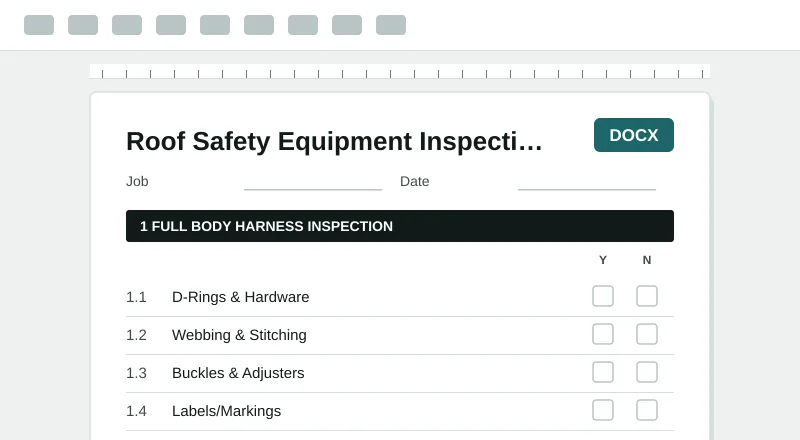
No. Print the paper form, save it as a PDF, or download the Word or Excel file, free, with no email and no sign-up. You only need an account to put the digital form on your crew’s phones.
Can I edit the template?
Yes. Download the Word or Excel version to add your logo, add checks from your project spec or remove sections you don’t need. They open in Google Docs and Google Sheets too.
How do I get my crew to fill it in on their phones?
Add the digital form to Workyard and attach it to the job or the task it belongs to. It shows up in the app your crew already clocks in with, and every form comes back signed, with its photos, filed to the job.