



A fire extinguisher inspection checklist is the short form someone fills in each month at every extinguisher: it's there, it's charged, it's undamaged, nothing is blocking it, and the tags are current. Contractors use it for extinguishers on job sites, in site trailers, on trucks and in the shop, and property teams use it for the buildings they manage.
Each completed form is one line in your fire extinguisher inspection log, the record that shows an inspector, insurer or GC that every unit was checked on time.
The four levels of fire extinguisher checks
The monthly look is only one of four checks an extinguisher needs over its life. The rest are done by a trained service technician.
| Check | How often | Who does it | What it covers |
|---|---|---|---|
| Visual inspection | Monthly | A trained person you assign | Present, accessible, charged, undamaged, pin and seal in place |
| Annual maintenance | Yearly | Qualified service technician | Full maintenance check, new dated tag |
| Six-year internal exam | Every 6 years | Qualified service technician | Stored-pressure dry chemical units that need a 12-year hydrostatic test are emptied and serviced |
| Hydrostatic test | 5 or 12 years, by type | Qualified tester | Pressure test of the shell, with a dated test record |
These intervals come from OSHA's portable fire extinguisher standard, 29 CFR 1910.157, and NFPA 10, the Standard for Portable Fire Extinguishers. Under OSHA's rule, the employer is responsible for inspecting, maintaining and testing the extinguishers it provides (paragraph (e)(1)). The hydrostatic intervals in its Table L-1 run 5 years for stored-pressure water and CO2 units and 12 years for dry chemical units with mild steel shells, among others. Check the label on each unit and your local fire code, and on construction sites check OSHA's construction fire protection rules as well.
How to use the fire extinguisher inspection form
The template takes a couple of minutes per unit and follows the order you'd look at it. Most checks are Yes or No with a note, and each section has an optional photo.
Unit identification
Location, serial number and type: ABC dry chemical, CO2, pressurized water, Class K wet chemical, or other. The serial number is what ties this month's check to last year's service tag and the hydrostatic record, so don't skip it.
Physical condition
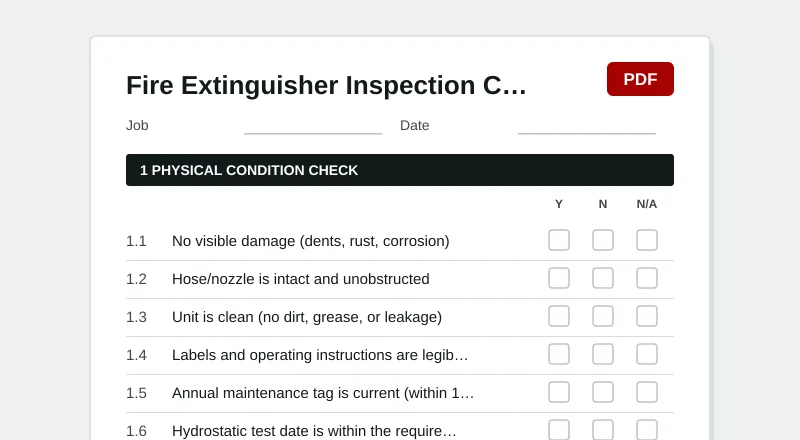
No dents, rust or corrosion. Hose and nozzle intact and clear. Unit clean, with no dirt, grease or leakage. Labels and operating instructions readable. Annual maintenance tag current, within 12 months. Hydrostatic test date within the required interval.
Pressure gauge
The needle sits in the green zone, and fullness is confirmed by weighing or hefting the unit. A gauge in the green on an extinguisher that feels light can mean a stuck gauge. Units without a gauge are checked by weight.
Safety pin and tamper seal
Pin inserted and secure, tamper seal intact. A broken seal means the unit may have been used, even if the gauge still reads full. Pull it from service until it's checked.
Accessibility and visibility
In its designated spot and mounted properly, clearly visible, signed if it's out of sight, and nothing in front of it. OSHA's rule is that extinguishers are mounted, located and identified so they can be reached without risk of injury.
Inspection record
Date, inspector name, signature and comments or actions. Write the action, not just the problem: "gauge low, unit swapped with spare from trailer 2, sent for service" tells the next person what happened.
Keeping a fire extinguisher inspection log
A fire extinguisher inspection log is the running record of every check on every unit. Most crews keep two records side by side:
- The tag on the unit. After each monthly check, the inspector initials and dates the back of the tag. Anyone walking past can see when it was last checked.
- The log. Unit ID, location, date, inspector, result and action for each check. The log is what you hand over when someone asks for proof, and it's how you spot the unit that keeps failing.
For the annual maintenance check, OSHA (paragraph (e)(3)) requires a record of the maintenance date, kept for one year after the last entry or for the life of the shell, whichever is less. Hydrostatic tests need their own certification record with the test date, the tester's signature and the serial number. Keep the monthly forms with the log; a missing month is hard to explain later.
Extinguishers on job sites, trailers and trucks
Job sites are harder on extinguishers than offices. Units get moved, borrowed, knocked off brackets, buried behind material deliveries and left in the rain. A few habits help:
- Number every unit and list where it belongs: trailer 1, hot work cart, truck 12.
- Check vehicle units on the same schedule as site units. The one in the truck is easy to forget.
- Swap, don't wait. When a unit goes out for service or gets used, put a spare in its place. OSHA (e)(5) calls for equivalent protection while units are out of service.
- Match the type to the hazard. The rating on the label says which kinds of fire it's for. An ABC unit is common on sites; a kitchen or fuel area may need something else.
- Train the crew. Where workers are expected to use extinguishers, OSHA (paragraph (g)) calls for training when they start and at least once a year after that.
For the wider picture, pair this form with a construction fire safety checklist.
Common fire extinguisher inspection mistakes
The same few misses show up again and again:
- skipped months, or a tag with no initials
- extinguishers blocked by material, equipment or a parked lift
- a gauge out of the green that nobody reported
- an expired annual service tag
- the unit missing from the truck or trailer
- nobody assigned to do the check
Monthly checks on your crew's phones
In Workyard, the fire extinguisher inspection form runs on the phone your crew already clocks in on. Tie it to a scheduled task each month and the assigned person gets a notification that opens straight to the form. Photos of the gauge or damage are a tap, the inspector signs with a finger, and a No on any item can go straight to the foreman or safety lead. Every check files itself with the date, photo and signature, so the log builds itself and exports as a PDF or CSV. See the construction inspection app or the wider safety tools.
Get the free fire extinguisher inspection checklist
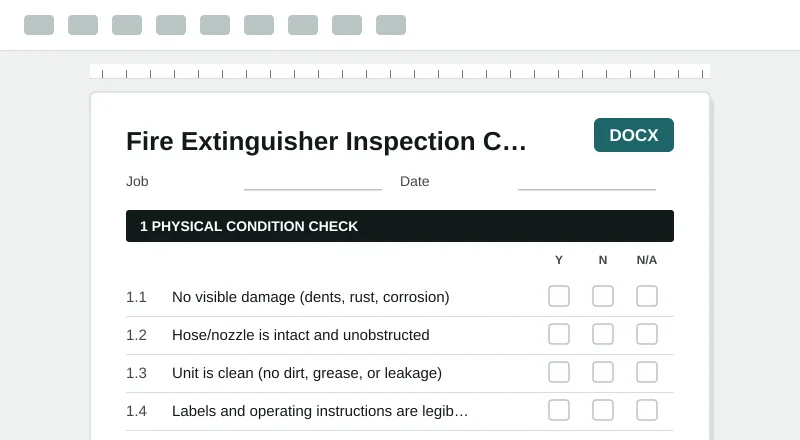
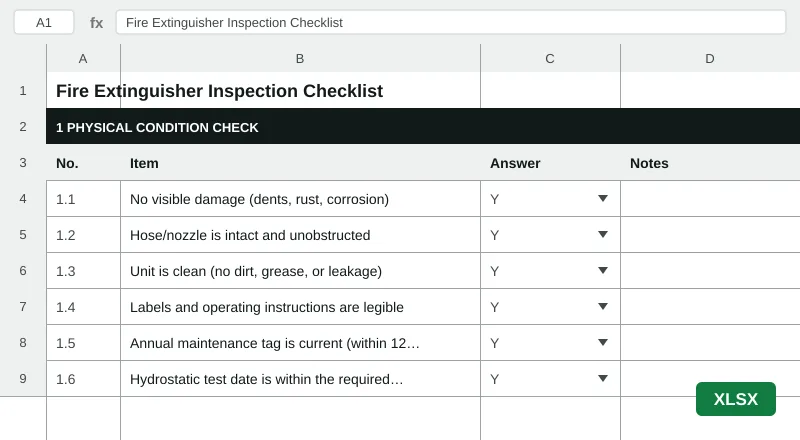
Download the fire extinguisher inspection form as a PDF to print and hang by the unit, or as a Word or Excel file to set up as a monthly log for every extinguisher you own. It's free, with no sign-up. The same checklist also runs on phones in Workyard.


