Skip to content
Log InBook a demo
Book a demo
Free template · paper and digital

Concrete Pouring & Masonry JHA

Lists the steps of a pour or masonry task with the hazards, risk level and controls for each, and gets the crew to sign on.

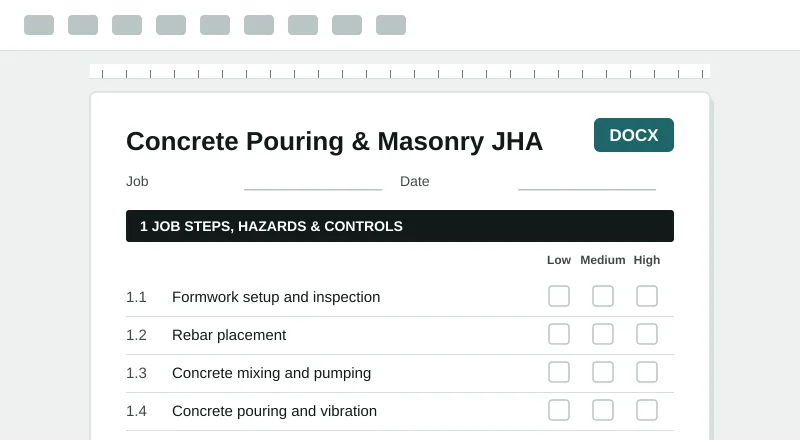
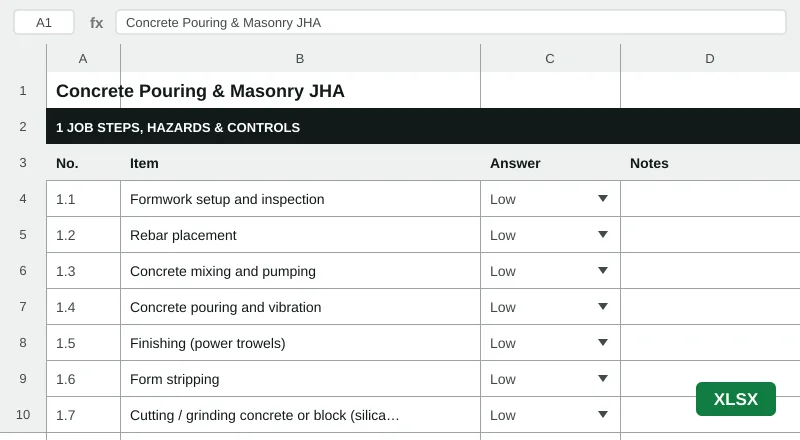
WordExcel
  • No email
  • No sign-up
  • Edit it, add your logo
See every check

The template

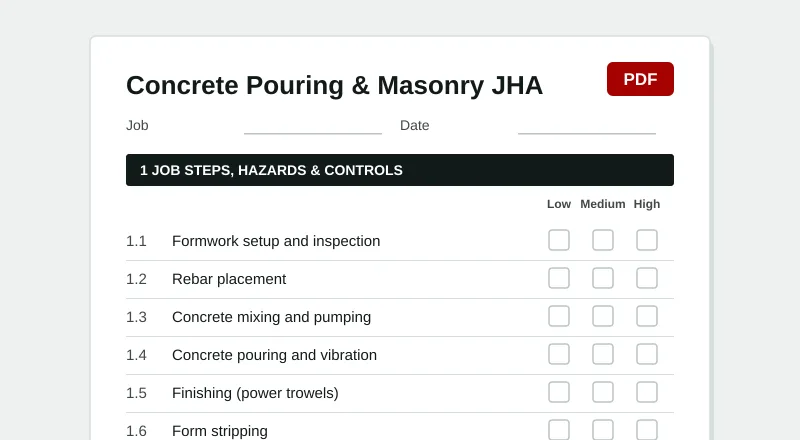
The full Concrete Pouring & Masonry JHA

Print it for the clipboard, or put it on your crew’s phones. Same 10 checks either way.

Your logo

Concrete Pouring & Masonry JHA

Identifies potential hazards and control measures for concrete and masonry work, including mixing, pouring, and block laying to prevent injuries and exposure.

Job
Date
Date
Shift Time
Project Name / Location / Work Area
Crew Supervisor (Name & Mobile)
Weather & Site ConditionsClearRainWindySnow/IceExtreme HeatOther

1 · Job Steps, Hazards & Controls

1 · Job Steps, Hazards & ControlsLowMediumHigh
1.1Formwork setup and inspection
1.2Rebar placement
1.3Concrete mixing and pumping
1.4Concrete pouring and vibration
1.5Finishing (power trowels)
1.6Form stripping
1.7Cutting / grinding concrete or block (silica, 29 CFR 1926.1153 Table 1)
1.8Scaffold erection and work at height
1.9Masonry block laying
1.10Masonry wall bracing and limited access zone (29 CFR 1926.706)

2 · Additional Notes / Sketches

Additional Notes / Sketches

3 · PPE Checklist

Select all that apply:
4 · Crew Signatures

Name
Signature
Date

5 · Reviewer Sign-Offs

Role (e.g., Site Superintendent, Safety Manager, Permit Issuer)
Name
Signature
Date/Time

Free download

Concrete Pouring & Masonry JHA template: PDF, Word and Excel

Print the form as it is, or download a template you can edit. Every format is free, with no email and no sign-up.

How to use it

How to complete the Concrete Pouring & Masonry JHA

  1. 01

    Do it on site, before the work starts

    Fill it in at the start of the task, where the work is, with the crew who’ll do it. Not in the truck the night before.

  2. 02

    Break the job into steps

    List each step of the task, then the hazards in each one. The crew doing the work knows them best.

  3. 03

    Put a control on every hazard

    For each hazard, write the control: PPE, a guard, a permit, a spotter. If you can’t control it, the step doesn’t start.

  4. 04

    Everyone signs before they start

    Read it out, answer questions and have every crew member sign. Redo it if the job or the conditions change.

Why we built this

Most injuries happen on a step nobody thought through

Ten minutes spent breaking the job into steps and naming the hazards is the cheapest safety measure you have. It’s also your record that the crew was told.

  • Built for the field. Every check is written the way crews talk, with room for notes, photos and a signature.
  • Free, with no catch. No email, no account. Print it and hand it out.
  • On paper or on the phone. The same form runs on the Workyard app, filed to the job when it’s sent.

3,000+contractors run their crews on Workyard

Meet Workyard

Who we are

Workyard is the construction operations platform for specialty contractors and self-performing general contractors determined to grow without sacrificing job control or margins.

Forms like this one are what our customers’ crews fill in on Workyard every day, on the same app they clock in with.

workers on Workyard every day
100,000+
free templates, none of them gated
182

Forms & Workflows

Get every form back from every crew, every day

  • It shows up on its own. Attach it to a task, a job or clock-out, and it’s on the crew’s phone when it’s due.
  • It can’t be skipped. Make it required and the day can’t close until it’s in.
  • You see it the same day. Filed, flagged or missing, every job on one board, before anyone has to call.

$123,000cut from insurance costs at TR3 Group

More jsas and jhas templates

Free templates for the rest of the job

  • JSAs and JHAs

    Electrical Work JHA

Browse all templates

Questions

Concrete Pouring & Masonry JHA FAQs

What hazards are associated with concrete pouring and masonry?

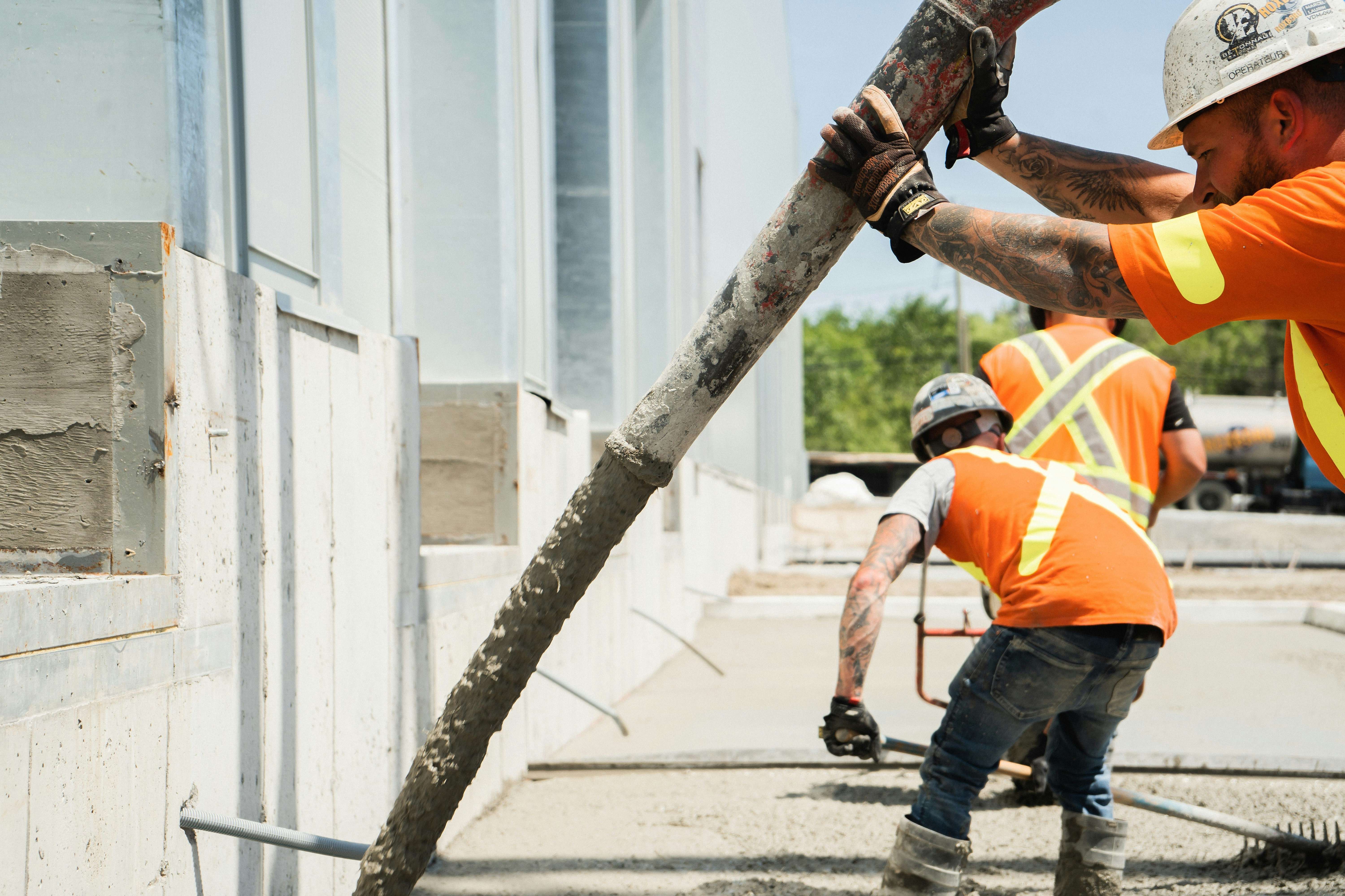
Concrete and masonry work hazards include contact with wet cement (chemical burns), falling objects, rebar impalement risks, ergonomic strain, and silica dust inhalation. A job hazard analysis helps identify risks and ensure protective measures like PPE, safe lifting, and formwork stability.

When should a JHA for concrete and masonry work be used?

A JHA should be completed before any concrete or masonry activity begins, including setting forms, mixing or pouring concrete, using mixers or trowels, and installing block or stone. It’s especially important for new environments, phases, or when introducing new materials, tools, or methods.

Who is responsible for completing the JHA?

A foreman or supervisor typically completes the JHA in collaboration with the crew. Worker involvement is critical, as they know the job steps and risks, and it ensures the plan is realistic and understood before work starts.

Do I need a Workyard account to use it?

No. Print the paper form, save it as a PDF, or download the Word or Excel file, free, with no email and no sign-up. You only need an account to put the digital form on your crew’s phones.

Can I edit the template?

Yes. Download the Word or Excel version to add your logo, add checks from your project spec or remove sections you don’t need. They open in Google Docs and Google Sheets too.

How do I get my crew to fill it in on their phones?

Add the digital form to Workyard and attach it to the job or the task it belongs to. It shows up in the app your crew already clocks in with, and every form comes back signed, with its photos, filed to the job.

Trigger the form at the right moment

A job's Forms tab in Workyard: each form, the clock-in or clock-out that triggers it, and how many have been submitted
A van check filled in on the Workyard app: the damage photo, a description and the tech's signature, ready to submit

Book a demo with a Workyard specialist

Your local Workyard specialist

Works with 50 contractors across the US

Your details

30 min · Video call