


An electrical JSA template is the form an electrical crew fills in before a task to break the work into steps, name the shock, arc flash and other hazards in each step, and write down how each one will be controlled. Electrical contractors, in-house maintenance electricians and GCs managing electrical subs use it before panel work, terminations, testing and any job near live parts.
It is a short planning sheet, not a replacement for lockout/tagout or an energized work permit. Its job is to make the crew stop, talk through the work and agree on the controls before anyone opens a cover.
What is a JHA in construction?
JHA stands for job hazard analysis. A JSA, or job safety analysis, is the same thing under a different name, and most contractors use the two terms interchangeably. In construction, a JHA takes one task, lists its steps in order, names the hazards in each step, and sets a control for each hazard.
A JHA for electrical work adds the questions that matter on electrical jobs: what voltage, whether the equipment can be put in an electrically safe condition, whether lockout/tagout is required, where the shock and arc flash boundaries are, and what PPE the task calls for.
When to complete a job safety analysis for electrical work
Complete it before the task starts, on the day, at the job. Do it again whenever the scope changes: a different panel, a circuit that won't de-energize, an extra step that wasn't planned. A JSA written for yesterday's conditions doesn't cover today's.
NFPA 70E, the electrical safety standard most contractors work to, calls for a job safety plan and a job briefing before each job that involves exposure to electrical hazards, which includes work on equipment that isn't in an electrically safe condition. That plan covers the critical steps of the job, the electrical hazards of each step, a shock risk assessment and an arc flash risk assessment, and how the worker will be protected. The standard doesn't require a particular form, so a JSA that records those points does the job. Check the current edition of NFPA 70E and your company program for the exact wording that applies to your work.
Routine tasks are the ones most often done without a plan, and they are where people get comfortable. Use the JSA for them too.
Who fills it in and signs
The qualified person in charge of the task fills it in and leads the briefing. Every crew member doing the work reads it, asks questions and signs on. The supervisor signs it off, and on larger jobs a safety manager countersigns. If someone joins the crew partway through, they get briefed and sign before they start.
What goes on the form, section by section
| Section | What it records |
|---|---|
| Project and task details | Date, shift, project and work area, type of task, the supervisor or qualified person, voltage level (under 50V, 120/208V, 277/480V, over 600V), whether LOTO is required, whether an energized work permit applies |
| Electrical hazard identification | Tick list: shock from exposed conductors, arc flash and arc blast, energized parts, backfeed, LOTO or test-before-touch failure, fire, overhead lines and buried cables, poor grounding, cords and open panels, wet locations, damaged cords or GFCIs |
| Controls and pre-task verifications | Job briefing held, voltage verified with a rated meter, LOTO applied and verified, permit approved if needed, barricades, arc flash and shock approach boundaries identified, insulated gloves and tools, GFCI protection, grounding verified, drawings reviewed, PPE selected |
| Task steps, hazards and controls | Each step of the job with its hazards, a high, medium or low risk score, and the control or safe practice |
| PPE checklist | Hard hat, safety glasses, rubber-insulated gloves and leather protectors, hearing protection, arc-rated face shield, FR clothing, voltage-rated tools, GFCI-protected cords |
| Emergency and stop-work plan | Emergency contact, the conditions that stop work, nearest AED, extinguisher and first aid kit |
| Signatures | Every crew member, then the qualified person or supervisor, and the safety manager if applicable |
How to fill out a JHA: a worked example
Take a common job: installing and terminating a new branch circuit in a 277/480V panel. Fill in the header, tick the hazards that apply, then work through the steps table. The template starts you with five steps that fit most panel work.
| Step | Hazards | Risk | Control |
|---|---|---|---|
| Review one-line diagram and scope | Wrong panel or circuit, backfeed from another source | Medium | Confirm panel ID and all sources on the drawings; walk the feed with the qualified person |
| Voltage test and lockout | Shock and arc flash while the panel is still live | High | Arc-rated PPE for the task, rated meter tested on a known source, lock and tag every source, test before touch |
| Install or terminate wiring | Contact with adjacent energized parts if a source was missed | Medium | Verify zero energy again, insulated tools, barricade the area |
| Inspect completed work | Loose terminations, tools left in the enclosure | Low | Torque check, tool count, cover reinstalled |
| Remove LOTO and restore power | Energizing with someone still in the work | Medium | Head count, everyone clear, locks and tags removed under your LOTO procedure |
Write hazards specifically. Energized bus bar behind the main breaker tells the crew something. Electrical does not. The same goes for controls: name the meter, the PPE and who checks it.
Mistakes that make an electrical JSA worthless
- Skipping it for routine work because the crew has done the task a hundred times.
- Copying yesterday's JSA and changing the date.
- Treating the briefing as enough when nobody walked the work area.
- Guessing at risk scores instead of thinking through how likely and how bad each hazard is.
- Not revising when the scope changes, such as a second panel or a source that won't lock out.
- Missing signatures from crew who joined late.
Running the electrical JHA on crews' phones
A paper JSA has to be on site, legible and signed by everyone, and then make it back to the office. In Workyard, the qualified person opens the electrical work JHA on their phone at the start of the task, the crew signs on the same screen, and photos of the panel, the locks and the barricades attach to the form. The signed JSA is filed to the job with the date, the photos and every signature, so the office can see which crew planned which task, and when. See how it works in the JHA app, or read about Workyard for electrical contractors.
Pair it with the lockout/tagout form for every isolation, the general job hazard analysis form for non-electrical tasks, and the electrical safety toolbox talk for the weekly crew meeting.
Get the free electrical JSA template
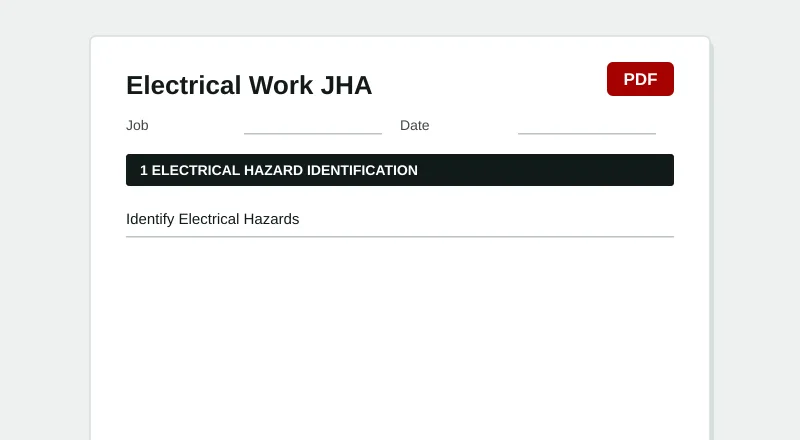
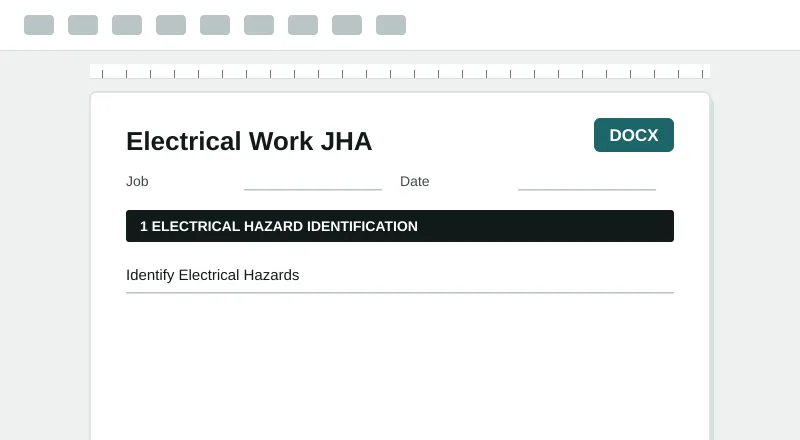
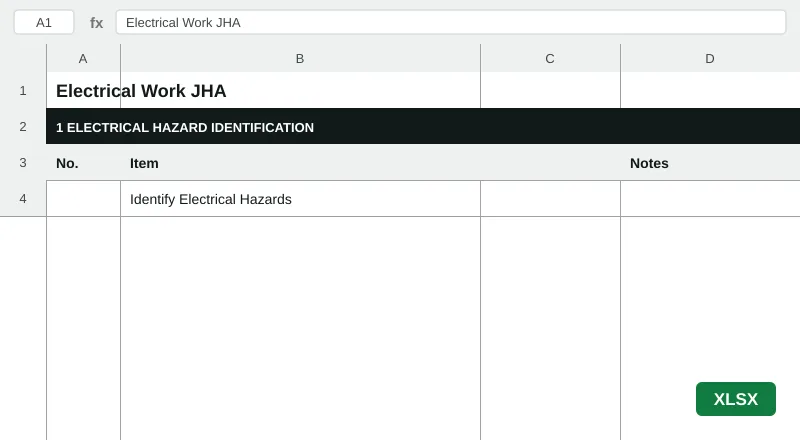
Download the electrical work JHA free as a PDF to print, a Word file to edit, or an Excel sheet. No sign-up. Add your company's emergency contacts and PPE rules, keep the steps table, and have the qualified person fill a fresh one for every task.


