


A furnace inspection form is the record an HVAC technician fills in during a furnace check: the unit's details, readings from the burner, heat exchanger, safety devices, blower, venting and controls, a log of anything that needs fixing, and a final call on whether the furnace stays in service. HVAC service companies, property managers and maintenance crews use it on gas, LP, oil and electric furnaces, usually once each heating season.
What goes on the furnace inspection form
The form records readings, not just ticks. Most sections have a target or spec column next to the actual reading, then Pass or Fail and notes, with photos for each.
| Section | What gets recorded |
|---|---|
| Property and equipment | Address, make and model, serial number, fuel type, install date, outdoor temperature and weather, indoor ambient CO |
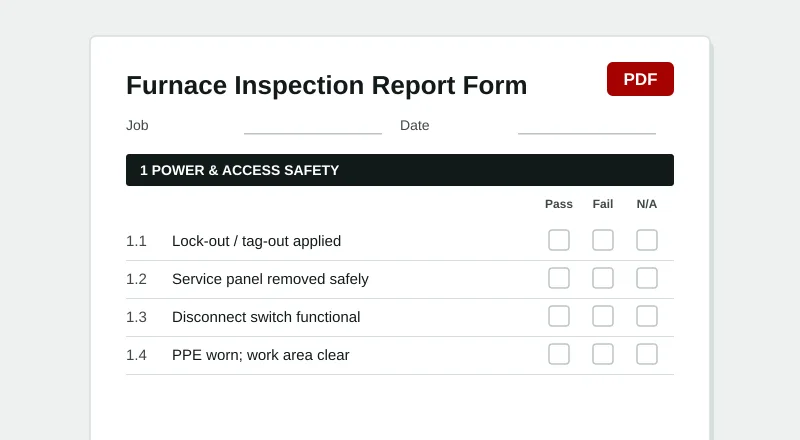
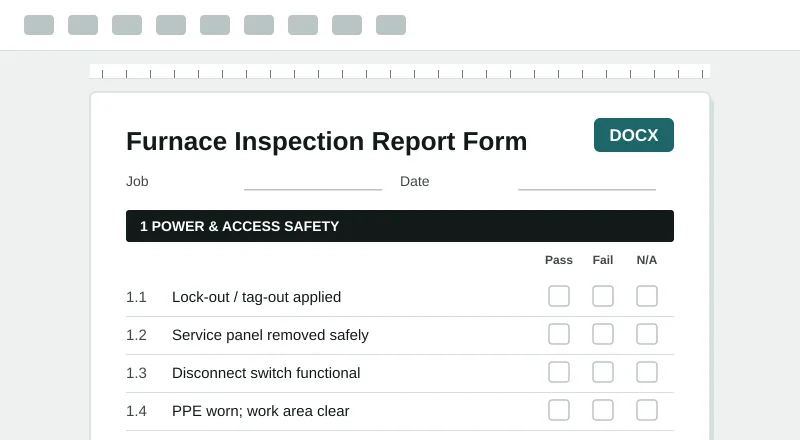
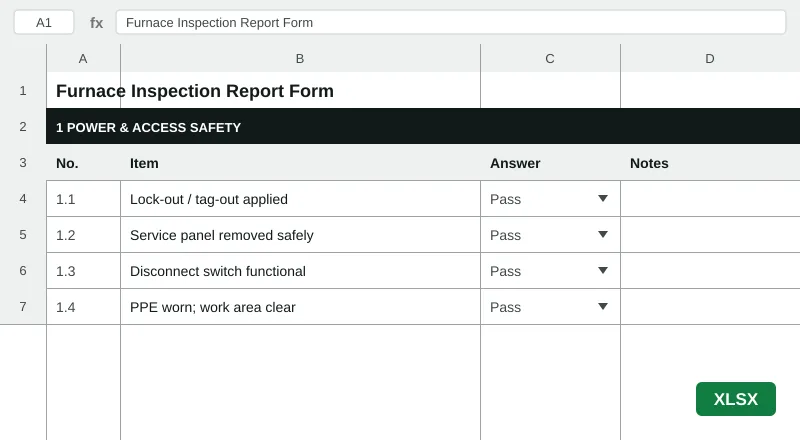
| Power and access safety | Lockout applied, service panel removed safely, disconnect working, PPE worn and work area clear |
| Burner assembly | Compartment clean, ignition sequence, manifold gas pressure per the manufacturer, flame color, flame-sensor current, gas valve and piping leak-checked |
| Heat exchanger | Mirror or scope inspection for cracks, rust, scale or soot, combustion leak test |
| Safety devices | High-limit cut-out temperature, pressure switch, roll-out switch, flame sensor repeat |
| Blower and filtration | Blower wheel, motor amps against nameplate, belt, filter size and type, filter pressure drop, filter replacement date |
| Venting and combustion | Flue draft, combustion air path, stack CO, combustion efficiency, condensate drain, vent connector, CO alarm present and working |
| Electrical and controls | Thermostat calibration within 2°F, wiring, control board fault codes, 24-volt control power reading between 20 and 28 volts |
After the checks come a deficiency log (issue, severity from 1 to 5, action needed, responsible party, target date, closed) and the final assessment. The form's references list IMC 2021 Chapter 8, NFPA 54 for gas, NFPA 31 for oil, ANSI/ACCA 4 QM and the manufacturer's maintenance manual. Check the current editions your area uses.
The furnace safety inspection checklist items that decide in or out of service
The disposition is simple: every item passes and the furnace stays in service, or deficiencies are outstanding and it goes out of service until they're fixed. A few items carry most of the safety weight, and they're worth extra care:
- Ambient and stack CO. The form records indoor CO at the start and stack CO during steady operation. It lists a stack limit of 400 ppm for gas and 100 ppm for oil.
- Heat exchanger. A crack lets combustion gases into the supply air. Use the mirror or scope, and photograph what you see.
- Venting. Draft, a secure and sloped connector with clearance to combustibles, and a clear combustion air path.
- Safety switches. High-limit, pressure and roll-out switches have to trip at their settings.
- CO alarm. Present and working, every visit.
Write the actual readings. A heat exchanger that passed with a combustion leak reading close to the limit is worth flagging for next season, and only a number shows that.
When someone asks for a certified furnace inspection form
Landlords, insurers, home buyers and some local rules ask for proof that a qualified technician inspected the furnace. The form has room for that proof: technician name, ID number, company, signature and date, plus the owner or representative's signature. Whether it counts as certified depends on who's asking and what licensing your area requires, so check with them before the visit.
Get the free furnace inspection form
Download the furnace inspection report as a PDF, Word or Excel file, free and with no sign-up. Print it for the service van or edit it with your company details. In Workyard's construction inspection app, techs fill in the same form on their phones at the unit: readings, photos of the heat exchanger and flame, signatures on screen for the tech and the owner, and an out-of-service result sent to the named service manager. Every inspection is filed to the job in the office and exports as a PDF for the customer. Related forms: the heating inspection report and more HVAC and mechanical templates.


