


An HVAC equipment startup checklist is the sheet a technician fills in the first time new heating and cooling equipment runs: the duct leakage test, refrigerant charge and leak check, airflow, controls, condensate drain and the manufacturer's own startup items, ending with a sign-off that the system is ready to hand over. HVAC and mechanical contractors use it on split systems, rooftop units, mini-splits, VRF systems, packaged units and heat pumps.
What the HVAC equipment startup checklist records
The form opens with the system type and the indoor and outdoor model and serial numbers, then works through the startup in order.
| Section | What you record |
|---|---|
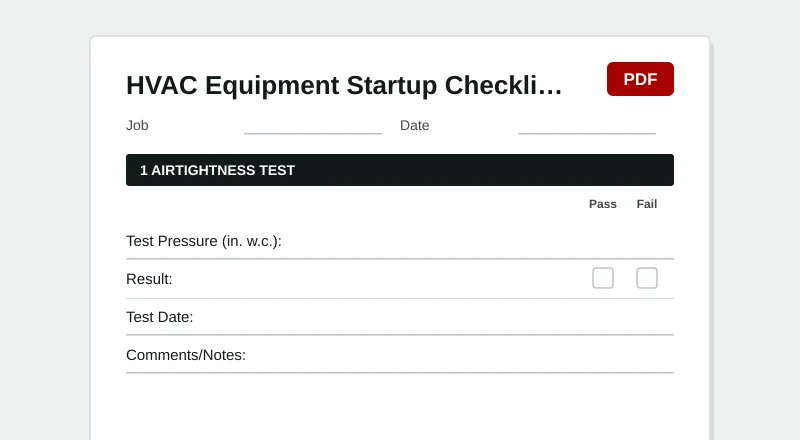
| Airtightness test | Duct leakage test pressure, pass or fail, date, notes and photos |
| Refrigerant and leak check | Refrigerant type, nitrogen pressure test and hold time, evacuation level in microns, charge, suction and discharge pressure, superheat, subcooling, the technician's EPA 608 certification number, leak check done and leak found |
| Airflow and fan performance | Supply and return airflow in CFM, static pressure, fan RPM, duct balancing confirmed |
| Controls and thermostat | Thermostat communicates, heating and cooling engage at setpoints, high and low pressure switches work, system shuts down on a fault |
| Condensate drain | Slope, working trap, clear line, overflow protection |
| OEM startup checklist | Manufacturer's checklist done, suction and discharge temperatures, voltage, amperage, all OEM items complete |
| Project info and sign-off | Job name, location, date, inspector, who did the startup and their EPA 608 number, signature, observer, and system ready for handover |
Write the readings, not just the checkmarks
Most of this form asks for numbers on purpose. A startup sheet that only says "charge OK" can't help the technician who comes out on a callback next summer, or the manufacturer reviewing a warranty claim. Record the actual nitrogen test pressure and how long it held, the micron level the vacuum reached, the charge you added, and the superheat and subcooling you measured with the conditions at the time. The target values come from the manufacturer's installation instructions for that unit, so keep them at hand and note in the comments if a reading is outside their range and what you did about it.
Take a photo of the gauges and the nameplate. It's quicker than writing out the serial numbers twice and settles any question about what was on site.
A commercial HVAC startup sheet as well as residential
The same form works as a commercial HVAC startup sheet for rooftop units, packaged equipment and VRF systems, and for residential splits and heat pumps. On commercial jobs, expect the owner's commissioning agent or the engineer to ask for the startup sheets as part of closeout, and to want the manufacturer's own startup form attached. Larger systems usually go on to formal commissioning, recorded on a form like the HVAC commissioning checklist.
The standards the form refers to
The form's intro names ASHRAE 193, ACCA Quality Installation and EPA Section 608. Its notes add that the duct leakage test is set by your local energy code (the IECC), while ASHRAE 193 is a lab test of the air handler's own airtightness, not of the ducts in the field. Refrigerant work falls under EPA Section 608, which is why the technician's certification number is on the form twice. Check the current energy code your jurisdiction has adopted for the test pressure and pass limit. Other mechanical forms are under HVAC and mechanical templates.
Run it in Workyard or download it free
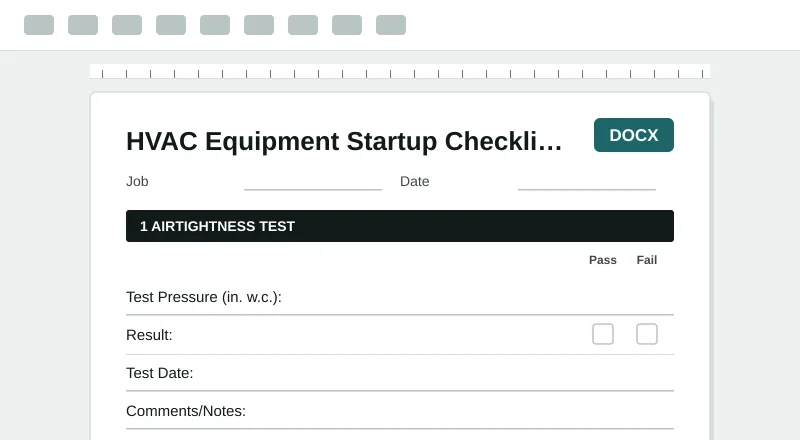
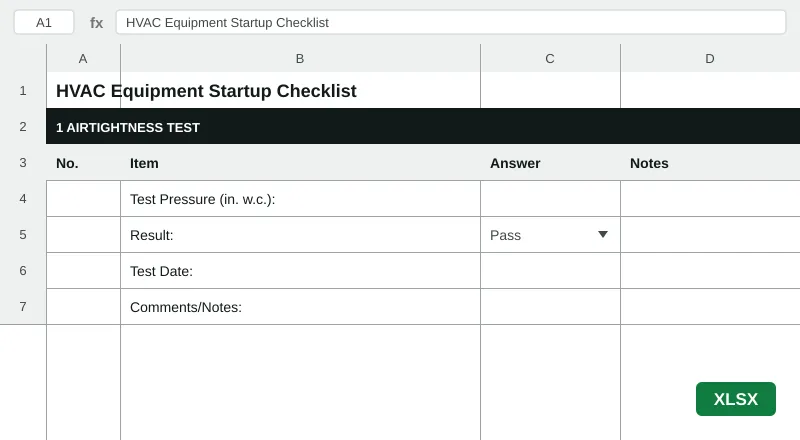
In Workyard, the startup checklist is a digital form your technician fills in on a phone at the unit, with photos of gauges and nameplates and a signature on screen. A failed leak check can go straight to a named person, and every startup sheet is filed to the job in the office, ready to export as PDF or CSV. See forms and workflows in Workyard. Or download the free template as a PDF, Word or Excel file.


