



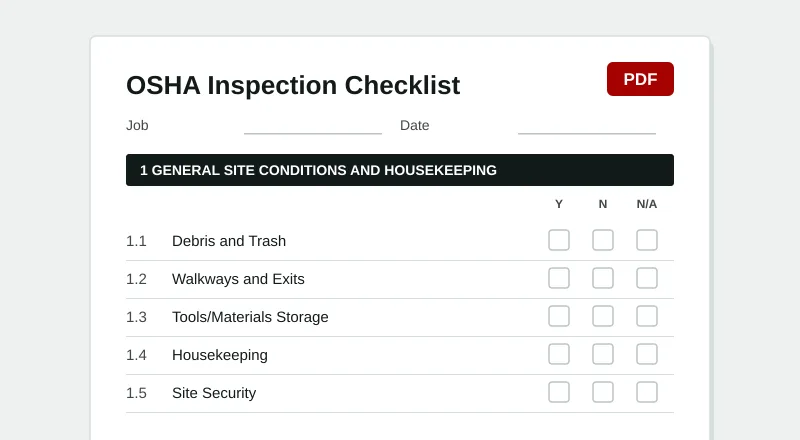
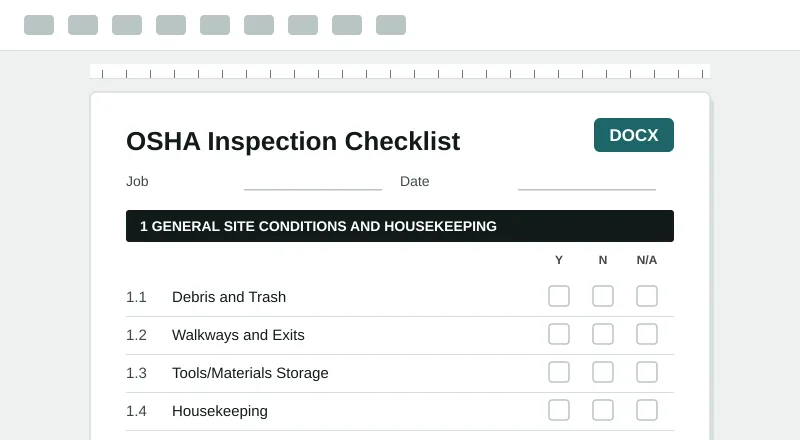
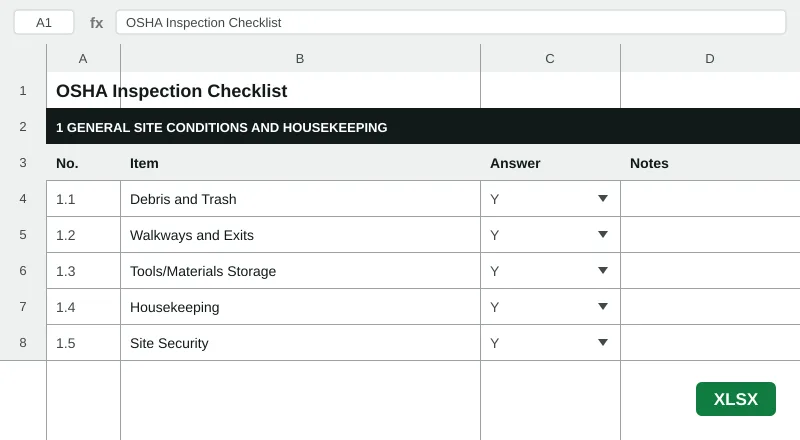
An OSHA inspection checklist is a self-inspection walk of your job site against the hazards OSHA cites most on construction work: falls, ladders and scaffolds, PPE, electrical, fire, trenches and cranes. Superintendents, foremen and safety leads use it to find and fix problems before an inspector or an injury does.
Most checklists that rank for this term were written for factories and warehouses. The one here is built for construction sites, with the questions a super would actually ask walking the job.
A self-inspection tool, not an OSHA form
OSHA doesn't publish one official checklist you're required to fill in. What its construction standards do require, under 29 CFR 1926.20(b)(2), is frequent and regular inspections of job sites, materials and equipment by a competent person: someone who can recognize existing and predictable hazards and has the authority to fix them. An OSHA safety inspection checklist is how you do that walk the same way every time and prove it happened.
OSHA doesn't set one interval for the general site walk. How often depends on the site and the work, and some hazards carry their own, stricter timing (more on that below).
Construction (1926) or general industry (1910)?
Construction work falls under OSHA's construction standards, 29 CFR Part 1926. General industry (factories, warehouses, shops) falls under Part 1910. Many free OSHA checklists are built on 1910 and miss what matters on a job site: guardrails on open edges, trench protection, scaffold planking, temporary power. If your crew builds, renovates, demolishes or repairs, check against the construction rules.
The OSHA construction inspection checklist, hazard by hazard
The OSHA construction inspection checklist starts with the inspector and site details (job, location, crew or foreman on duty, type of inspection, any special operations) and then works through eight sections. Every question is answered Yes, No or N/A, and each section has space for photos.
| Section | What the inspector checks |
|---|---|
| General site conditions and housekeeping | Debris and protruding nails, clear walkways and exits, tool and material storage, slippery or cluttered surfaces, perimeter fencing, signs and barricades |
| Fall protection and work at height | Fall exposures of 6 feet or more, guardrails with top rails and midrails on open edges, covered floor holes and skylights, harnesses and lanyards worn and inspected, rated anchor points, safety nets |
| Ladders, scaffolds and stairways | Ladder condition and setup, extension ladders 3 feet above the landing and secured, stair handrails, fully planked scaffolds, guardrails on platforms over 10 feet, daily scaffold inspection and tagging, level base |
| PPE | Hard hats, eye and face protection, hearing protection, hi-vis near equipment, gloves, harnesses, respirators where dust or chemicals are present |
| Electrical safety | Cord condition, GFCI protection on 120-volt circuits, covered boxes and outlets, lockout/tagout on electrical work, grounded or double-insulated tools, clearance from overhead lines |
| Fire protection and emergency access | Charged, marked extinguishers within travel distance, flammables in approved containers, hot work permits and fire watch, clear exits and emergency vehicle access, SDS on site and chemicals labeled |
| Specialized activities | Trenches 5 feet or deeper sloped, shored or shielded and inspected daily, cranes and hoists inspected before shift with certified operators, demolition protection |
| Issues, actions and documentation | Outcome, issues found and corrective actions, person responsible, due date, inspector name and signature, next inspection date |
Checks that can't wait for the weekly walk
Some hazards need a look before work starts every shift or every day, whatever your general walk schedule. The checklist builds these in:
- Scaffolds: inspected by a competent person before use each day and tagged safe or unsafe. Pair the site walk with a dedicated scaffold inspection checklist.
- Trenches and excavations: protective systems checked daily by a competent person, and again after rain or anything else that changes the ground.
- Cranes and hoists: inspected before each shift.
- Fall protection and electrical: conditions change as the building goes up, so check them on every walk, not monthly.
Fire extinguishers and site postings can usually go on a longer cycle. Write your schedule down so the crew knows which checks are theirs and when.
Fixing what you find
A No on the checklist only protects anyone once it's fixed. The last section of the form turns findings into work:
- Pick the outcome: pass with no further action, pass with corrective action needed, or fail.
- Describe each issue and its fix. Name the location ("Level 3, east stair, missing midrail"), not just the category.
- Assign a person and a due date. An item without both stays open.
- Photograph it before and after the fix.
- Set the next inspection date and recheck open items first when you walk again.
Anything that puts someone in immediate danger, such as an unguarded edge or an unprotected trench, gets fixed or closed off before work continues, not added to the list.
Mistakes that leave a site exposed
- Using a general industry checklist. It won't ask about trench protection or scaffold planking.
- Checking boxes from the trailer. A checklist filled in without walking the site is worse than none: it says the site was safe when nobody looked.
- Findings with no owner. The same missing guardrail shows up three weeks running.
- No photos or dates. If an incident happens, an unsigned, undated checklist proves little.
- Forgetting the subs' areas. The hazards on your site are your problem regardless of whose crew created them.
OSHA safety inspection checklists on crews' phones
In Workyard, the checklist runs on the super's phone with the rest of your safety paperwork. Each question gets its Yes, No or N/A on the walk, photos go straight into the section they belong to, and the inspector signs on the screen. Every completed inspection comes back to the office under the job, and a No can go straight to the person you name, so a problem found on the walk doesn't live only in one person's head. Workyard doesn't track corrective actions to a due date; the re-check is a new inspection.
Get the free OSHA inspection checklist
Download the OSHA inspection checklist as a PDF, Word document or Excel sheet. It's free and there's no sign-up. Add the hazards specific to your trade in the Word or Excel version. For a broader program review, see the OSHA compliance checklist, and find more walk-through forms under site inspections.


