Skip to content
Log InBook a demo
Book a demo
Free template · paper and digital

Well Inspection Report Form

Records the condition of a water well from casing to treatment equipment and logs each deficiency with the action to take.

WordExcel
  • No email
  • No sign-up
  • Edit it, add your logo

29 checks · 9 sections · Updated Nov 2026

See every check

The template

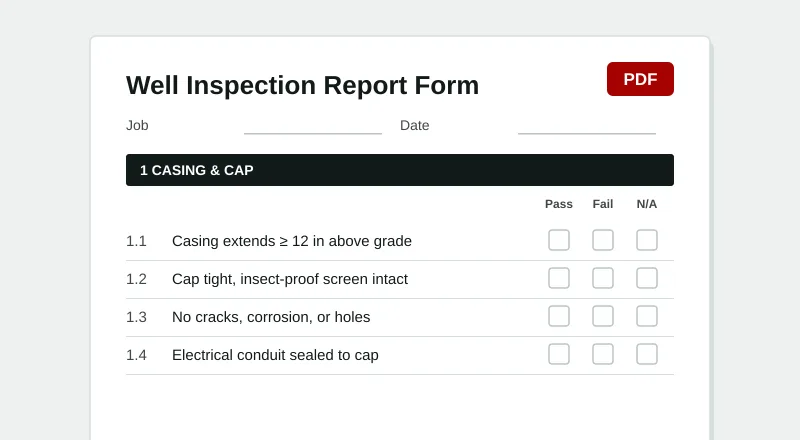
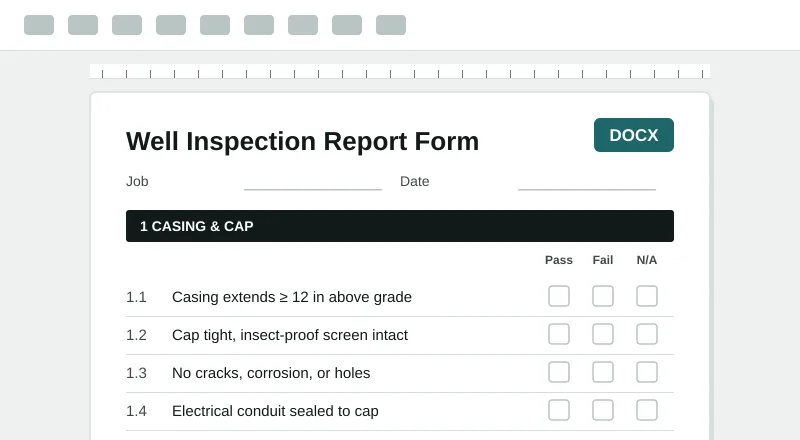
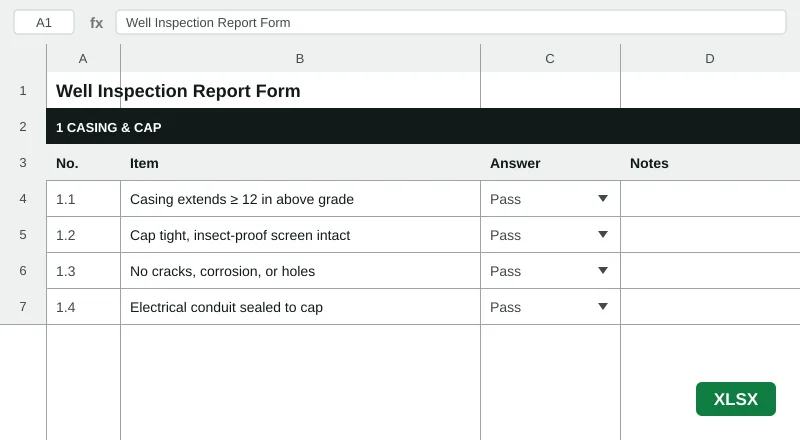
The full Well Inspection Report Form

Print it for the clipboard, or put it on your crew’s phones. Same 29 checks either way.

Your logo

Well Inspection Report Form

Check pump output, casing, and water tests with this well report—supports safe, efficient operation and helps identify code breaches.

Job
Date
Well Tag / ID
Location
Address / Parcel
Year Drilled
Total Depth (ft)
Static Water Level (ft)
Pump Setting Depth (ft)
Original Driller’s Log on File?YesNo
WeatherClearRainSnowHotCold

1 · Casing & Cap

1 · Casing & CapPassFailN/A
1.1Casing extends ≥ 12 in above grade
1.2Cap tight, insect-proof screen intact
1.3No cracks, corrosion, or holes
1.4Electrical conduit sealed to cap

Photos · photo refs

2 · Site Drainage & Setbacks

2 · Site Drainage & SetbacksPassFailN/A
2.1Ground slopes away 5 ft around well
2.2≥ 100 ft from septic drainfield
2.3≥ 50 ft from fuel / chemical storage
2.4≥ 100 ft from livestock enclosures
2.5No ponding or fertilizer mixing nearby

Photos · photo refs

3 · Pump & Plumbing

3 · Pump & PlumbingPassFailN/A
3.1Flow test gpm meets demand
3.2Pressure tank cut-in/out psi
3.3Pump amperage within nameplate ±10 %
3.4Wiring insulation intact, conduit secure
3.5No leaks at pitless adapter / unions

Photos · photo refs

4 · Wellhead & Adapter

4 · Wellhead & AdapterPassFailN/A
4.1Pitless adapter watertight, no rust
4.2Vent screened, free of debris
4.3No biofilm or mineral crust on fittings
4.4Protective bollards installed (if traffic)

Photos · photo refs

5 · Treatment Equipment

5 · Treatment EquipmentPassFail
5.1Sediment / Cartridge Filter
5.2Water Softener
5.3Carbon / Iron Filter
5.4UV Disinfection Unit
5.5Reverse-Osmosis or Other

Photos · photo refs

6 · Water-Quality Sampling

6 · Water-Quality SamplingPassFail
6.1Total Coliform / E. coli (CFU/100 mL)
6.2Nitrate-N (mg/L)
6.3Arsenic (µg/L)
6.4pH
6.5Iron (mg/L)
6.6Manganese, Lead, etc. (specify)

Photos · photo refs

7 · Deficiency & Action Log

Entries

SectionIssueRecommended ActionResponsible PartyTarget DateClosedNotes

Photos · photo refs

8 · Overall Assessment

Well ConditionGoodServiceableNeeds Repair
Next Routine Inspection1 yr3 yrOther
Sampling Frequency RecommendedAnnualSemi-annualOther

9 · Sign-Off

Inspector

Name
Agency
Signature
Date

Owner/Representative

Name
Signature
Date

References & Standards

  • EPA – Private Drinking Water Wells guidance
  • CDC – Private-Well Best Practices
  • State Well Construction & Setback Codes
  • ANSI/NGWA-01-14 – Water Well Construction Standard

Your AHJ and the code edition it has adopted govern. This checklist supports your inspection; it doesn’t replace the one your jurisdiction requires.

Free download

Well Inspection Report Form template: PDF, Word and Excel

Print the form as it is, or download a template you can edit. Every format is free, with no email and no sign-up.

How to use it

How to run the Well Inspection Report Form

  1. 01

    Run it before the work is covered

    Walk it before the next trade closes things up or the area is handed over, and again after any fix. Fill in the header first so the record stands on its own.

  2. 02

    Work the sections in order

    Go through the 9 sections in order so nothing gets skipped. Answer every check: a blank isn’t an answer.

  3. 03

    Every miss gets a photo and an owner

    Write down what’s wrong, take a photo and name the trade that owns the fix, with a date.

  4. 04

    Re-check, sign, then release

    Walk the misses again once they’re fixed. Sign it off, and only then let the area close.

Why we built this

An inspection only counts if it’s written down

A miss found before the work is covered up is a quick fix. Found after, it’s a tear-out, a failed inspection and a schedule hit. The written record is how you prove the check happened.

  • Built for the field. Every check is written the way crews talk, with room for notes, photos and a signature.
  • Free, with no catch. No email, no account. Print it and hand it out.
  • On paper or on the phone. The same form runs on the Workyard app, filed to the job when it’s sent.

3,000+contractors run their crews on Workyard

Meet Workyard

Who we are

Workyard is the construction operations platform for specialty contractors and self-performing general contractors determined to grow without sacrificing job control or margins.

Forms like this one are what our customers’ crews fill in on Workyard every day, on the same app they clock in with.

workers on Workyard every day
100,000+
free templates, none of them gated
182

Forms & Workflows

Get every form back from every crew, every day

  • It shows up on its own. Attach it to a task, a job or clock-out, and it’s on the crew’s phone when it’s due.
  • It can’t be skipped. Make it required and the day can’t close until it’s in.
  • You see it the same day. Filed, flagged or missing, every job on one board, before anyone has to call.

$123,000cut from insurance costs at TR3 Group

More site inspections templates

Free templates for the rest of the job

Browse all templates

Questions

Well Inspection Report Form FAQs

Why inspect a private well every year?

Annual inspections catch microscopic casing cracks, loose caps, or declining pump yield long before taste or odor changes alert you. Coupled with yearly bacteria and nitrate tests, the report builds a trendline that guides maintenance, extends pump life, and protects household health.

What issues can a thorough inspection reveal?

The checklist exposes corroded casing, missing sanitary seals, pitless-adapter leaks, inadequate septic setbacks, reduced pump flow, frayed wiring, or vibration suggesting impeller wear. Water labs may uncover bacterial contamination, fertilizer-driven nitrates, or natural arsenic—allowing timely disinfection, repairs, or treatment upgrades.

How should I prepare my property for a well inspection?

Clear brush and debris around the wellhead, ensure the pressure-tank and electrical panel are accessible, and gather previous drill logs, lab reports, and service invoices. Delay inspection one week after shocking the well so residual chlorine doesn’t mask real water-quality conditions.

When should water be retested after repairs or treatment?

Collect new samples 24–48 hours after completing repairs or installing treatment, once lines are flushed and chemistry stabilizes. Submit to a certified lab for microbes and the specific contaminant addressed. Keep the results with your inspection log to confirm the fix and guide future comparisons.

Do I need a Workyard account to use it?

No. Print the paper form, save it as a PDF, or download the Word or Excel file, free, with no email and no sign-up. You only need an account to put the digital form on your crew’s phones.

Can I edit the template?

Yes. Download the Word or Excel version to add your logo, add checks from your project spec or remove sections you don’t need. They open in Google Docs and Google Sheets too.

How do I get my crew to fill it in on their phones?

Add the digital form to Workyard and attach it to the job or the task it belongs to. It shows up in the app your crew already clocks in with, and every form comes back signed, with its photos, filed to the job.

Trigger the form at the right moment

A job's Forms tab in Workyard: each form, the clock-in or clock-out that triggers it, and how many have been submitted
A van check filled in on the Workyard app: the damage photo, a description and the tech's signature, ready to submit

Book a demo with a Workyard specialist

Your local Workyard specialist

Works with 50 contractors across the US

Your details

30 min · Video call