


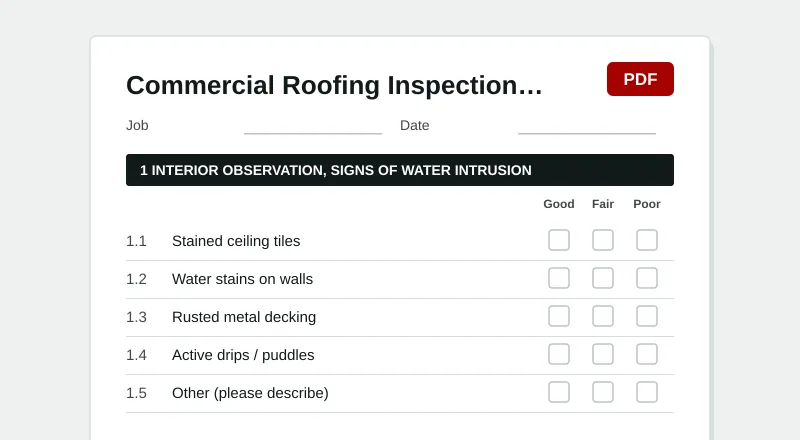
A commercial roof inspection checklist is the record a roofer, facility manager or building owner fills in on each walk of a low-slope roof: leaks showing inside, drains and ponding, membrane and seams, flashings, penetrations and debris. Roofing contractors use it for maintenance agreements and warranty walks, and property teams use it to track the roofs they own.
What goes on the commercial roof inspection checklist
The commercial roof inspection form starts with the building: address, roof system (TPO, EPDM, PVC, BUR, mod-bit, metal or SPF), installation year, warranty status and weather. Before anyone steps on the roof, the inspector confirms the safety pre-check: fall protection in place, ladders and access secure, electrical hazards assessed and PPE on. The form ties this to OSHA 1926 Subpart M.
Six rating sections follow. Each item is rated 1 to 5 and each section has its own photo upload.
| Section | What the inspector rates |
|---|---|
| Interior observation | Stained ceiling tiles, wall stains, rusted metal deck, active drips |
| Drainage and ponding | Drains and scuppers clear, water gone within 48 hours of rain, debris, missing drain domes |
| Membrane and seams | Blisters, punctures, open laps, displaced ballast |
| Flashings and edges | Coping gaps, cracked sealant, loose termination bars, edge metal |
| Penetrations | HVAC curbs, skylights, pipe boots, lightning protection cable |
| Growth and debris | Algae, vegetation, loose fasteners, trash |
The form closes with a summary of findings, recommended repairs and a list of the references it draws on: IBC 2021 Chapter 15, NRCA maintenance guidance, ASTM D7053 for tracing leaks in low-slope roofs, ANSI/SPRI ES-1 for edges and OSHA 1910.28 for roof-edge safety. The inspector signs, and the facility rep can sign too.
Commercial vs residential roof inspections
A commercial roof is usually low-slope, so most of the checklist is about water: where it collects, how fast it drains and where it gets in. Seams, flashings and the curbs around rooftop equipment cause most leaks, and the interior section often finds them first. A residential roof is usually steep-slope shingles or tile, where you look at missing or lifted shingles, valleys, gutters and attic ventilation. For houses and smaller buildings, use the roof inspection checklist instead.
Commercial roof inspection report example
A good filled-in report is short and specific. For example: TPO, installed 2014, warranty active. Interior: stained tiles in rooms 210 and 212 (rated 2). Drainage: north drain dome missing, ponding about 10 ft across after yesterday's rain (rated 2). Membrane: open lap at the east RTU curb (rated 1). Recommended: reseal the lap, replace the dome, clear the drain, recheck after the next rain. Each finding has a photo, and the rating tells the owner what to fix first.
Fill it in on a phone or download it
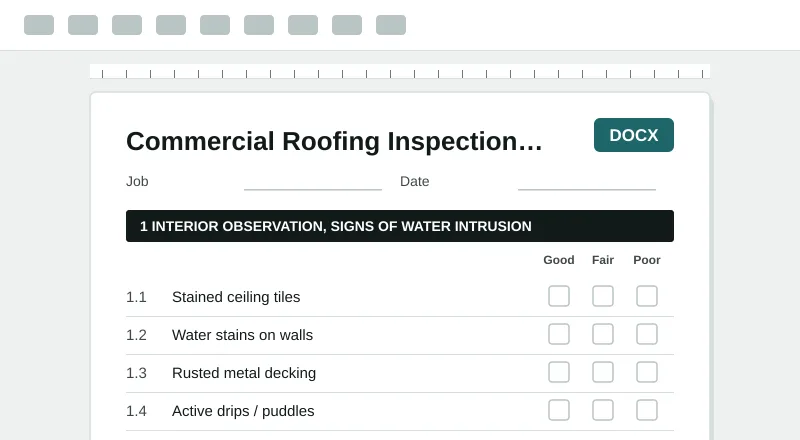
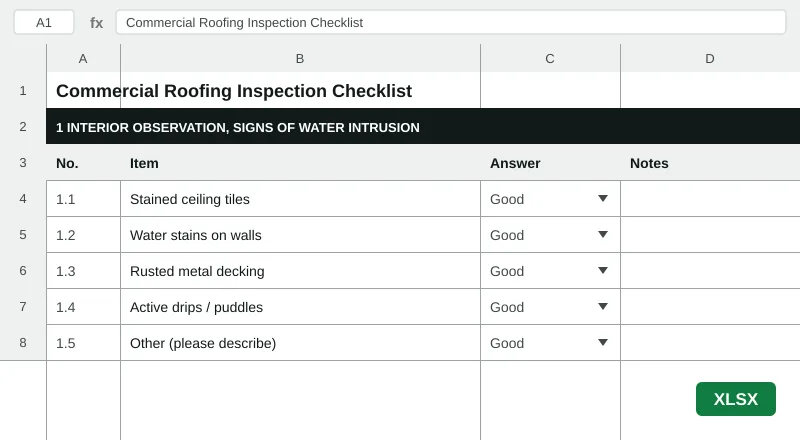
Many roof warranties ask for documented maintenance inspections, often in spring and fall and after big storms, so check the terms on each roof. In Workyard, crews fill in the checklist on their phones on the job, take photos in each section and sign on screen. Low ratings go to the person you name, and every report is filed to the job in the office, ready to export as a PDF for the owner. See the construction inspection app and more roofing templates. The template is free as a PDF, Word or Excel file.


