PM₂.₅ or fine particles (Safe Range: ≤35 µg/m³)SafeAt Risk
PM₁₀ or coarse particles (Safe Range: ≤150 µg/m³)SafeAt Risk
VOCs or volatile organic compounds (guideline: ≤500 ppb TVOC)SafeAt Risk
Carbon monoxide (Safe Range: ≤9 ppm)SafeAt Risk
Carbon monoxide (Safe Range: ≤10 ppm)SafeAt Risk
IAQ Monitor Make/Model & Calibration Date
Select a date
Outdoor Reference Readings (CO₂, PM₂.₅)
Enter text
HVAC & Ventilation System Check
Inspect the building’s mechanical ventilation and airflow controls
Check that the HVAC system is running and responsive
Select an option
Inspect outdoor air dampers for operation and position
Select an option
Confirm supply and return vents are clean and unobstructed
Select an option
Test exhaust fans in restrooms and kitchens for airflow
Select an option
Open and close windows/doors to confirm operability
Select an option
Evaluate indoor air circulation and thermal comfort
Select an option
Air Filtration & Cleaning
Review air filtration systems and general IAQ maintenance tasks
Check HVAC filters for cleanliness and replacement status
Select an option
Inspect HVAC ducts, coils, and drain pans for cleanliness
Select an option
Test portable air purifiers (if present) for performance
Select an option
Verify use of low-emission or green cleaning products
Select an option
Confirm regular cleaning of floors and surfaces
Select an option
Occupant Activities & Complaints
Monitor occupant behavior and note reported complaints
Select an option
General Information
Project Name
Enter text
Location
Enter text
Date & Time of Inspection
Select a date
Inspector Name
Enter text
Inspector Signature
Sign here
Submit
Scroll through the form
The template
The full Air Quality Assessment Form
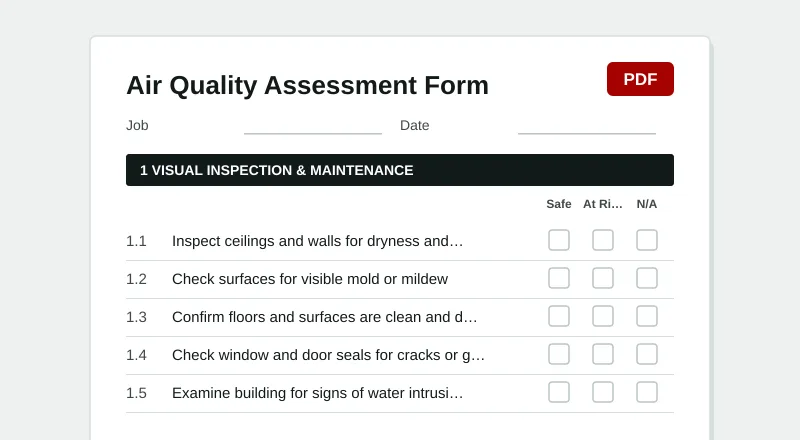
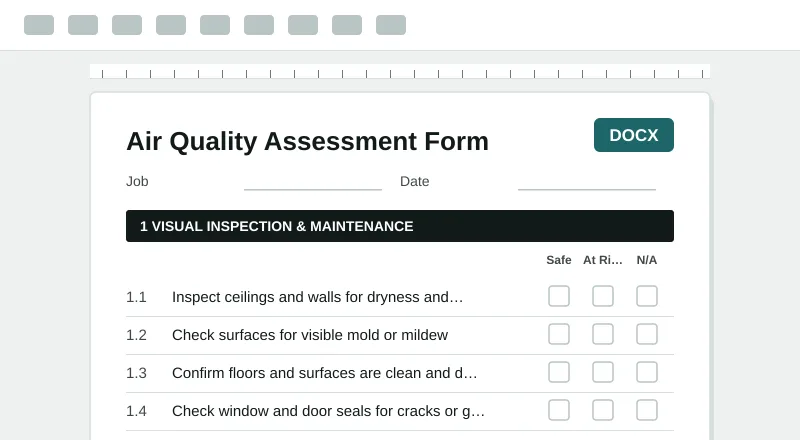
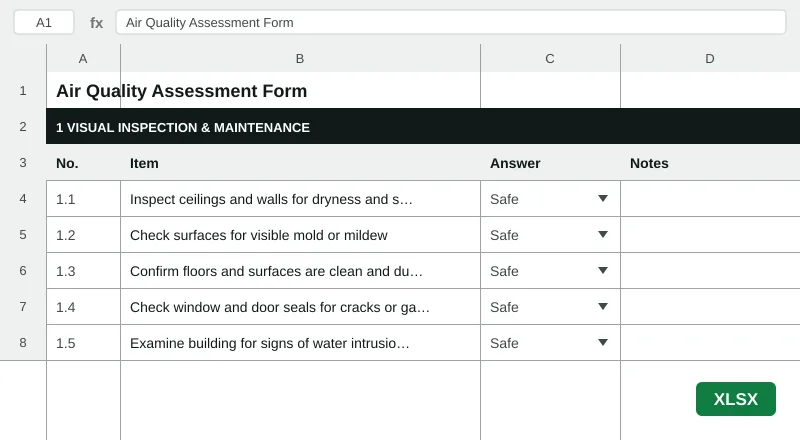
Print it for the clipboard, or put it on your crew’s phones. Same 29 checks either way.
Your logo
Air Quality Assessment Form
An air quality assessment form is used by field service, construction, and property management teams to document indoor air conditions during inspections or investigations. It captures data like CO₂ levels, temperature, humidity, particulates, and VOCs to help verify indoor air quality and identify ventilation or contamination issues.
Job
Date
1 · Visual Inspection & Maintenance
1 · Visual Inspection & Maintenance
Safe
At Risk
N/A
Note(s)
1.1
Inspect ceilings and walls for dryness and structural integrity
1.2
Check surfaces for visible mold or mildew
1.3
Confirm floors and surfaces are clean and dust-free
1.4
Check window and door seals for cracks or gaps
1.5
Examine building for signs of water intrusion or pooling
2 · Potential Pollutant Sources
2 · Potential Pollutant Sources
Safe
At Risk
N/A
Note(s)
2.1
Check for use of fragrance-producing items (e.g. incense, candles)
2.2
Inspect kitchens and bathrooms for mold or excess moisture
2.3
Confirm fuel-burning appliances are vented properly
2.4
Check if cleaning chemicals are stored and labeled correctly
2.5
Verify indoor areas are free of smoke or combustion sources
3 · Temperature & Humidity
3 · Temperature & Humidity
Safe
At Risk
Value (ASHRAE recommends 68–78°F and 30–60% RH)
3.1
Record indoor temperature (°F or °C)
3.2
Measure relative humidity (%)
4 · Contaminant Log
4 · Contaminant Log
Safe
At Risk
Measured Level
4.1
Carbon dioxide (guideline: ≤1,000 ppm, or ≤700 ppm above outdoor)
4.2
PM₂.₅ or fine particles (Safe Range: ≤35 µg/m³)
4.3
PM₁₀ or coarse particles (Safe Range: ≤150 µg/m³)
4.4
VOCs or volatile organic compounds (guideline: ≤500 ppb TVOC)
4.5
Carbon monoxide (Safe Range: ≤9 ppm)
4.6
Carbon monoxide (Safe Range: ≤10 ppm)
IAQ Monitor Make/Model & Calibration Date
Outdoor Reference Readings (CO₂, PM₂.₅)
5 · HVAC & Ventilation System Check
5 · HVAC & Ventilation System Check
Satisfactory
Needs Improvement
Note(s)
5.1
Check that the HVAC system is running and responsive
5.2
Inspect outdoor air dampers for operation and position
5.3
Confirm supply and return vents are clean and unobstructed
5.4
Test exhaust fans in restrooms and kitchens for airflow
5.5
Open and close windows/doors to confirm operability
5.6
Evaluate indoor air circulation and thermal comfort
6 · Air Filtration & Cleaning
6 · Air Filtration & Cleaning
Satisfactory
Needs Improvement
Note(s)
6.1
Check HVAC filters for cleanliness and replacement status
6.2
Inspect HVAC ducts, coils, and drain pans for cleanliness
6.3
Test portable air purifiers (if present) for performance
6.4
Verify use of low-emission or green cleaning products
6.5
Confirm regular cleaning of floors and surfaces
7 · Occupant Activities & Complaints
Monitor occupant behavior and note reported complaints:Confirm occupants report no IAQ-related discomfortObserve whether personal air fresheners are in useIdentify recent activities that could impact air qualityConfirm proper waste disposal and cleanliness practicesDocument occupant complaints or odor concerns (if any)
8 · General Information
Project Name
Location
Date & Time of Inspection
Inspector Name
Name
Signature
Date
Air Quality Assessment Form on a phone
Air Quality Assessment Form
Job *
26-104 Riverside DuplexesSelect a job
Oct 14, 8:12 AM26-104 Riverside Duplexes
Visual Inspection & Maintenance
Inspect the area for visible signs of leaks, damage, or contamination
Inspect ceilings and walls for dryness and structural integritySafeAt RiskN/A
Check surfaces for visible mold or mildewSafeAt RiskN/A
Confirm floors and surfaces are clean and dust-freeSafeAt RiskN/A
Check window and door seals for cracks or gapsSafeAt RiskN/A
Examine building for signs of water intrusion or poolingSafeAt RiskN/A
Potential Pollutant Sources
Review possible contributors to indoor air contamination
Check for use of fragrance-producing items (e.g. incense, candles)SafeAt RiskN/A
Inspect kitchens and bathrooms for mold or excess moistureSafeAt RiskN/A
Confirm fuel-burning appliances are vented properlySafeAt RiskN/A
Check if cleaning chemicals are stored and labeled correctlySafeAt RiskN/A
Verify indoor areas are free of smoke or combustion sourcesSafeAt RiskN/A
Temperature & Humidity
Measure and assess environmental comfort conditions in the space
Record indoor temperature (°F or °C)SafeAt Risk
Measure relative humidity (%)SafeAt Risk
Contaminant Log
Log air quality readings using a calibrated IAQ monitor or testing device
Workyard is the construction operations platform for specialty contractors and self-performing general contractors determined to grow without sacrificing job control or margins.
Forms like this one are what our customers’ crews fill in on Workyard every day, on the same app they clock in with.
workers on Workyard every day
100,000+
free templates, none of them gated
182
Forms & Workflows
Get every form back from every crew, every day
It shows up on its own. Attach it to a task, a job or clock-out, and it’s on the crew’s phone when it’s due.
It can’t be skipped. Make it required and the day can’t close until it’s in.
You see it the same day. Filed, flagged or missing, every job on one board, before anyone has to call.
7:02 AMToolbox talkMeridian Business ParkRay T. · 12 signaturesFiled to job
9:40 AMSite inspectionFairview Clinic · L2 eastDiego M. · 8 photosFiled to job
11:15 AMSite inspectionFairview Clinic · L2 westFirestop answered No at grid C-4Flagged · to the PM
2:14 PMPre-start checkMeridian Business ParkExcavator 3 · Dana C. · signedFiled to job
4:30 PMDaily logRiverside TowerDue at clock-outMissing
Fairview L2 west: firestop at C-4 answered No. Photo attached, PM notified at 11:15 AM. The ceiling stays open until it’s fixed, not a box ticked on a sheet in the truck.
An indoor air quality (IAQ) assessment typically costs between $200 and $1,000 depending on space size, number of test points, and depth of analysis. Comprehensive tests for mold, VOCs, or lab-based sampling can increase costs, especially for commercial buildings.
Who carries out indoor air quality assessments?
IAQ assessments are performed by HVAC technicians, industrial hygienists, environmental consultants, or building engineers trained in air sampling and ventilation standards like ASHRAE 62.1. In facilities management, they are often part of routine HVAC maintenance or tenant complaint investigations.
How to measure AQI inside a home?
AQI is an outdoor air metric, but indoor air quality can be measured using IAQ monitors that track CO₂, PM₂.₅, VOCs, temperature, and humidity. Results are compared to EPA or ASHRAE benchmarks to assess indoor conditions.
What are the five common measures of air quality?
The most common indoor air quality indicators are carbon dioxide (CO₂), particulate matter (PM₂.₅ or PM₁₀), volatile organic compounds (VOCs), temperature, and humidity.
Do I need a Workyard account to use it?
No. Print the paper form, save it as a PDF, or download the Word or Excel file, free, with no email and no sign-up. You only need an account to put the digital form on your crew’s phones.
Can I edit the template?
Yes. Download the Word or Excel version to add your logo, add checks from your project spec or remove sections you don’t need. They open in Google Docs and Google Sheets too.
How do I get my crew to fill it in on their phones?
Add the digital form to Workyard and attach it to the job or the task it belongs to. It shows up in the app your crew already clocks in with, and every form comes back signed, with its photos, filed to the job.