Skip to content
Log InBook a demo
Book a demo
Free template · paper and digital

Wire Rope Inspection Checklist Form

Checks a wire rope or sling for broken strands, wear, corrosion and bad fittings, then records whether it stays in service.

WordExcel
  • No email
  • No sign-up
  • Edit it, add your logo
See every check

The template

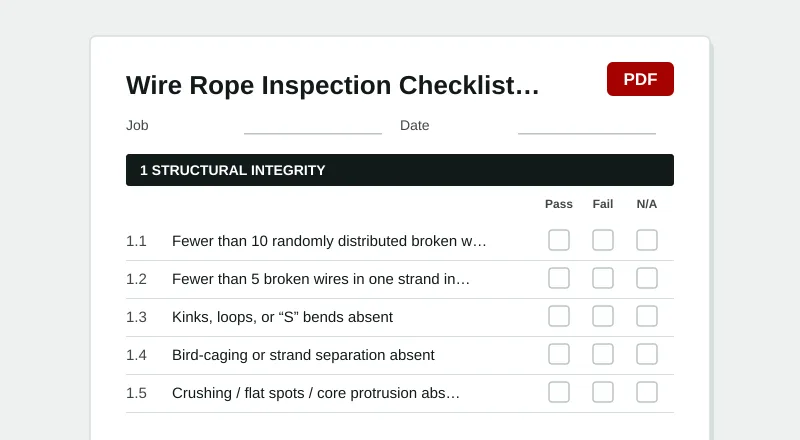
The full Wire Rope Inspection Checklist Form

Print it for the clipboard, or put it on your crew’s phones. Same 17 checks either way.

Your logo

Wire Rope Inspection Checklist Form

Use the Wire Rope Inspection Checklist to spot wire breaks, kinks, corrosion and heat damage, and log OSHA 1926.251 / 1910.184 and ASME B30.9 / B30.30 compliance before each lift.

Job
Date
Rope / Sling ID
Diameter & Construction
Working Load Limit (WLL)
Date Placed in Service
Ambient ConditionsClearRainSnowHeatChemical Vapors
Sling ID Tag Present & Legible (WLL, diameter, manufacturer)YesNo (remove sling from service)N/A (crane or hoist rope)

1 · Structural Integrity

1 · Structural IntegrityPassFailN/A
1.1Fewer than 10 randomly distributed broken wires in one rope lay (crane running rope: fewer than 6)
1.2Fewer than 5 broken wires in one strand in one rope lay (crane running rope: fewer than 3)
1.3Kinks, loops, or “S” bends absent
1.4Bird-caging or strand separation absent
1.5Crushing / flat spots / core protrusion absent

Photos · photo refs

2 · Surface Wear & Corrosion

2 · Surface Wear & CorrosionPassFailN/A
2.1Outer wire wear < 1/3 original dia.
2.2Uniform corrosion light; no pitting
2.3No heat discoloration / arc gouges
2.4Lubrication adequate; no dry sections

Photos · photo refs

3 · Diameter & Length Checks

3 · Diameter & Length ChecksPassFailN/A
3.1Diameter reduction ≤ 5 % of original
3.2Rope stretch / lay length normal
3.3Drum spooling even; no cross wraps

Photos · photo refs

4 · End Fittings & Hooks

4 · End Fittings & HooksPassFailN/A
4.1Socket / swage tight, no cracks
4.2Thimbles seated, no distortion
4.3Hook throat opening ≤ 5 % stretch
4.4Hook latch present & closes fully
4.5Eye splices whipped & tucks secure

Photos · photo refs

5 · Deficiency & Action

Log

SectionIssueAction RequiredTarget DateClosedNotes

Photos · photo refs

6 · Final Assessment

DispositionAll items Pass → Rope IN SERVICEAny Fail → Rope OUT OF SERVICE

7 · Sign-Off

Inspector / Rigger

Name
Signature
Date

Supervisor

Name
Signature
Date

Supervisor

Name
Signature
Date

References & Standards

  • OSHA 29 CFR 1926.251, Rigging Equipment for Material Handling (construction)
  • OSHA 29 CFR 1926.1413, Wire Rope: Inspection (cranes)
  • OSHA 29 CFR 1910.184, Slings
  • ASME B30.9, Slings
  • ASME B30.30, Ropes
  • ISO 4309, Cranes – Wire Ropes – Care & Maintenance
  • ASME B30.10, Hooks

Your AHJ and the code edition it has adopted govern. This checklist supports your inspection; it doesn’t replace the one your jurisdiction requires.

Free download

Wire Rope Inspection Checklist Form template: PDF, Word and Excel

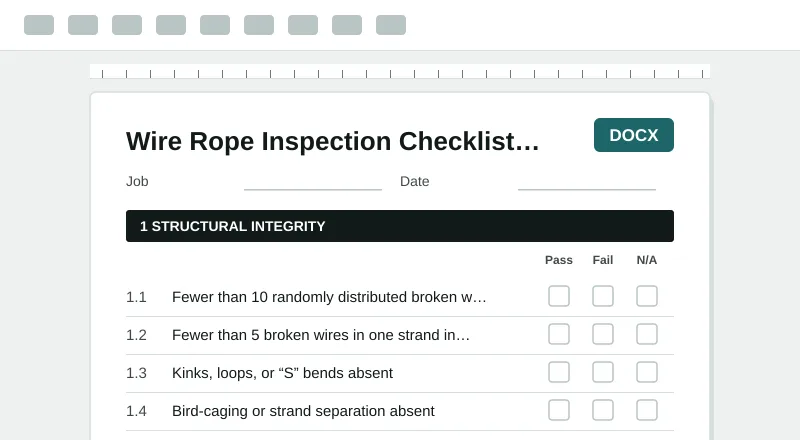
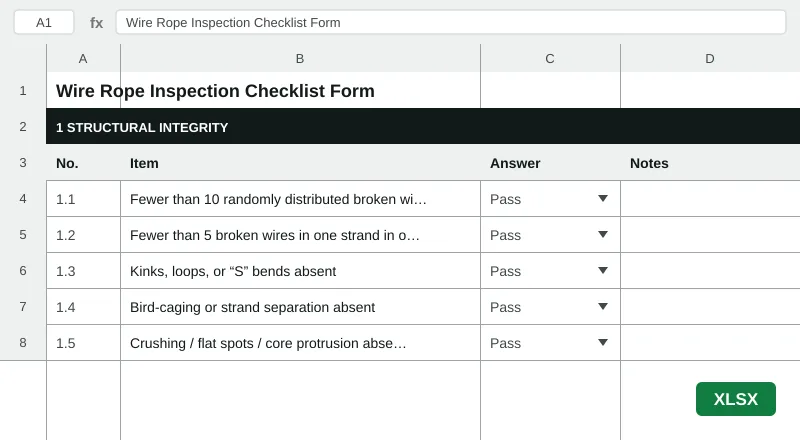
Print the form as it is, or download a template you can edit. Every format is free, with no email and no sign-up.

How to use it

How to run the Wire Rope Inspection Checklist Form

  1. 01

    Run it before the work is covered

    Walk it before the next trade closes things up or the area is handed over, and again after any fix. Fill in the header first so the record stands on its own.

  2. 02

    Work the sections in order

    Go through the 7 sections in order so nothing gets skipped. Answer every check: a blank isn’t an answer.

  3. 03

    Every miss gets a photo and an owner

    Write down what’s wrong, take a photo and name the trade that owns the fix, with a date.

  4. 04

    Re-check, sign, then release

    Walk the misses again once they’re fixed. Sign it off, and only then let the area close.

Why we built this

An inspection only counts if it’s written down

A miss found before the work is covered up is a quick fix. Found after, it’s a tear-out, a failed inspection and a schedule hit. The written record is how you prove the check happened.

  • Built for the field. Every check is written the way crews talk, with room for notes, photos and a signature.
  • Free, with no catch. No email, no account. Print it and hand it out.
  • On paper or on the phone. The same form runs on the Workyard app, filed to the job when it’s sent.

3,000+contractors run their crews on Workyard

Meet Workyard

Who we are

Workyard is the construction operations platform for specialty contractors and self-performing general contractors determined to grow without sacrificing job control or margins.

Forms like this one are what our customers’ crews fill in on Workyard every day, on the same app they clock in with.

workers on Workyard every day
100,000+
free templates, none of them gated
182

Forms & Workflows

Get every form back from every crew, every day

  • It shows up on its own. Attach it to a task, a job or clock-out, and it’s on the crew’s phone when it’s due.
  • It can’t be skipped. Make it required and the day can’t close until it’s in.
  • You see it the same day. Filed, flagged or missing, every job on one board, before anyone has to call.

$123,000cut from insurance costs at TR3 Group

More site inspections templates

Free templates for the rest of the job

Browse all templates

Questions

Wire Rope Inspection Checklist Form FAQs

How often should wire-rope slings be inspected?

Perform a user check before every shift and each critical lift. A competent person must complete and document a detailed inspection at least yearly for normal service or quarterly in harsh marine, mining, or demolition environments. Adhering to this cadence catches gradual wear and sudden damage alike.

What conditions require immediate removal from service?

Remove any rope showing ten random broken wires in one lay, five broken wires in one strand, kinks, birdcaging, heat or arc burns, one-third wear of outside wires, diameter reduction beyond tolerance, or hooks with throat openings grown more than 15 percent.

How can inspectors confirm internal damage they cannot see?

Use calipers to measure rope diameter at multiple points, comparing results to the original spec. A consistent reduction suggests core deterioration. For high-value lifts, non-destructive magnetic flux testing would reveal internal breaks or corrosion, providing quantitative evidence for retirement decisions.

Why keep detailed inspection records instead of simple tick marks?

Time-stamped photos, serial numbers, and measured wear trends prove diligence to OSHA, insurers, and customers. Records show how fast ropes deteriorate in specific tasks, enabling proactive replacement scheduling, accurate budgeting, and strong legal defense if an incident investigation questions maintenance practices.

Do I need a Workyard account to use it?

No. Print the paper form, save it as a PDF, or download the Word or Excel file, free, with no email and no sign-up. You only need an account to put the digital form on your crew’s phones.

Can I edit the template?

Yes. Download the Word or Excel version to add your logo, add checks from your project spec or remove sections you don’t need. They open in Google Docs and Google Sheets too.

How do I get my crew to fill it in on their phones?

Add the digital form to Workyard and attach it to the job or the task it belongs to. It shows up in the app your crew already clocks in with, and every form comes back signed, with its photos, filed to the job.

Trigger the form at the right moment

A job's Forms tab in Workyard: each form, the clock-in or clock-out that triggers it, and how many have been submitted
A van check filled in on the Workyard app: the damage photo, a description and the tech's signature, ready to submit

Book a demo with a Workyard specialist

Your local Workyard specialist

Works with 50 contractors across the US

Your details

30 min · Video call