



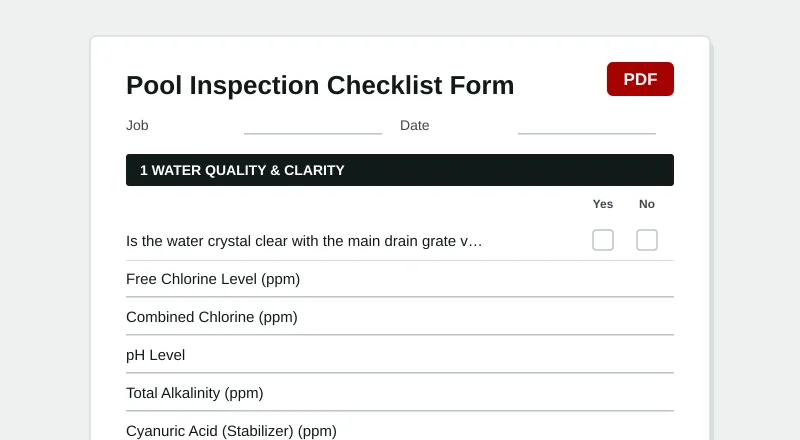
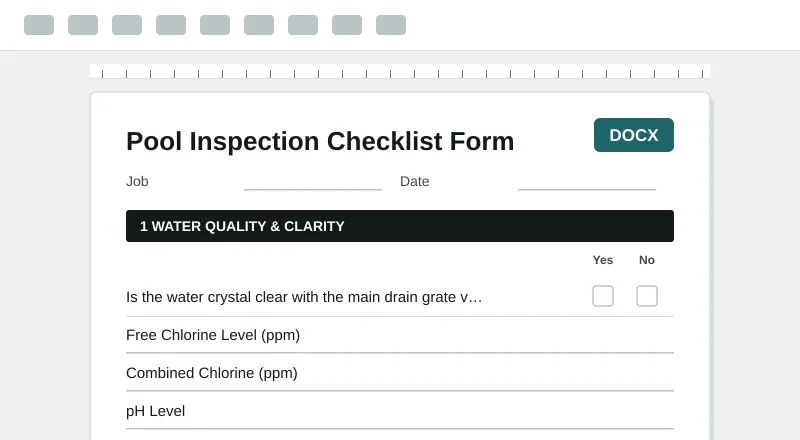
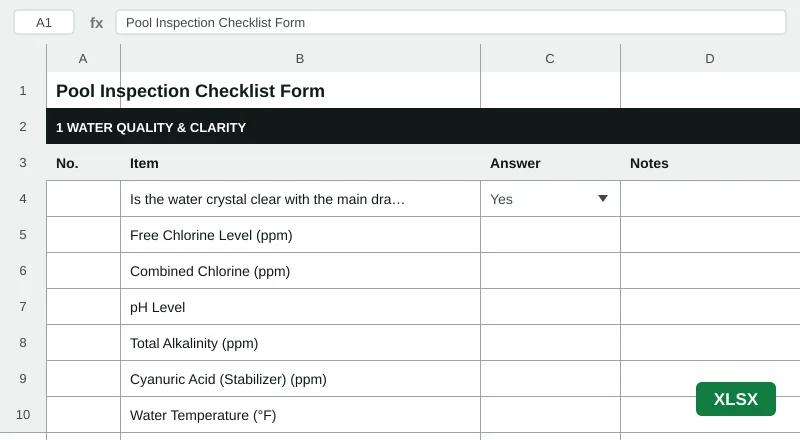
A pool inspection checklist is the record a pool tech, property manager or maintenance lead fills in to show a pool is safe to open: water chemistry, the pool and deck, rescue equipment, fencing and gates, signs, and the pump room. Hotels, apartment communities, HOAs, fitness centers and public pools run it on a set routine, and pool builders and service contractors use it at turnover and on service visits. The inspector finishes by marking the pool clear for use, with or without corrective actions, and signing.
What the pool inspection checklist covers
| Section | What gets checked |
|---|---|
| General information | Facility, location, pool type (indoor, outdoor, spa, wading pool), inspection type (daily, weekly, monthly), weather |
| Water quality and clarity | Main drain visible at the deepest point, chemistry readings, water temperature, test kit used, photos |
| Pool area and surfaces | Walls and floor, steps, ladders and rails, deck, depth and No Diving markers, rope and float line, skimmers and inlets, anti-entrapment drain covers, circulation |
| Safety equipment | Life ring with rope, rescue pole with body hook, first aid kit, emergency phone, spine board, AED where required, everything in date and in good repair |
| Perimeter security | Fence or barrier with no gaps, self-closing and self-latching gates, locks and alarms, no other way in, safety cover after hours |
| Signage | No Lifeguard on Duty, rules and emergency info, bather load, depth markings, chemical notices, signs in good repair |
| Maintenance and mechanical | Pump and filter, flow meter reading, GFCI protection near the water, chlorinators and pH feeders, chemical storage, SDS, PPE, logs up to date, emergency action plan |
| Comments, photos and confirmation | Notes, inspector name, date, signature, clear for use, next inspection date |
Comment on every No. A No with no note leaves the next person guessing what was wrong.
The swimming pool chemical inspection form section
The water quality section works as a swimming pool chemical inspection form on its own. It records free chlorine, combined chlorine, pH, total alkalinity, cyanuric acid and water temperature, and checks that readings came from a DPD test kit meeting NSF/ANSI Standard 50. The first check is the simplest: can you see the main drain grate at the deepest point? If not, the water is not clear enough to swim in.
Your state or county health code sets the acceptable range for each reading, so write those ranges at the top of your copy. The maintenance section backs up the readings: feeders working, chemicals labeled and locked in a ventilated area, SDS on site and the daily chemistry log current.
Commercial vs residential pool inspections
The form is written for shared pools: hotels, apartments, gyms and public facilities. Those pools usually answer to a health department, which can require rescue equipment, posted rules, a bather load and a written emergency action plan, so every section applies. Drain covers that meet the Virginia Graeme Baker (VGB) Act and electrical protection under NEC Article 680 are on the form for every pool. For a backyard pool, the water, surface, drain cover, fencing and gate, and electrical checks still matter. Mark the lifeguard, bather load and rescue gear rows N/A where your local code does not require them.
Free pool inspection forms, on paper or on a phone
Download this one free as a PDF, Word or Excel file, no sign-up needed. In Workyard it runs as a digital inspection form on staff phones, with photos per section, a signature on screen, any No flagged to a named person, and every inspection filed in the office for PDF or CSV export. For the rest of the property, see the facility inspection checklist and other property management forms.


