Checks hose condition, fittings and fluid level on a machine, then logs leaks, wear and the action taken, so a failing hose is replaced before it bursts.
System Depressurized: (Hydraulic system confirmed depressurized before work)YesNoN/A
Environmental Factors (No adjacent heat sources or hazards [fire, sparks] near hose.)YesNoN/A
Comments
Enter text
Pressure Test (If Applicable)
Pressure Test Checklist
Pressure Test Performed?YesNoN/A
Test Pressure (psi)
Enter text
Test Result
Select an option
Last Maintenance Date
Select a date
Comments
Enter text
Findings & Actions
Action Required
Select an option
Follow-Up Date
Select a date
Image Upload
Inspector Comments
Enter text
Inspector Name
Enter text
Inspector Signature
Sign here
Date of Inspection
Select a date
Submit
Scroll through the form
The template
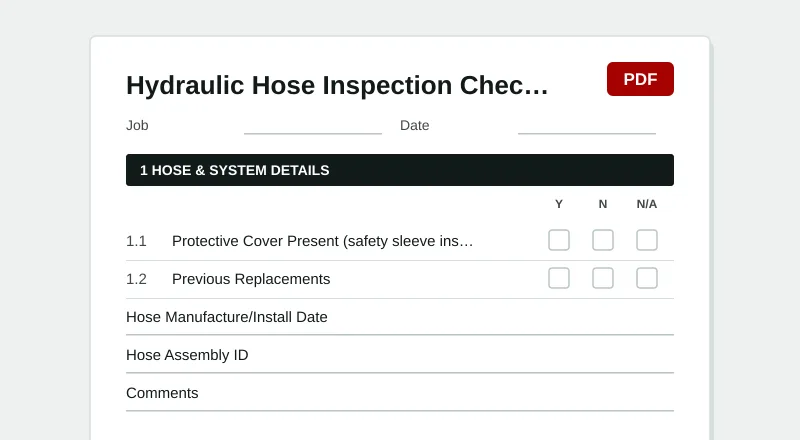
The full Hydraulic Hose Inspection Checklist
Print it for the clipboard, or put it on your crew’s phones. Same 17 checks either way.
Your logo
Hydraulic Hose Inspection Checklist
This free Hydraulic Hose Inspection Checklist is used to assess the safety and integrity of hydraulic hoses and fittings. It helps prevent leaks, blowouts, and downtime by identifying wear, abrasion, or improper installation.
Job
Date
Hydraulic Fluid TypeOilWaterOther
Total Service Hours
Rated System Pressure (psi)
Safety Preparedness (Equipment locked-out or depressurized for inspection)YesNo
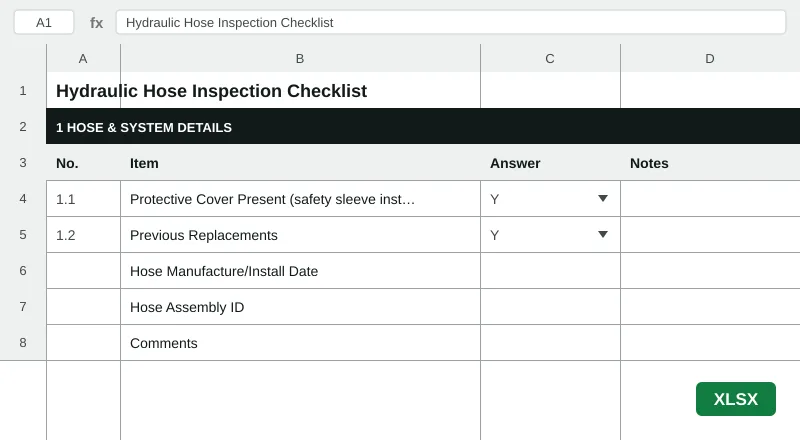
A spreadsheet with a dropdown for every answer, ready to fill in, sort and keep as a log.
Download Excel
How to use it
How to run the Hydraulic Hose Inspection Checklist
01
Check it before the first start
Do it at the start of every shift, before the machine moves, with the operator who’ll run it.
02
Walk around, then test from the seat
Work through the 6 sections: fluids and the walk-around first, then controls, brakes and safety devices with it running.
03
A fail means it stays parked
Tag out anything that fails and report it to the shop or the super, with a photo. It doesn’t run until it’s fixed.
04
Sign it and keep it with the machine
The operator signs. Keep each day’s sheet with the machine, so the next operator and the inspector can see its history.
Why we built this
Most breakdowns give a warning first
A leak, a worn hose, brakes that feel soft. A few minutes at the start of the shift catches them before they cost a day of downtime, or someone’s safety.
Built for the field. Every check is written the way crews talk, with room for notes, photos and a signature.
Free, with no catch. No email, no account. Print it and hand it out.
On paper or on the phone. The same form runs on the Workyard app, filed to the job when it’s sent.
Workyard is the construction operations platform for specialty contractors and self-performing general contractors determined to grow without sacrificing job control or margins.
Forms like this one are what our customers’ crews fill in on Workyard every day, on the same app they clock in with.
workers on Workyard every day
100,000+
free templates, none of them gated
182
Forms & Workflows
Get every form back from every crew, every day
It shows up on its own. Attach it to a task, a job or clock-out, and it’s on the crew’s phone when it’s due.
It can’t be skipped. Make it required and the day can’t close until it’s in.
You see it the same day. Filed, flagged or missing, every job on one board, before anyone has to call.
7:02 AMToolbox talkMeridian Business ParkRay T. · 12 signaturesFiled to job
9:40 AMSite inspectionFairview Clinic · L2 eastDiego M. · 8 photosFiled to job
11:15 AMSite inspectionFairview Clinic · L2 westFirestop answered No at grid C-4Flagged · to the PM
2:14 PMPre-start checkMeridian Business ParkExcavator 3 · Dana C. · signedFiled to job
4:30 PMDaily logRiverside TowerDue at clock-outMissing
Fairview L2 west: firestop at C-4 answered No. Photo attached, PM notified at 11:15 AM. The ceiling stays open until it’s fixed, not a box ticked on a sheet in the truck.
Power Cord and Plug: Is the power cord free of cuts, frays or splices, and is the plug intact?
Tool Housing: Is the saw’s body, handle and housing physically sound (no cracks, breaks or loose parts)?
Fixed (Upper) Guard: Is the upper guard securely in place and covering the top of the blade (except where tilted for bevel cuts)?
Retractable (Lower) Guard: Is the lower guard operable (automatically retracts when cutting and returns to cover the blade immediately when not cutting)?
Guard Condition: Are all guards (upper and lower) free of damage, corrosion, or deformation?
Regular inspections help identify damage or failure risks before they lead to fluid leaks or pressure loss. This protects both personnel and equipment from hydraulic-related hazards.
What are signs a hose needs replacement?
Common signs include cracking, bulging, abrasion, oil seepage, exposed wire braids, or leaks near the fittings. If any of these are present, the hose should be replaced immediately.
Who performs hydraulic hose inspections?
Maintenance technicians, heavy equipment operators, or hydraulic specialists typically perform these inspections. Training in fluid power systems is often required.
How often should hoses be checked?
Inspection frequency varies by usage, but daily checks before operation and monthly detailed reviews are common in high-use or mission-critical equipment.
Do I need a Workyard account to use it?
No. Print the paper form, save it as a PDF, or download the Word or Excel file, free, with no email and no sign-up. You only need an account to put the digital form on your crew’s phones.
Can I edit the template?
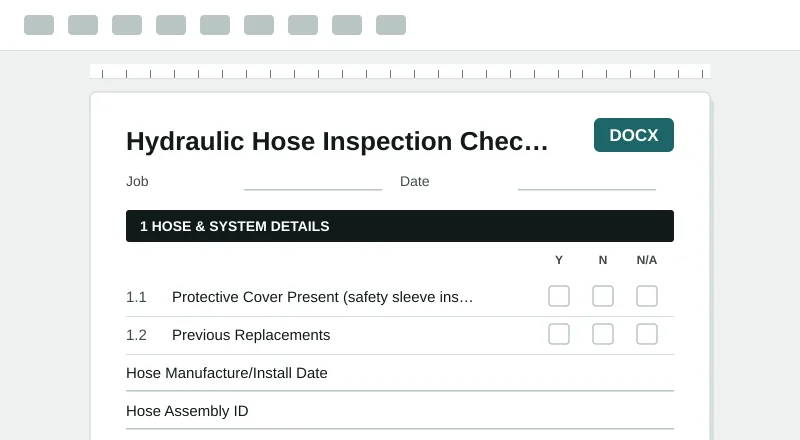
Yes. Download the Word or Excel version to add your logo, add checks from your project spec or remove sections you don’t need. They open in Google Docs and Google Sheets too.
How do I get my crew to fill it in on their phones?
Add the digital form to Workyard and attach it to the job or the task it belongs to. It shows up in the app your crew already clocks in with, and every form comes back signed, with its photos, filed to the job.