

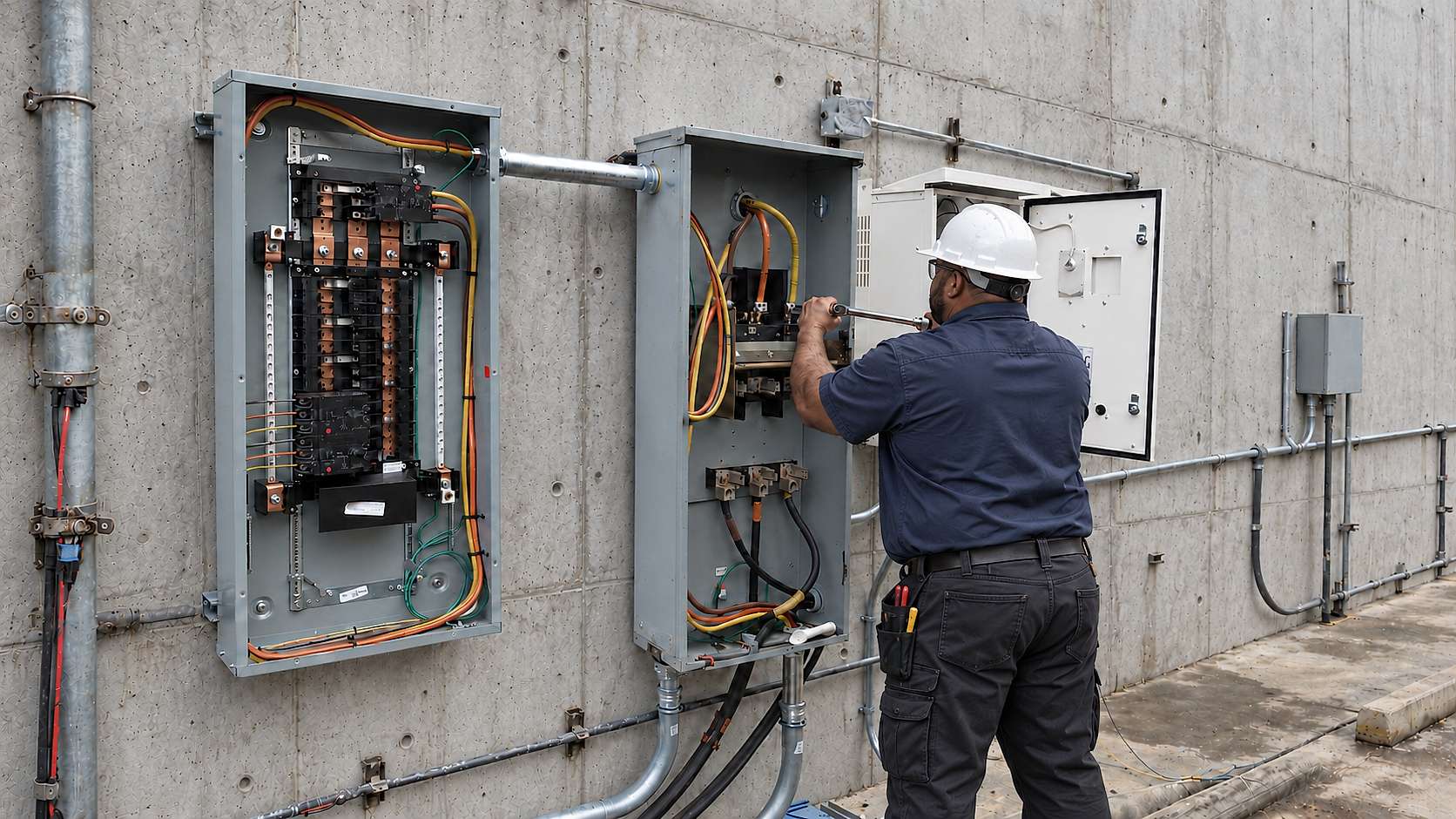

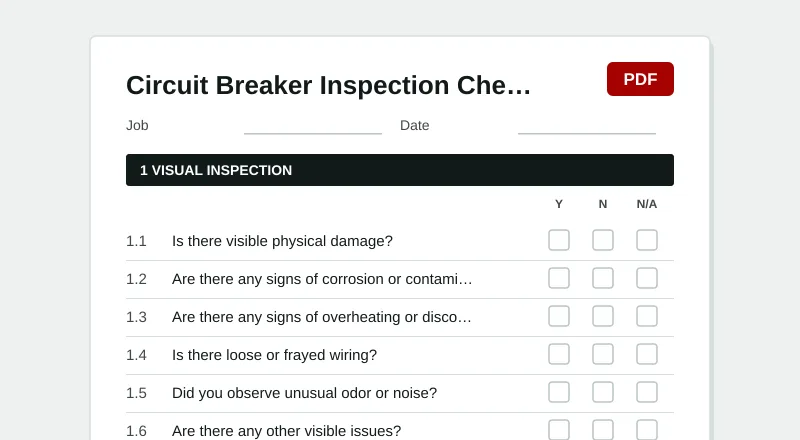
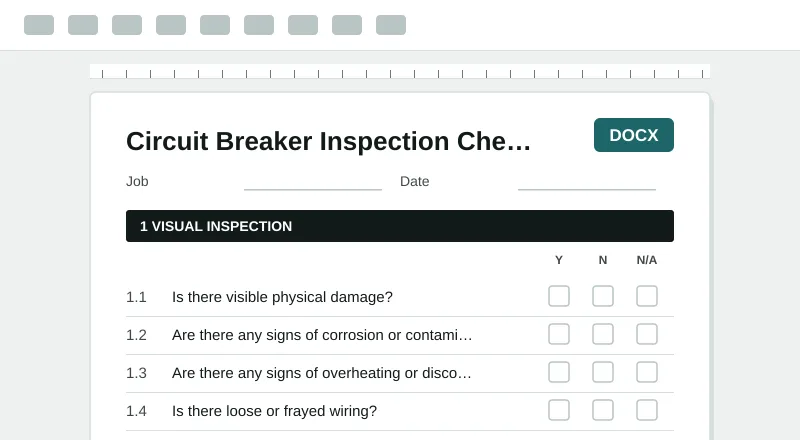
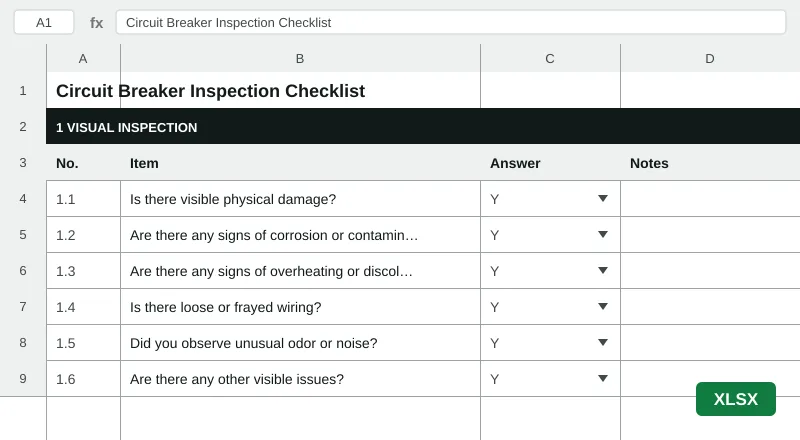
A circuit breaker inspection records the condition of one breaker and the panel around it: visible damage, heat, how the handle operates, whether it trips, whether it is labeled and rated right for the circuit, and what needs fixing. Electricians, facility maintenance techs and electrical contractors use the form on residential, commercial and industrial panels, on main panels, subpanels and control rooms, during routine maintenance, after a trip or a burning smell, or before taking over a building. The inspector signs, and the overall condition tells the office whether it can wait.
What the circuit breaker inspection checklist covers
| Section | What gets recorded |
|---|---|
| General information | Panel or location, breaker ID or circuit, rating in amps, type (molded case, GFCI/AFCI, main disconnect, branch circuit), residential, commercial or industrial, energized or locked out, qualified person, arc-flash PPE and approach boundaries |
| Visual inspection | Physical damage, corrosion or contamination, overheating or discoloration, loose or frayed wiring, odor or noise |
| Thermal and mechanical checks | Thermographic scan done, thermal anomaly found, max temperature, hotspot location, manual operation (smooth, stiff, not performed), trip function test |
| Panel condition and compliance | Cover secure, unused openings sealed, interior clean, connections tight, breaker labeled, panel accessible, rating and coordination match the circuit, grounding and bonding secure, protection from the environment |
| Summary and recommendations | Overall condition, corrective action needed, actions taken during the inspection, compliance notes, photos, inspector name, date and sign-off |
The visual checks follow NFPA 70B and OSHA. The summary uses three levels: OK, minor issues, and critical issues needing immediate action. Anything critical should reach a supervisor the same day.
Before you open the panel: energized or locked out
Decide first whether the inspection happens live or de-energized, and record it. A thermal scan has to be done under load, so it is usually energized work. If the panel is live, the form asks you to confirm a qualified person is doing the work and is wearing arc-flash PPE that matches the equipment label under NFPA 70E, with approach boundaries set. If you are working inside the panel, lock it out first and use your lockout/tagout procedure.
Replacing a breaker is a job for a licensed electrician under local and federal electrical codes, as the form notes. If the inspection finds a breaker to replace, record it as a corrective action and leave the swap to the electrician.
How to label a circuit breaker panel
"Is the breaker properly labeled?" is one of the panel checks, and an unclear directory is one of the easiest findings to fix. A good label:
- Names what the circuit actually feeds and where, such as "Kitchen counter receptacles, north wall", not "Kitchen" or "Plugs".
- Matches the breaker's position number in the panel directory.
- Is legible and permanent, typed or printed, not pencil on the door.
- Gets updated whenever a circuit is added, moved or removed.
Your electrical code requires each circuit to be identified, so check the local requirements. Confirm each label by switching the breaker off and checking what goes dead, rather than trusting the old directory.
Run it on a phone or download it free
In Workyard the checklist runs as a digital inspection form on the electrician's phone, with thermal and panel photos, a signature on screen, critical findings flagged to a named person, and every inspection filed to the job for PDF or CSV export. For the whole panel, use the electrical panel inspection checklist, and isolate energy with the lockout/tagout form. You can also download it free as a PDF, Word or Excel file, no sign-up needed.


