Power Cord and Plug: Is the power cord free of cuts, frays or splices, and is the plug intact?
1.2
Tool Housing: Is the saw’s body, handle and housing physically sound (no cracks, breaks or loose parts)?
1.3
Fixed (Upper) Guard: Is the upper guard securely in place and covering the top of the blade (except where tilted for bevel cuts)?
1.4
Retractable (Lower) Guard: Is the lower guard operable (automatically retracts when cutting and returns to cover the blade immediately when not cutting)?
1.5
Guard Condition: Are all guards (upper and lower) free of damage, corrosion, or deformation?
1.6
Switch/Trigger Condition: Is the on/off trigger/switch in good condition and properly insulated?
1.7
Automatic Lock-off (Constant Pressure) Control: Does the saw have a constant-pressure trigger that stops the motor when released?
Blade Condition Checklist
Y
N
N/A
1.8
Blade Condition: Is the blade free of cracks, chips, missing teeth, and suitably sharp?
1.9
Blade Rating: Is the blade’s maximum RPM marked, legible and at least the saw’s no-load speed?
1.10
Blade Tightness Key: Is the blade-change key (spindle lock key) present and used when installing blades?
2 · Electrical Safety
Y
N
N/A
2.1
Ground/Insulation: Is the saw double-insulated or properly grounded?
2.2
Electrical Connection: Are all cable connections secure and free of loose wires?
2.3
GFCI Protection: Is the saw plugged into a GFCI-protected outlet or covered by an assured equipment grounding conductor program?
2.4
Work Area: Is the operating area dry, well-lit, and free of obstructions or trip hazards?
3 · Operational & PPE Verification
Y
N
N/A
3.1
Correct Blade for Material: Is the blade type appropriate for the material being cut (e.g. wood vs. metal)?
3.2
Blade Size & Arbor: Are the blade diameter and arbor hole correct for this saw?
3.3
PPE Usage: Is the operator wearing all required PPE? (Eye protection, hearing protection, gloves, etc.)
3.4
Operator Qualification: Is the operator trained and competent to use this saw?
Power Cord and Plug: Is the power cord free of cuts, frays or splices, and is the plug intact?YesNoN/A
Tool Housing: Is the saw’s body, handle and housing physically sound (no cracks, breaks or loose parts)?YesNoN/A
Fixed (Upper) Guard: Is the upper guard securely in place and covering the top of the blade (except where tilted for bevel cuts)?YesNoN/A
Retractable (Lower) Guard: Is the lower guard operable (automatically retracts when cutting and returns to cover the blade immediately when not cutting)?YesNoN/A
Guard Condition: Are all guards (upper and lower) free of damage, corrosion, or deformation?YesNoN/A
Switch/Trigger Condition: Is the on/off trigger/switch in good condition and properly insulated?YesNoN/A
Automatic Lock-off (Constant Pressure) Control: Does the saw have a constant-pressure trigger that stops the motor when released?YesNoN/A
Blade Condition Checklist
Blade Condition: Is the blade free of cracks, chips, missing teeth, and suitably sharp?YesNoN/A
Blade Rating: Is the blade’s maximum RPM marked, legible and at least the saw’s no-load speed?YesNoN/A
Blade Tightness Key: Is the blade-change key (spindle lock key) present and used when installing blades?YesNoN/A
Electrical Safety
Electrical Safety Checklist
Ground/Insulation: Is the saw double-insulated or properly grounded?YesNoN/A
Electrical Connection: Are all cable connections secure and free of loose wires?YesNoN/A
GFCI Protection: Is the saw plugged into a GFCI-protected outlet or covered by an assured equipment grounding conductor program?YesNoN/A
Work Area: Is the operating area dry, well-lit, and free of obstructions or trip hazards?YesNoN/A
Operational & PPE Verification
Operational & PPE Checklist
Correct Blade for Material: Is the blade type appropriate for the material being cut (e.g. wood vs. metal)?YesNoN/A
Blade Size & Arbor: Are the blade diameter and arbor hole correct for this saw?YesNoN/A
PPE Usage: Is the operator wearing all required PPE? (Eye protection, hearing protection, gloves, etc.)YesNoN/A
Operator Qualification: Is the operator trained and competent to use this saw?YesNoN/A
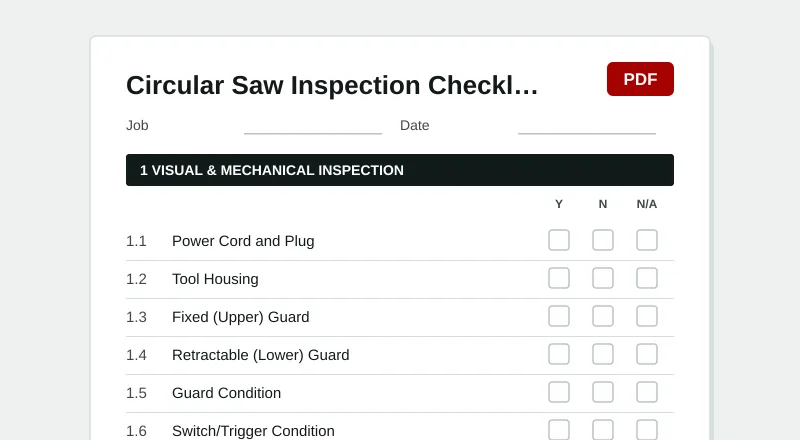
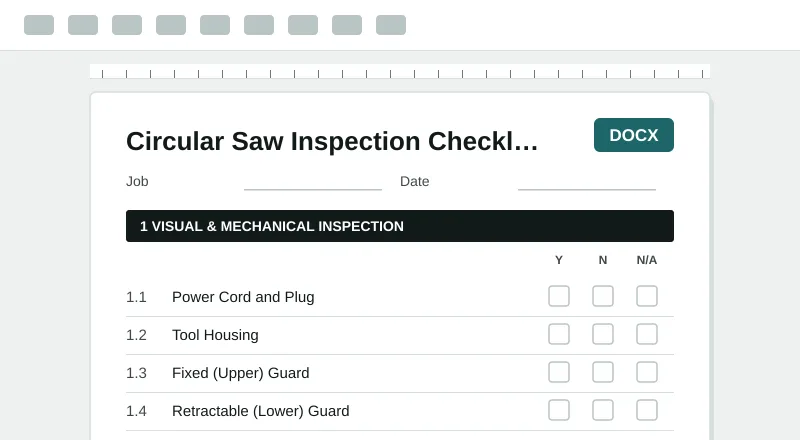
Print it for the clipboard, or put it on your crew’s phones. Same 18 checks either way.
Your logo
Circular Saw Inspection Checklist
This free Circular Saw Inspection Checklist is used to assess the condition, functionality, and safety of portable circular saws. It documents issues related to blades, guards, electrical connections, and cleanliness. This form helps ensure the tool is safe, operable, and compliant with jobsite safety rules before use.
Job
Date
1 · Visual & Mechanical Inspection
Y
N
N/A
1.1
Power Cord and Plug: Is the power cord free of cuts, frays or splices, and is the plug intact?
1.2
Tool Housing: Is the saw’s body, handle and housing physically sound (no cracks, breaks or loose parts)?
1.3
Fixed (Upper) Guard: Is the upper guard securely in place and covering the top of the blade (except where tilted for bevel cuts)?
1.4
Retractable (Lower) Guard: Is the lower guard operable (automatically retracts when cutting and returns to cover the blade immediately when not cutting)?
1.5
Guard Condition: Are all guards (upper and lower) free of damage, corrosion, or deformation?
1.6
Switch/Trigger Condition: Is the on/off trigger/switch in good condition and properly insulated?
1.7
Automatic Lock-off (Constant Pressure) Control: Does the saw have a constant-pressure trigger that stops the motor when released?
Blade Condition Checklist
Y
N
N/A
1.8
Blade Condition: Is the blade free of cracks, chips, missing teeth, and suitably sharp?
1.9
Blade Rating: Is the blade’s maximum RPM marked, legible and at least the saw’s no-load speed?
1.10
Blade Tightness Key: Is the blade-change key (spindle lock key) present and used when installing blades?
2 · Electrical Safety
Y
N
N/A
2.1
Ground/Insulation: Is the saw double-insulated or properly grounded?
2.2
Electrical Connection: Are all cable connections secure and free of loose wires?
2.3
GFCI Protection: Is the saw plugged into a GFCI-protected outlet or covered by an assured equipment grounding conductor program?
2.4
Work Area: Is the operating area dry, well-lit, and free of obstructions or trip hazards?
3 · Operational & PPE Verification
Y
N
N/A
3.1
Correct Blade for Material: Is the blade type appropriate for the material being cut (e.g. wood vs. metal)?
3.2
Blade Size & Arbor: Are the blade diameter and arbor hole correct for this saw?
3.3
PPE Usage: Is the operator wearing all required PPE? (Eye protection, hearing protection, gloves, etc.)
3.4
Operator Qualification: Is the operator trained and competent to use this saw?
Power Cord and Plug: Is the power cord free of cuts, frays or splices, and is the plug intact?YesNoN/A
Tool Housing: Is the saw’s body, handle and housing physically sound (no cracks, breaks or loose parts)?YesNoN/A
Fixed (Upper) Guard: Is the upper guard securely in place and covering the top of the blade (except where tilted for bevel cuts)?YesNoN/A
Retractable (Lower) Guard: Is the lower guard operable (automatically retracts when cutting and returns to cover the blade immediately when not cutting)?YesNoN/A
Guard Condition: Are all guards (upper and lower) free of damage, corrosion, or deformation?YesNoN/A
Switch/Trigger Condition: Is the on/off trigger/switch in good condition and properly insulated?YesNoN/A
Automatic Lock-off (Constant Pressure) Control: Does the saw have a constant-pressure trigger that stops the motor when released?YesNoN/A
Blade Condition Checklist
Blade Condition: Is the blade free of cracks, chips, missing teeth, and suitably sharp?YesNoN/A
Blade Rating: Is the blade’s maximum RPM marked, legible and at least the saw’s no-load speed?YesNoN/A
Blade Tightness Key: Is the blade-change key (spindle lock key) present and used when installing blades?YesNoN/A
Electrical Safety
Electrical Safety Checklist
Ground/Insulation: Is the saw double-insulated or properly grounded?YesNoN/A
Electrical Connection: Are all cable connections secure and free of loose wires?YesNoN/A
GFCI Protection: Is the saw plugged into a GFCI-protected outlet or covered by an assured equipment grounding conductor program?YesNoN/A
Work Area: Is the operating area dry, well-lit, and free of obstructions or trip hazards?YesNoN/A
Operational & PPE Verification
Operational & PPE Checklist
Correct Blade for Material: Is the blade type appropriate for the material being cut (e.g. wood vs. metal)?YesNoN/A
Blade Size & Arbor: Are the blade diameter and arbor hole correct for this saw?YesNoN/A
PPE Usage: Is the operator wearing all required PPE? (Eye protection, hearing protection, gloves, etc.)YesNoN/A
Operator Qualification: Is the operator trained and competent to use this saw?YesNoN/A
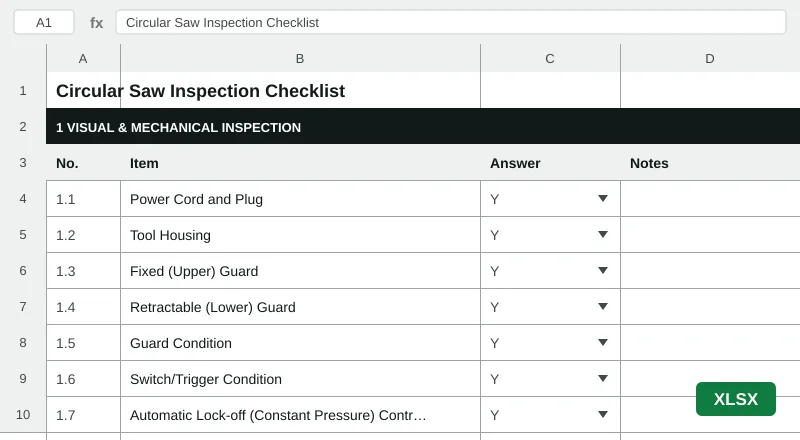
A spreadsheet with a dropdown for every answer, ready to fill in, sort and keep as a log.
Download Excel
How to use it
How to run the Circular Saw Inspection Checklist
01
Check it before the first start
Do it at the start of every shift, before the machine moves, with the operator who’ll run it.
02
Walk around, then test from the seat
Work through the 5 sections: fluids and the walk-around first, then controls, brakes and safety devices with it running.
03
A fail means it stays parked
Tag out anything that fails and report it to the shop or the super, with a photo. It doesn’t run until it’s fixed.
04
Sign it and keep it with the machine
The operator signs. Keep each day’s sheet with the machine, so the next operator and the inspector can see its history.
Why we built this
Most breakdowns give a warning first
A leak, a worn hose, brakes that feel soft. A few minutes at the start of the shift catches them before they cost a day of downtime, or someone’s safety.
Built for the field. Every check is written the way crews talk, with room for notes, photos and a signature.
Free, with no catch. No email, no account. Print it and hand it out.
On paper or on the phone. The same form runs on the Workyard app, filed to the job when it’s sent.
Workyard is the construction operations platform for specialty contractors and self-performing general contractors determined to grow without sacrificing job control or margins.
Forms like this one are what our customers’ crews fill in on Workyard every day, on the same app they clock in with.
workers on Workyard every day
100,000+
free templates, none of them gated
182
Forms & Workflows
Get every form back from every crew, every day
It shows up on its own. Attach it to a task, a job or clock-out, and it’s on the crew’s phone when it’s due.
It can’t be skipped. Make it required and the day can’t close until it’s in.
You see it the same day. Filed, flagged or missing, every job on one board, before anyone has to call.
7:02 AMToolbox talkMeridian Business ParkRay T. · 12 signaturesFiled to job
9:40 AMSite inspectionFairview Clinic · L2 eastDiego M. · 8 photosFiled to job
11:15 AMSite inspectionFairview Clinic · L2 westFirestop answered No at grid C-4Flagged · to the PM
2:14 PMPre-start checkMeridian Business ParkExcavator 3 · Dana C. · signedFiled to job
4:30 PMDaily logRiverside TowerDue at clock-outMissing
Fairview L2 west: firestop at C-4 answered No. Photo attached, PM notified at 11:15 AM. The ceiling stays open until it’s fixed, not a box ticked on a sheet in the truck.
More equipment pre-start checks templates
Free templates for the rest of the job
Circuit Breaker Inspection Checklist
Visual InspectionYNN/A
Is there visible physical damage?
Are there any signs of corrosion or contamination?
Are there any signs of overheating or discoloration?
Inspecting a circular saw before use helps identify potential safety issues such as dull or cracked blades, loose guards, or damaged power cords. Catching these issues early prevents accidents and ensures the tool operates as intended.
Is a daily inspection required?
Yes, in most safety-conscious work environments, daily inspections are required—especially when tools are shared among workers. A daily inspection ensures each operator uses the tool in a safe and compliant condition.
Who fills out this inspection?
Typically, the assigned operator completes the inspection at the beginning of their shift or before each use. Some sites may require safety officers to sign off periodically for documentation purposes.
What happens if the saw fails inspection?
If the saw fails inspection, it should be taken out of service immediately and reported to the supervisor or tool crib. The tool should not be used again until the identified issues are resolved and it passes re-inspection.
Do I need a Workyard account to use it?
No. Print the paper form, save it as a PDF, or download the Word or Excel file, free, with no email and no sign-up. You only need an account to put the digital form on your crew’s phones.
Can I edit the template?
Yes. Download the Word or Excel version to add your logo, add checks from your project spec or remove sections you don’t need. They open in Google Docs and Google Sheets too.
How do I get my crew to fill it in on their phones?
Add the digital form to Workyard and attach it to the job or the task it belongs to. It shows up in the app your crew already clocks in with, and every form comes back signed, with its photos, filed to the job.