Saw fueled at least 10 ft from ignition sources, started at least 10 ft from the fueling area, on the ground or firmly supported (no drop starting)
Select an option
Chain / bar oil full, pump is working.
Select an option
Personal Protective Equipment (PPE) Checks
PPE checklist
Hard hat (ANSI Z89.1) worn & in good condition
Select an option
Eye/face protection (ANSI Z87.1) worn & in good condition
Select an option
Hearing protection worn & in good condition
Select an option
Cut-resistant work gloves worn & in good condition
Select an option
Chainsaw chaps worn & in good condition
Select an option
Cut-resistant (chainsaw-protective) boots worn & in good condition
Select an option
Hi-vis vest worn (low-light or roadside work)
Select an option
Worksite Safety Checks
Area clear of people
Select an option
No bystanders within danger zone
Select an option
Obstacles removed for stable footing
Select an option
Escape / Retreat Path Identified
Select an option
Hand signals or radio contact with team established
Select an option
Overhead hazards noted
Select an option
Weather related risks identified
Select an option
Job plan including safety plan briefed before starting work
Select an option
Confirmation & Signature
Photo Upload (Optional)
Operator Name
Enter text
Operator Date & Time
Select a date
Operator Signature
Sign here
Submit
Scroll through the form
The template
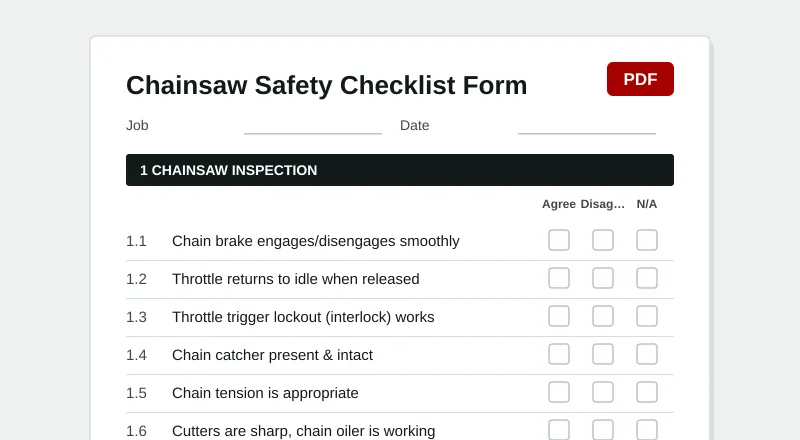
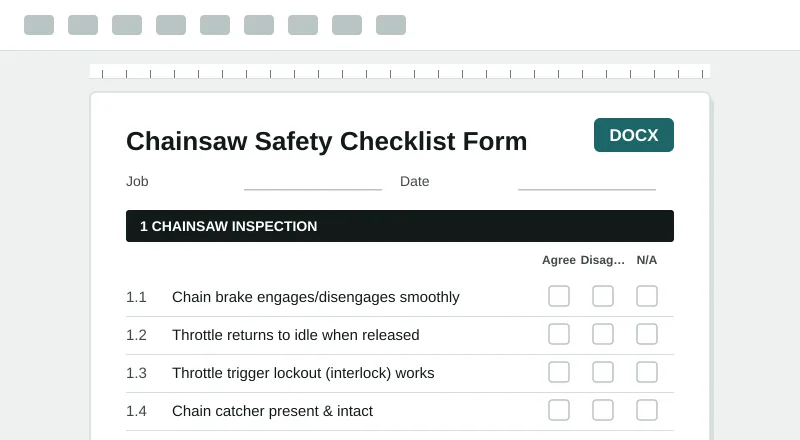
The full Chainsaw Safety Checklist Form
Print it for the clipboard, or put it on your crew’s phones. Same 27 checks either way.
Your logo
Chainsaw Safety Checklist Form
This Chainsaw Safety Checklist helps crews document pre-use inspections aligned with OSHA 29 CFR 1910.266 and ANSI standards. It standardizes checks on equipment and PPE to reduce risk and support compliance, and is optimized for use by field workers using mobile devices.
Job
Date
Job Location
Saw identifier (equipment ID or serial #)
1 · Chainsaw Inspection
Agree
Disagree
N/A
Note(s)
1.1
Chain brake engages/disengages smoothly
1.2
Throttle returns to idle when released
1.3
Throttle trigger lockout (interlock) works
1.4
Chain catcher present & intact
1.5
Chain tension is appropriate
1.6
Cutters are sharp, chain oiler is working
1.7
Muffler & guard present and intact
1.8
All handles, covers & guards are tight
1.9
With saw off/idling, chain does not move
1.10
Fuel level is sufficient for job
1.11
Saw fueled at least 10 ft from ignition sources, started at least 10 ft from the fueling area, on the ground or firmly supported (no drop starting)
1.12
Chain / bar oil full, pump is working.
2 · Personal Protective Equipment (PPE) Checks
Agree
Disagree
N/A
Note(s)
2.1
Hard hat (ANSI Z89.1) worn & in good condition
2.2
Eye/face protection (ANSI Z87.1) worn & in good condition
2.3
Hearing protection worn & in good condition
2.4
Cut-resistant work gloves worn & in good condition
2.5
Chainsaw chaps worn & in good condition
2.6
Cut-resistant (chainsaw-protective) boots worn & in good condition
2.7
Hi-vis vest worn (low-light or roadside work)
3 · Worksite Safety Checks
Agree
Disagree
N/A
Note(s)
3.1
Area clear of people
3.2
No bystanders within danger zone
3.3
Obstacles removed for stable footing
3.4
Escape / Retreat Path Identified
3.5
Hand signals or radio contact with team established
3.6
Overhead hazards noted
3.7
Weather related risks identified
3.8
Job plan including safety plan briefed before starting work
4 · Confirmation & Signature
Photo Upload (Optional) · photo refs
Operator Name
Operator Date & Time
Name
Signature
Date
Chainsaw Safety Checklist Form on a phone
Chainsaw Safety Checklist Form
Job *
26-104 Riverside DuplexesSelect a job
Oct 14, 8:12 AM26-104 Riverside Duplexes
Chainsaw Inspection
Chain brake engages/disengages smoothly
AgreeSelect an option
Throttle returns to idle when released
AgreeSelect an option
Throttle trigger lockout (interlock) works
AgreeSelect an option
Chain catcher present & intact
AgreeSelect an option
Chain tension is appropriate
AgreeSelect an option
Cutters are sharp, chain oiler is working
AgreeSelect an option
Muffler & guard present and intact
AgreeSelect an option
All handles, covers & guards are tight
AgreeSelect an option
With saw off/idling, chain does not move
AgreeSelect an option
Fuel level is sufficient for job
AgreeSelect an option
Saw fueled at least 10 ft from ignition sources, started at least 10 ft from the fueling area, on the ground or firmly supported (no drop starting)
AgreeSelect an option
Chain / bar oil full, pump is working.
AgreeSelect an option
Personal Protective Equipment (PPE) Checks
PPE checklist
Hard hat (ANSI Z89.1) worn & in good condition
AgreeSelect an option
Eye/face protection (ANSI Z87.1) worn & in good condition
AgreeSelect an option
Hearing protection worn & in good condition
AgreeSelect an option
Cut-resistant work gloves worn & in good condition
AgreeSelect an option
Chainsaw chaps worn & in good condition
AgreeSelect an option
Cut-resistant (chainsaw-protective) boots worn & in good condition
AgreeSelect an option
Hi-vis vest worn (low-light or roadside work)
AgreeSelect an option
Worksite Safety Checks
Area clear of people
AgreeSelect an option
No bystanders within danger zone
AgreeSelect an option
Obstacles removed for stable footing
AgreeSelect an option
Escape / Retreat Path Identified
AgreeSelect an option
Hand signals or radio contact with team established
AgreeSelect an option
Overhead hazards noted
AgreeSelect an option
Weather related risks identified
AgreeSelect an option
Job plan including safety plan briefed before starting work
AgreeSelect an option
Confirmation & Signature
Photo Upload (Optional)
Operator Name
Enter text
Operator Date & Time
Oct 14, 2026Select a date
Operator Signature
Signed on the phone
Submit
The digital form
Same checklist, on every phone on the job
Shows up when it’s due. Triggered by the job assignment, or at clock-in or clock-out. Nobody has to remember it.
Pre-filled before they start. Job, date and inspector fill in on their own, so the crew only answers the checks.
Photos and other media, attached. Snapped on the spot and saved with the answers they explain.
Never lose a form again. Every one is filed to the job the moment it’s sent. No data entry back at the office.
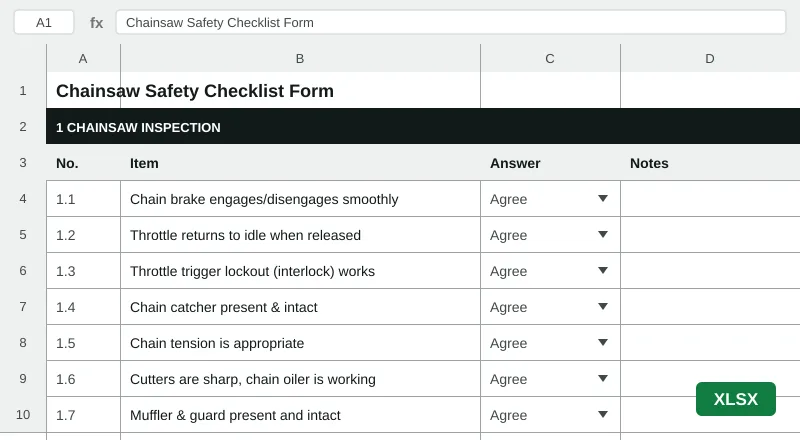
A spreadsheet with a dropdown for every answer, ready to fill in, sort and keep as a log.
Download Excel
How to use it
How to run the Chainsaw Safety Checklist Form
01
Check it before the first start
Do it at the start of every shift, before the machine moves, with the operator who’ll run it.
02
Walk around, then test from the seat
Work through the 4 sections: fluids and the walk-around first, then controls, brakes and safety devices with it running.
03
A fail means it stays parked
Tag out anything that fails and report it to the shop or the super, with a photo. It doesn’t run until it’s fixed.
04
Sign it and keep it with the machine
The operator signs. Keep each day’s sheet with the machine, so the next operator and the inspector can see its history.
Why we built this
Most breakdowns give a warning first
A leak, a worn hose, brakes that feel soft. A few minutes at the start of the shift catches them before they cost a day of downtime, or someone’s safety.
Built for the field. Every check is written the way crews talk, with room for notes, photos and a signature.
Free, with no catch. No email, no account. Print it and hand it out.
On paper or on the phone. The same form runs on the Workyard app, filed to the job when it’s sent.
Workyard is the construction operations platform for specialty contractors and self-performing general contractors determined to grow without sacrificing job control or margins.
Forms like this one are what our customers’ crews fill in on Workyard every day, on the same app they clock in with.
workers on Workyard every day
100,000+
free templates, none of them gated
182
Forms & Workflows
Get every form back from every crew, every day
It shows up on its own. Attach it to a task, a job or clock-out, and it’s on the crew’s phone when it’s due.
It can’t be skipped. Make it required and the day can’t close until it’s in.
You see it the same day. Filed, flagged or missing, every job on one board, before anyone has to call.
7:02 AMToolbox talkMeridian Business ParkRay T. · 12 signaturesFiled to job
9:40 AMSite inspectionFairview Clinic · L2 eastDiego M. · 8 photosFiled to job
11:15 AMSite inspectionFairview Clinic · L2 westFirestop answered No at grid C-4Flagged · to the PM
2:14 PMPre-start checkMeridian Business ParkExcavator 3 · Dana C. · signedFiled to job
4:30 PMDaily logRiverside TowerDue at clock-outMissing
Fairview L2 west: firestop at C-4 answered No. Photo attached, PM notified at 11:15 AM. The ceiling stays open until it’s fixed, not a box ticked on a sheet in the truck.
More equipment pre-start checks templates
Free templates for the rest of the job
Circuit Breaker Inspection Checklist
Visual InspectionYNN/A
Is there visible physical damage?
Are there any signs of corrosion or contamination?
Are there any signs of overheating or discoloration?
Power Cord and Plug: Is the power cord free of cuts, frays or splices, and is the plug intact?
Tool Housing: Is the saw’s body, handle and housing physically sound (no cracks, breaks or loose parts)?
Fixed (Upper) Guard: Is the upper guard securely in place and covering the top of the blade (except where tilted for bevel cuts)?
Retractable (Lower) Guard: Is the lower guard operable (automatically retracts when cutting and returns to cover the blade immediately when not cutting)?
Guard Condition: Are all guards (upper and lower) free of damage, corrosion, or deformation?
1. What are the 5 point safety checks on a chainsaw?
The most common pre-use safety checks include: (1) chain tension, (2) chain brake function, (3) chain lubrication flow, (4) throttle lock operation, and (5) proper PPE. These checks help prevent injuries and mechanical failure before the saw is put to work.
2. What safety gear is required when using a chainsaw?
OSHA and ANSI standards recommend a hard hat, eye and ear protection, chainsaw chaps, gloves, and sturdy boots. This PPE must be worn at all times while operating a chainsaw, especially on job sites with multiple workers or heavy vegetation.
3. Can a chainsaw be used without a working chain brake?
No, chainsaws must not be used if the chain brake is broken or untested. The chain brake is a key safety feature that helps prevent kickback injuries. Always confirm it functions properly before each use, as required by OSHA and ANSI safety guidelines.
4. Are chainsaw safety checklists required by OSHA?
OSHA doesn’t mandate the use of a specific checklist, but it does require regular inspections and documented safety procedures. A daily checklist helps meet these expectations and shows due diligence during audits, training, or incident reviews.
Do I need a Workyard account to use it?
No. Print the paper form, save it as a PDF, or download the Word or Excel file, free, with no email and no sign-up. You only need an account to put the digital form on your crew’s phones.
Can I edit the template?
Yes. Download the Word or Excel version to add your logo, add checks from your project spec or remove sections you don’t need. They open in Google Docs and Google Sheets too.
How do I get my crew to fill it in on their phones?
Add the digital form to Workyard and attach it to the job or the task it belongs to. It shows up in the app your crew already clocks in with, and every form comes back signed, with its photos, filed to the job.