Skip to content
Log InBook a demo
Book a demo
Free template · paper and digital

Hoist Inspection Checklist

Daily pre-use checks for a hoist, plus extra monthly and annual items, with pass or fail marked on each line.

WordExcel
  • No email
  • No sign-up
  • Edit it, add your logo
See every check

The template

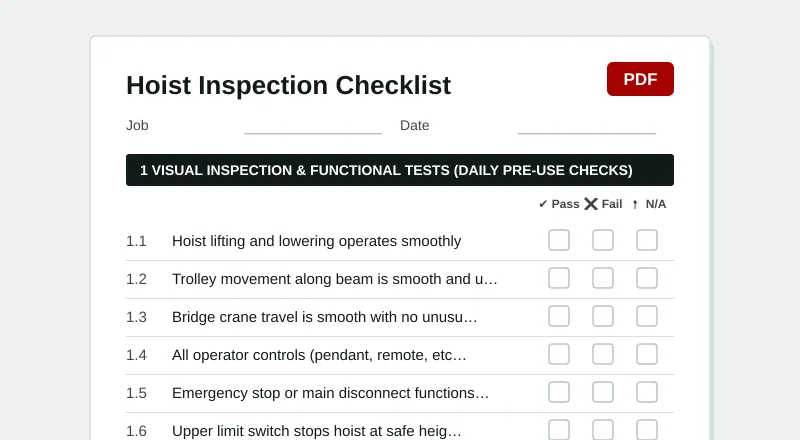
The full Hoist Inspection Checklist

Print it for the clipboard, or put it on your crew’s phones. Same 32 checks either way.

Your logo

Hoist Inspection Checklist

This Hoist Inspection Checklist supports field teams in conducting routine safety checks that align with OSHA and ASME standards. Optimized for mobile use, it allows teams to document issues promptly, enhance jobsite safety practices, and strengthen equipment inspection records, helping businesses stay proactive and reduce risk.

Job
Date
Date
Job Site / Location
Hoist Identification
Hoist Type
Rated Capacity
Inspection FrequencyDaily/Pre-UsePeriodic (Monthly/Annual)
Inspector

1 · Visual Inspection & Functional Tests (Daily Pre-Use Checks)

1 · Visual Inspection & Functional Tests (Daily Pre-Use Checks)✔ Pass❌ Fail⚠️ N/A
1.1Hoist lifting and lowering operates smoothly
1.2Trolley movement along beam is smooth and unobstructed
1.3Bridge crane travel is smooth with no unusual vibration or noise
1.4All operator controls (pendant, remote, etc.) function properly and respond correctly (no sticking buttons or maladjustment)
1.5Emergency stop or main disconnect functions correctly.
1.6Upper limit switch stops hoist at safe height; travel limit stops and other safety interlocks (e.g. travel end stops, overspeed devices) are tested and working
1.7Hook is free of cracks or deformation (throat opening not >15% beyond normal, no twist >10°)
1.8Hook safety latch is present and closes fully.
1.9Chain condition: has no cracks, gouges, twists, or stretched links beyond manufacturer’s limits. (Mark N/A if a wire rope hoist)
1.10Chain condition: is clean, properly reeved on sprockets, and lubricated as required; no dry or rusty links. (Mark N/A if a wire rope hoist)
1.11Wire rope condition: Wire rope has no broken strands, kinks, bird-caging, or severe wear. (N/A if chain hoist)
1.12Wire rope condition: Rope is properly reeved on drum and sheaves (seated in grooves per manufacturer spec). (N/A if chain hoist)
1.13Wire rope condition: Rope is not worn beyond discard criteria, has no flat spots or excessive corrosion. (N/A if chain hoist)
1.14No leaks or damage to hydraulic / pneumatic systems (hoses, pipes, cylinders, valves, compressors).
1.15No unusual noise, vibration, or other indicators of malfunction.

2 · Additional Periodic Inspection Items (Monthly/Annual)

2 · Additional Periodic Inspection Items (Monthly/Annual)✔ OK❌ Issue⚠️ N/A
2.1Structural frames of hoist, trolley, crane bridge and support structure are free from bends, breaks and corrosion.
2.2All mounting bolts, nuts, pins, and rivets are in place and tight. No evidence of looseness
2.3Sheaves, drums, and rollers are not cracked or excessively worn.
2.4Rope drum has no cracks; grooves are not excessively worn or corrugated. Sheaves turn freely and are properly aligned.
2.5No excessive wear, cracking, or distortion on gears, shafts, bearings, pins, wheels, or rollers in the hoist and trolley mechanisms.
2.6Brake drums or discs have no significant wear or scoring
2.7Brake linings/pads are not worn out, pawls and ratchets (in ratchet or Weston-style brakes) are intact
2.8Brakes stop and hold load properly
2.9Measure hook throat opening and twist against allowable limits (document measurements). No cracks evident (magnetic particle or dye penetrant test if required).
2.10Latch springs back and secures the throat consistently.
2.11Load chain links and end attachments show no stretching beyond 2% or manufacturer specs, no pitting or corrosion.
2.12Chain is properly lubricated. Chain sprockets are not excessively worn; they mesh properly with the chain with no hooking or sharp wear. (N/A if wire rope hoist)
2.13Wire rope is thoroughly inspected over its full length – no more than allowed number of broken wires, no severe corrosion or kinking. (N/A for chain hoists)
2.14Rope termination (end socket or clips) is secure. Sheave grooves smooth with no rope crushing (N/A for chain hoists)
2.15Open electrical panels to check contactors, pushbuttons, limit switches for pitting, charring, or deterioration. Wiring insulation intact (no exposed conductors). Pendant control strain relief is secure.
2.16Load sensors, load indicators, or wind speed indicator (where present) working and accurate
2.17Hoist has an up-to-date inspection tag or sticker displayed

3 · Inspection Results & Sign-off

Overall Status of HoistPass – No further action requiredPass – Corrective actions requiredFail

Photos · photo refs

Inspector’s Name
Name
Signature
Date
Date
Name
Signature
Date
Free download

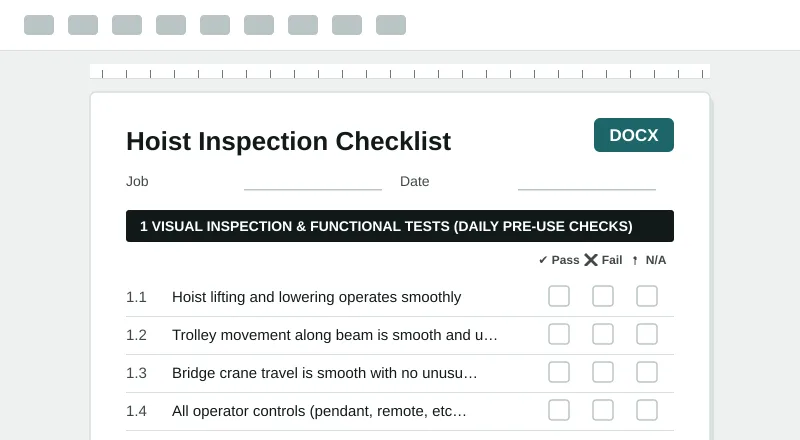
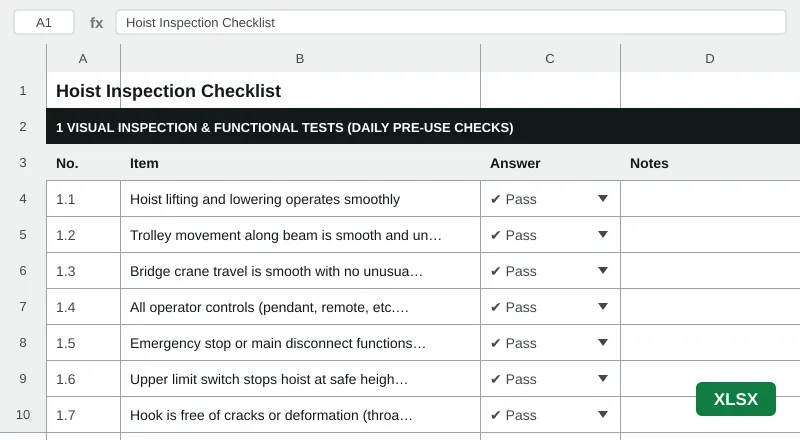
Hoist Inspection Checklist template: PDF, Word and Excel

Print the form as it is, or download a template you can edit. Every format is free, with no email and no sign-up.

How to use it

How to run the Hoist Inspection Checklist

  1. 01

    Check it before the first start

    Do it at the start of every shift, before the machine moves, with the operator who’ll run it.

  2. 02

    Walk around, then test from the seat

    Work through the 3 sections: fluids and the walk-around first, then controls, brakes and safety devices with it running.

  3. 03

    A fail means it stays parked

    Tag out anything that fails and report it to the shop or the super, with a photo. It doesn’t run until it’s fixed.

  4. 04

    Sign it and keep it with the machine

    The operator signs. Keep each day’s sheet with the machine, so the next operator and the inspector can see its history.

Why we built this

Most breakdowns give a warning first

A leak, a worn hose, brakes that feel soft. A few minutes at the start of the shift catches them before they cost a day of downtime, or someone’s safety.

  • Built for the field. Every check is written the way crews talk, with room for notes, photos and a signature.
  • Free, with no catch. No email, no account. Print it and hand it out.
  • On paper or on the phone. The same form runs on the Workyard app, filed to the job when it’s sent.

3,000+contractors run their crews on Workyard

Meet Workyard

Who we are

Workyard is the construction operations platform for specialty contractors and self-performing general contractors determined to grow without sacrificing job control or margins.

Forms like this one are what our customers’ crews fill in on Workyard every day, on the same app they clock in with.

workers on Workyard every day
100,000+
free templates, none of them gated
182

Forms & Workflows

Get every form back from every crew, every day

  • It shows up on its own. Attach it to a task, a job or clock-out, and it’s on the crew’s phone when it’s due.
  • It can’t be skipped. Make it required and the day can’t close until it’s in.
  • You see it the same day. Filed, flagged or missing, every job on one board, before anyone has to call.

$123,000cut from insurance costs at TR3 Group

More equipment pre-start checks templates

Free templates for the rest of the job

  • Equipment Pre-Start Checks

    Circuit Breaker Inspection Checklist

  • Equipment Pre-Start Checks

    Circular Saw Inspection Checklist

  • Equipment Pre-Start Checks

    Crane Inspection Checklist

  • Equipment Pre-Start Checks

    Hand Tool Inspection Checklist

Browse all templates

Questions

Hoist Inspection Checklist FAQs

Who should fill out a Hoist Inspection Checklist?

A qualified hoist operator, safety officer, or maintenance technician typically completes the form. The person should be familiar with the equipment and trained in recognizing basic safety concerns as outlined in OSHA and ASME guidelines.

How often should I perform a hoist inspection?

Inspections should be done before each shift or use, and more thorough checks should be done weekly or monthly depending on frequency and type of hoist. Refer to OSHA 1910.179 and the manufacturer's recommendations for specific intervals.

Does this form replace certified inspections?

No, this form is not a substitute for periodic inspections required by certified personnel. It helps teams log frequent checks and support compliance efforts, but certified inspections are still required at defined intervals.

Can I use this checklist for different types of hoists?

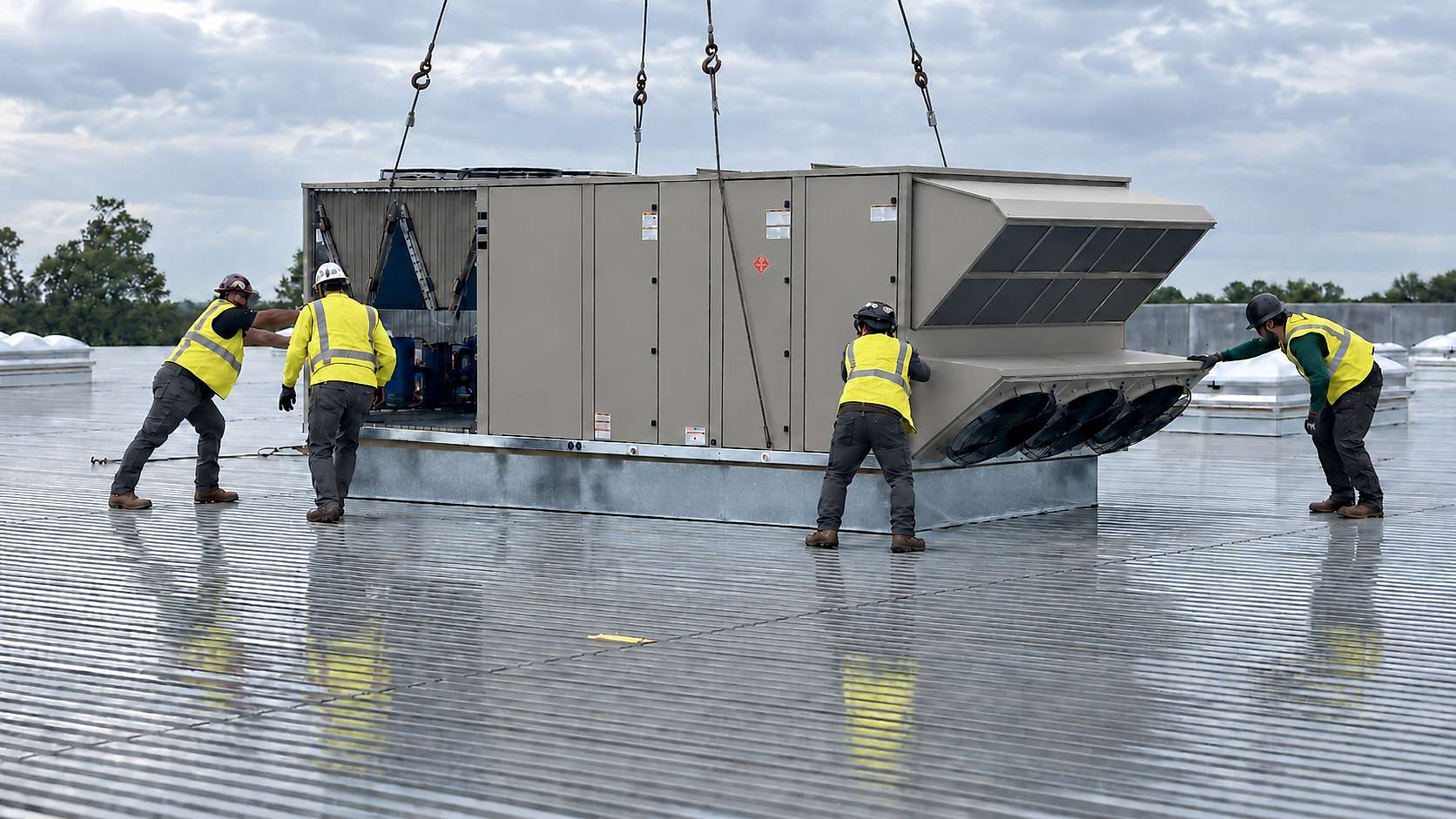
Yes, for overhead hoists: chain, wire rope, electric or manual, including trolley and bridge units. Specify the hoist type in the provided field and tailor the checks if needed for special configurations. Construction personnel and material hoists (OSHA 1926.552, ANSI A10.4 and A10.5) need their own checklist.

Do I need a Workyard account to use it?

No. Print the paper form, save it as a PDF, or download the Word or Excel file, free, with no email and no sign-up. You only need an account to put the digital form on your crew’s phones.

Can I edit the template?

Yes. Download the Word or Excel version to add your logo, add checks from your project spec or remove sections you don’t need. They open in Google Docs and Google Sheets too.

How do I get my crew to fill it in on their phones?

Add the digital form to Workyard and attach it to the job or the task it belongs to. It shows up in the app your crew already clocks in with, and every form comes back signed, with its photos, filed to the job.

Trigger the form at the right moment

A job's Forms tab in Workyard: each form, the clock-in or clock-out that triggers it, and how many have been submitted
A van check filled in on the Workyard app: the damage photo, a description and the tech's signature, ready to submit

Book a demo with a Workyard specialist

Your local Workyard specialist

Works with 50 contractors across the US

Your details

30 min · Video call