



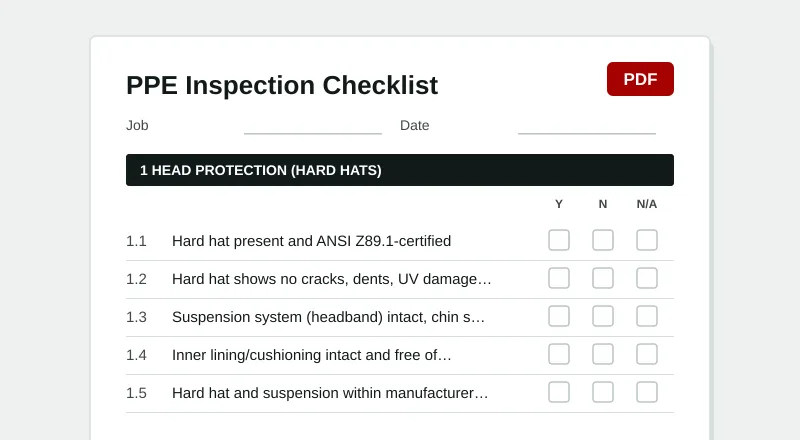
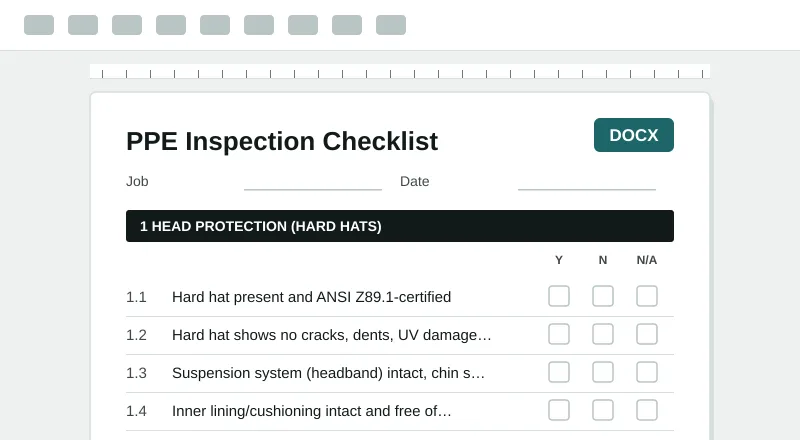
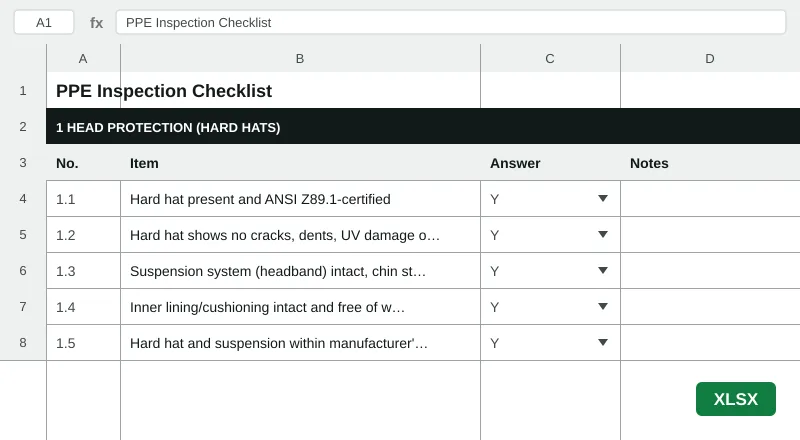
A PPE inspection checklist is a short form a worker or supervisor goes through before the shift to confirm that each piece of protective gear is the right kind for the task, in good condition and worn properly. Workyard's version covers hard hats, eye and face protection, hearing protection, respirators, gloves, boots, fall arrest gear and high-visibility clothing, with a sign-off at the end.
Foremen, site safety managers and crew members on construction, roofing, concrete, paving and other field jobs use it. Each completed form records one worker's gear on one day, which makes it easy to show what was checked and by whom.
What is PPE, and what does a PPE inspection check?
PPE is personal protective equipment: the gear a worker wears to keep a hazard from reaching them when it can't be removed from the job. A PPE inspection does two jobs. It checks condition, meaning no cracks, tears, expired filters or worn-out soles. And it checks compliance, meaning the worker has the right gear for today's task and is wearing it correctly.
Both matter. A brand-new pair of general-purpose gloves still fails on a job that needs cut-resistant ones, and the right hard hat does nothing with a broken suspension. Under OSHA's PPE rules, employers are responsible for providing the right equipment and keeping it in safe condition, while workers are expected to use it and report damage.
Who does what in a PPE program
PPE checks work best when each level has a clear job:
- Workers look over their own gear before each use and report anything damaged.
- Foremen check that the crew has and wears the right gear for the day's tasks, usually at the morning huddle, and fill in the form.
- Safety managers run periodic formal inspections, review the forms and track replacements.
- Everyone pulls gear from service after an impact, a fall or any damage, whatever the schedule says.
The form starts with project or site, crew, worker name, and the equipment ID or serial number, so every finding traces back to one person and one item.
What's on the construction PPE checklist
The template has eight equipment sections and a sign-off. Each item is answered Yes or No; any No needs a fix before work starts.
| Equipment | What the form checks | Pull it from service if |
|---|---|---|
| Hard hats | Present and marked to ANSI Z89.1, shell, suspension and chin strap, inner lining, date code within the maker's service life | Cracks, dents, UV damage, broken suspension, past its date |
| Eye and face | Glasses or goggles marked Z87.1, lenses, side shields, face shield fit, correct welding shade | Cracked or badly scratched lenses, missing side shields |
| Hearing | Plugs or muffs available for noisy tasks, clean and fitting, cushions intact | Torn cushions, cracked cups, plugs that won't seal |
| Respiratory | Correct NIOSH-approved respirator, facepiece, valves and straps, filter or cartridge service life, current fit test, user seal check, fit test date | Torn facepiece or straps, expired or clogged cartridges, no current fit test |
| Hands | Glove type matches the hazard, no holes or fraying, clean | Holes, tears, chemical damage |
| Feet | Safety-toe boots, sole and upper condition, EH-rated where there is an electrical hazard, slip-resistant soles | Exposed toe cap, holes, soles worn smooth |
| Fall protection | Harness sized and fitted, webbing on harness and lanyard, self-retracting lifeline locks, locking hardware, last inspection per tag | Cuts, fraying, abrasion, a damaged shock absorber, hardware that won't lock |
| High-visibility | Vest or jacket of the right class, reflective tape bonded, fabric not faded or torn | Peeling tape, faded fabric, torn panels |
The sign-off asks whether the results are satisfactory, lists any issue and corrective action still outstanding, and takes a photo, the inspector's name, the date and a signature.
Match the PPE to the task first
Inspecting gear only helps if it is the right gear. Before the checklist, someone has to look at the work and decide what it calls for: cut-resistant gloves for sheet metal, a face shield on the grinder, a respirator for cutting concrete, a harness for the roof edge. OSHA expects employers to base PPE on an assessment of the hazards, and the simplest way to do that is to put the PPE needed for each step on the job hazard analysis. The inspection then checks against that list.
How to run a PPE inspection
- Check before use. Each worker looks over their gear at the start of the shift. The foreman confirms it against the day's tasks.
- Go section by section. Mark Yes or No on every row, and N/A only where the gear isn't needed today.
- Photograph defects. A picture of the cut in the webbing ends the argument about whether the harness was fine.
- Tag out and replace. Failed gear comes out of service right away, gets tagged so nobody grabs it, and is replaced before the worker starts.
- Log it against the item. Record the equipment ID or serial, the fit test date for respirators and the last tag inspection for fall gear.
- Sign it. The inspector signs and lists anything still open.
Mistakes that let bad PPE back on the job
- Check your gear as the whole inspection, with no list and no record.
- Failed items tossed back in the gang box instead of tagged and removed.
- Ignoring date codes on hard hats, cartridges and fall gear.
- No record of who was issued what, so nobody knows whose respirator is due for a fit test.
- Wrong gear that is in perfect shape, such as the wrong vest class on a road job.
- Fit ignored. A harness that is too loose or glasses that slide off don't protect anyone.
Use the findings in your PPE toolbox talks
The best topic for a PPE toolbox talk is what failed on your own job last week. Show the cracked hard hat or the frayed lanyard, explain what to look for, and record who attended. Workyard's toolbox talks keep the talk and the sign-in sheet on the crew's phones.
Running PPE checks on crews' phones in Workyard
In Workyard, the PPE checklist is a digital form crews fill in on their phones at clock-in, before work starts. Photos of damaged gear attach to the item, the inspector signs on the screen, and every submission lands back in the office the same day, filed by job and worker. See Workyard's safety tools.
Get the free PPE checklist template
Download the PPE Inspection Checklist as a PDF, Word or Excel file. It is free and there is no sign-up. Print the PDF for a daily sheet on the clipboard, edit the Word file to match the gear your trade uses, or use Excel as a monthly log. To record what gear was issued to each worker, use the PPE log.


