


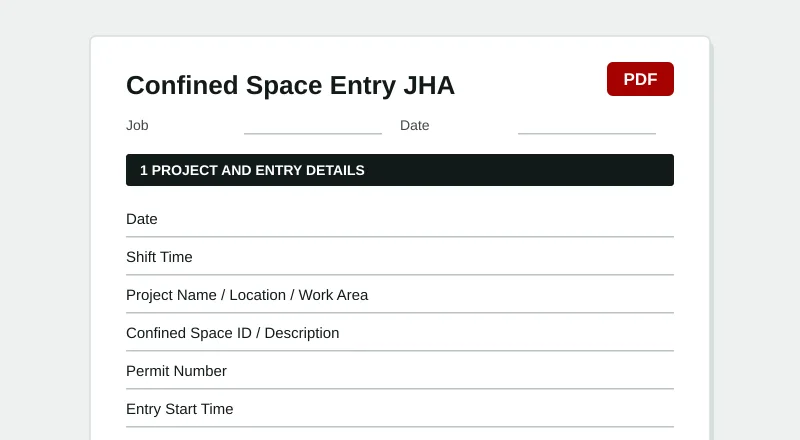
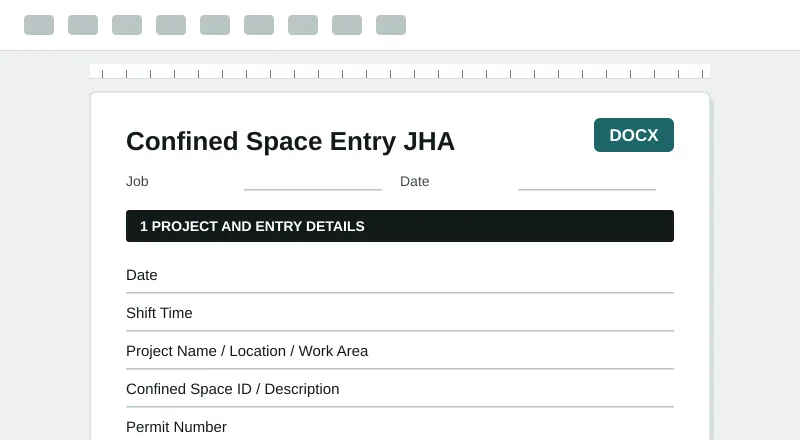
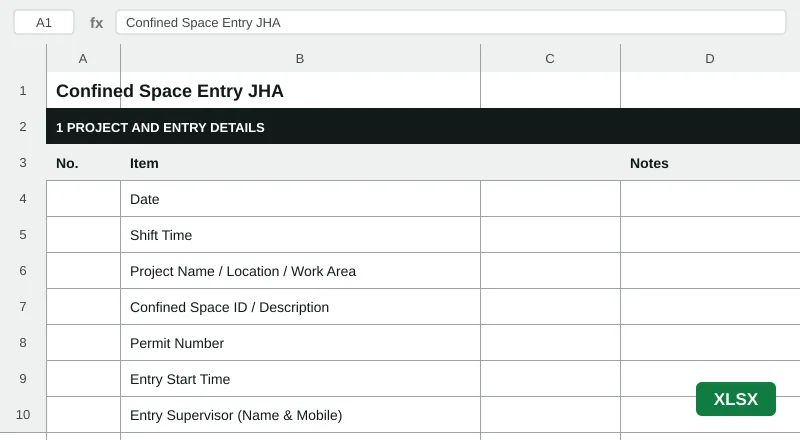
A confined space JHA is a job hazard analysis for one entry into a tank, vault, manhole, pit or similar space: who's going in, what the air tests read, what can go wrong at each step, how each hazard is controlled and how you'd get someone out. Entry supervisors on utility, civil, industrial and restoration jobs fill it in before each entry and again whenever conditions change, and the supervisor, attendant, entrant and safety manager all sign it.
Confined space JHA vs the entry permit
For a permit-required confined space, OSHA's rules call for a written entry permit, and the JHA doesn't replace it. The permit authorizes the entry; the JHA is the plan behind it, step by step. That's why the form asks for the permit number at the top: the two travel together. Check the current OSHA rule for confined spaces in construction, and your own program, for what your permit has to include.
If you need a simpler pre-entry check for spaces that don't need a full analysis, the confined space entry checklist covers the basics.
What's on the confined space JHA
The form moves from who and where, to what's in the air, to how the work gets done and how the crew gets out if it goes wrong.
| Section | What you record |
|---|---|
| Project and entry details | Date, shift, work area, space ID, permit number, entry start time, entry supervisor with a mobile number, entrants, attendants, the gas meter's ID and calibration date |
| Atmospheric tests | Oxygen, flammable gases as % LEL, carbon monoxide and hydrogen sulfide, each with a reading, the time and whether it's acceptable. Test oxygen first, then flammables, then toxics |
| Hazards present | Low or high oxygen, flammable vapors, toxic gases, engulfment, electrical, slips and falls, moving parts, heat or cold, poor lighting, tight or vertical entries |
| Controls | Initial and periodic testing, continuous ventilation, lockout verified, isolation and blanking of lines, PPE, rescue plan, communications tested, permit posted, standby rescue, attendant briefed |
| Job steps | Each step with its hazard, risk level and control |
| PPE | From hard hats and gloves to respirators or SCBA, harnesses, chemical suits and intrinsically safe lights |
| Rescue plan | Rescue team contact, method (tripod, winch, retrieval line or entry rescue) and where the equipment is |
| Signatures | Entry supervisor, attendant, entrant and safety manager |
The form lists acceptable ranges beside the readings (oxygen between 19.5% and 23.5%, flammables under 10% LEL). Set your own limits for carbon monoxide and hydrogen sulfide from your program and the current OSHA exposure limits, and follow the meter maker's instructions for bump testing and calibration.
Confined space JSA example: the job steps
Whether you call it a confined space JSA or a JHA, the job steps are the heart of it. The form lists the standard steps of an entry; you fill in what's true for this space:
| Step | Hazard | Risk | Control |
|---|---|---|---|
| Open entry cover | Heavy lid, pinch points, open hole | Medium | Lid lifter, two people, barricade the opening |
| Test atmosphere before entry | Bad air sitting in the space | High | Calibrated meter, test top, middle and bottom |
| Install ventilation and lighting | Blower pulling in exhaust, cords in water | Medium | Blower intake away from engines, GFCI on cords |
| Retest and confirm conditions | Readings changed since first test | High | Retest after ventilating; log the time |
| Descend into space | Fall, getting stuck | High | Harness and retrieval line on a tripod |
| Perform work task | Fumes from the work itself | High | Continuous monitoring, attendant in contact |
| Exit and close permit | Leaving tools or people behind | Low | Head count, close the permit, replace the cover |
Download the JHA or run it on phones
Download the confined space JHA free as a PDF, Word or Excel file, no sign-up needed, or browse more hazard analyses in JSAs and JHAs. To run it on site, use Workyard's JHA app: the entry supervisor fills it in on a phone at the space, adds photos, everyone signs on screen, and every completed JHA is filed to the job in the office, ready to export as a PDF or CSV.


