


A hazard report form is how anyone on a job site writes up an unsafe condition, an unsafe act or a near miss the moment they see it, then follows it through to a fix. Workers, foremen and safety officers fill it in; the superintendent and project manager sign off once the hazard is controlled and the fix is checked.
What is a construction hazard report?
A construction hazard report records one hazard that exists right now: a missing guardrail, a damaged extension cord, a trench with water seeping in, a forklift operator cutting a blind corner. It captures where and when it was found, what was done on the spot, who was told and what will fix it for good.
It is different from a job hazard analysis. A JHA is written before a task starts and plans the controls for each step. A hazard report is written when something turns up that the plan didn't catch. Both belong in a safety program, and a hazard that keeps coming back on the report is a sign the job hazard analysis for that task needs another look.
What goes on the hazard report form
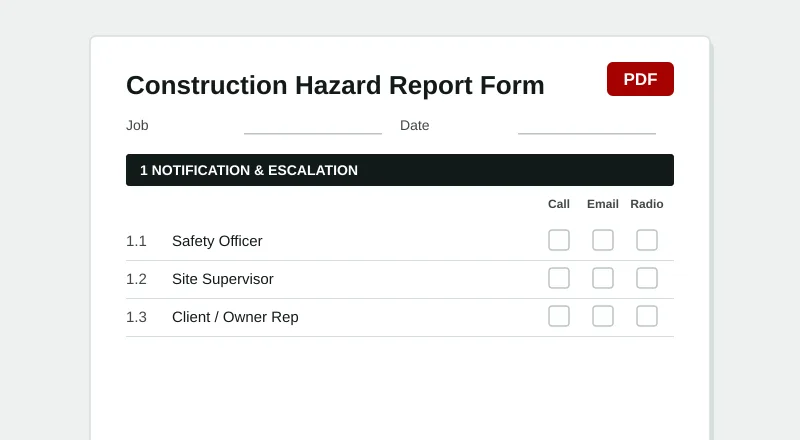
The form walks the reporter from discovery to close-out in six sections.
- Job details. Job ID, location, weather, shift, the report type (unsafe condition, unsafe act or near miss) and the hazard category: physical, chemical, biological, ergonomic, electrical, fall, or struck-by and caught-in. Then the date and time found, the crew or trade, and the exact location or equipment.
- Hazard description. What the hazard is, what could happen if it isn't corrected, the immediate action taken to control it, a risk rating (low, medium, high or imminent danger) and photos.
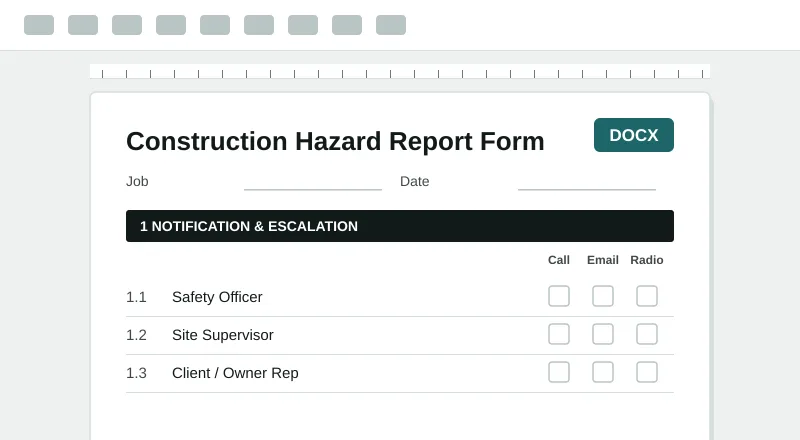
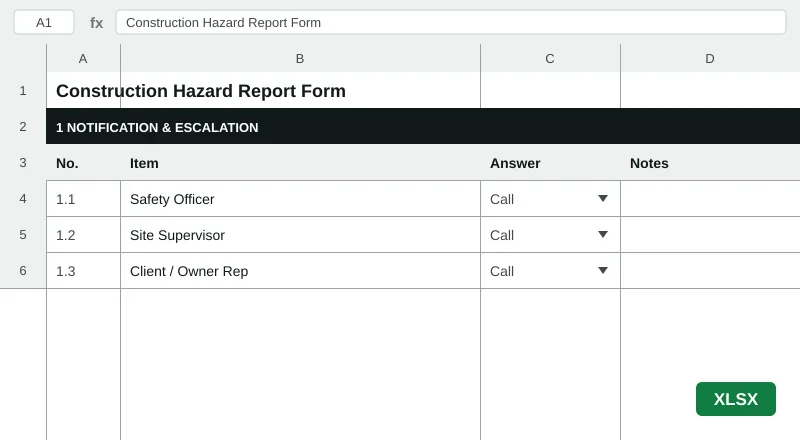
- Notification and escalation. When and how the safety officer, site supervisor and client or owner rep were told.
- Root-cause check. Which factors apply: condition of equipment or materials, behavior or training, a design or layout flaw, the environment, or something else.
- Corrective plan. Each action item with the responsible party, resources needed, target date and status.
- Verification and close-out. Follow-up dates and what was done to confirm the fix worked.
The sign-off has an option to report anonymously, and signature lines for the hazard identifier or safety officer, the site superintendent and the project manager or owner.
The form's references list OSHA 29 CFR 1926.21(b)(2) on training and hazard recognition, OSHA 29 CFR 1904 on injury and illness recordkeeping, ISO 45001:2018 clause 10.2 and ANSI/ASSP Z10. Check the current versions for what applies to your work.
A hazard reporting form, filled in
Here's how a near miss might read on the form:
- Report type: near miss. Category: struck-by.
- Hazard: a bundle of conduit slid off an unsecured stack on the level 3 deck edge and landed in the laydown area below.
- Potential consequence: a serious head injury to anyone in the laydown area.
- Immediate action: area below barricaded, remaining stack moved back from the edge.
- Risk rating: high.
- Root cause: behavior (material staged at the edge), and layout (no toe boards on that section).
- Corrective plan: toe boards installed by the framing foreman by end of day; material staging rule covered at the next toolbox talk.
- Close-out: toe boards checked the next morning, photo attached.
Nobody was hurt, and that's exactly why it's worth a report. The same stack could fall again tomorrow with someone underneath. Hazards like this one also show up in a scheduled safety audit report, but a report written the same hour gets the fix in sooner.
Get the free hazard report form
Download the construction hazard report form as a PDF, Word or Excel file, free and with no sign-up. Keep printed copies in the site trailer and the gang boxes. With Workyard's safety tools, crews can fill in the same form on their phones on the job: photos straight from the camera, signatures on screen, high-risk answers sent to the named safety lead, and every report filed to the job in the office and exportable as a PDF or CSV.


