


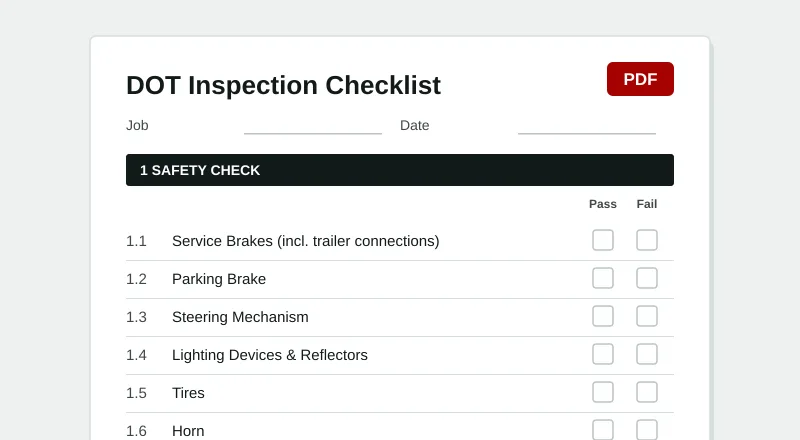
A DOT inspection checklist is the form a driver uses to check a commercial truck, tractor or trailer before driving it and to report defects at the end of the day, so the vehicle is safe and the paperwork holds up if an officer pulls it over. Contractors running dump trucks, flatbeds, crew trucks with trailers and equipment haulers use it every day the vehicle runs.
The template covers the items federal rules list for the driver's daily inspection, adds fluids and cargo, and ends with the sign-offs: driver, supervisor, mechanic and the next driver.
Three inspections people call a "DOT inspection"
"DOT inspection" can mean three different things, and each has its own rule and its own paperwork.
| Inspection | Who does it | How often | Federal rule |
|---|---|---|---|
| Pre-trip inspection | The driver | Before driving, every time | 49 CFR 396.13 |
| Driver vehicle inspection report (DVIR) | The driver | At the end of each day's work on each vehicle, when a defect is found or reported | 49 CFR 396.11 |
| Annual (periodic) inspection | A qualified inspector | At least once every 12 months | 49 CFR 396.17 |
| Roadside inspection | FMCSA, state enforcement or CVSA-certified inspectors | Whenever you're stopped or pass a checkpoint | Federal and state enforcement rules |
The DOT inspection form here is built for the first two: the driver's daily walk-around and the end-of-day report. Doing those well is also the best preparation for the other two. Whether a particular truck counts as a commercial motor vehicle under these rules depends on its weight rating and how it's used, so check FMCSA's definitions for your fleet, especially pickups pulling trailers.
What goes on the DOT inspection form
The template follows the order a driver works: identify the vehicle, walk around it, check fluids and load, decide if it's safe, sign.
Vehicle info
Motor carrier operator, vehicle type (tractor, trailer or truck), license plate, unit number, make and model, and VIN. Fill in one form per vehicle. The DVIR rule calls for a separate report for each vehicle a driver operates that day.
Pre-trip safety components
Eleven items, each marked Pass or Fail with a defect description when it fails: service brakes including trailer brake connections, parking brake, steering mechanism, lighting devices and reflectors, tires, horn, windshield wipers, rear vision mirrors, coupling devices, wheels and rims, and emergency equipment. These match the parts and accessories the DVIR rule (396.11) names.
Fluids, cargo and overall status
Engine oil, coolant, brake fluid and power steering fluid each get a level or status and a note. Cargo securement and tarps or covers get Pass or Fail. Then the driver picks the overall status (Safe to Operate, or Not Safe and Requires Repair), adds notes and uploads photos of any defect.
Sign-offs
The driver signs with name, date and time. A supervisor reviews and signs. If defects were listed, a mechanic certifies either that they were repaired or that repair wasn't needed, with name, signature and date. Last, the next driver reviews and signs.
How to run a DOT truck inspection checklist walk-around
A good walk-around runs the same direction every time, so nothing gets skipped. A typical DOT truck inspection checklist order:
- In the cab: documents present, horn, wipers, mirrors adjusted, gauges and warning lights, parking brake holds.
- Front of the truck: headlights, turn signals, steering linkage for looseness or damage.
- Each side: tires, wheels and rims, lug nuts, brake components you can see, fuel tank and cap, exhaust.
- Rear and trailer: coupling devices, safety chains, air and electrical lines, trailer brakes, lights and reflectors.
- Load: straps, chains and binders tight, tarps secured, nothing able to shift.
- Fluids: oil, coolant, brake and power steering levels.
Measure where a measurement matters. Federal equipment rules (49 CFR 393.75) set minimum tread depth at 4/32 of an inch for front tires on a truck or truck tractor and 2/32 of an inch for other tires, measured in a major groove. "Looks fine" isn't a measurement.
Defects, repairs and the next driver
A listed defect doesn't end with the driver's report. Under 396.11, any defect likely to affect safe operation has to be repaired before the vehicle runs again, and the carrier or its mechanic certifies on the report that each defect was repaired or that repair wasn't necessary. Under 396.13, the next driver has to be satisfied the vehicle is safe, review the last report and sign it to confirm required repairs were certified. The form's repair certification and next driver sections are where that happens.
Keep the DVIR, the repair certification and the driver's review for three months from the date the report was prepared.
Can I do my own annual DOT inspection?
Yes, if the person doing it is qualified. Under 49 CFR 396.19, the inspector has to understand the inspection standards, be able to identify defective components and know the tools and methods. They qualify by completing a federal or state training program or holding a state certificate, or through at least a year of training and experience, such as working as a mechanic in a fleet's maintenance program or at a commercial truck garage. The carrier keeps evidence of the inspector's qualifications for as long as they do inspections, plus a year.
The inspector writes a report under 396.21 identifying themselves, the carrier, the date, the vehicle and the components inspected, with the results. Keep the original or a copy for 14 months from the inspection date, where the vehicle is housed or maintained.
Roadside inspection levels
Roadside inspections follow the North American Standard levels. Levels 1 to 3 are the ones most drivers see:
- Level 1: full inspection of the driver's documents and the vehicle.
- Level 2: walk-around of the driver and vehicle, without getting under the truck.
- Level 3: driver-only: license, medical certificate, hours-of-service records.
- Level 4: a special one-time inspection of a single item.
- Level 5: vehicle-only, with no driver check.
- Level 6: enhanced inspection for certain radioactive shipments.
Keep the license, medical card, hours-of-service records, registration, insurance and the latest inspection report in the cab.
Running DOT inspections on drivers' phones
In Workyard, the pre-trip opens on the driver's phone at clock-in, for the people who drive and nobody else. The driver taps Pass or Fail for each item, photographs defects and signs with a finger, and if the check is still open at the end of the day, clock-out waits until it's done. A Fail or a No to "Safe to drive?" goes straight to the shop or the person you name, with the photos. Every inspection is kept with the driver, truck and date, ready to filter, export or send as a PDF to an insurer or auditor. See the vehicle inspection app, the DVIR and vehicle inspection forms, or the trailer inspection checklist for crews who tow.
Get the free DOT inspection checklist
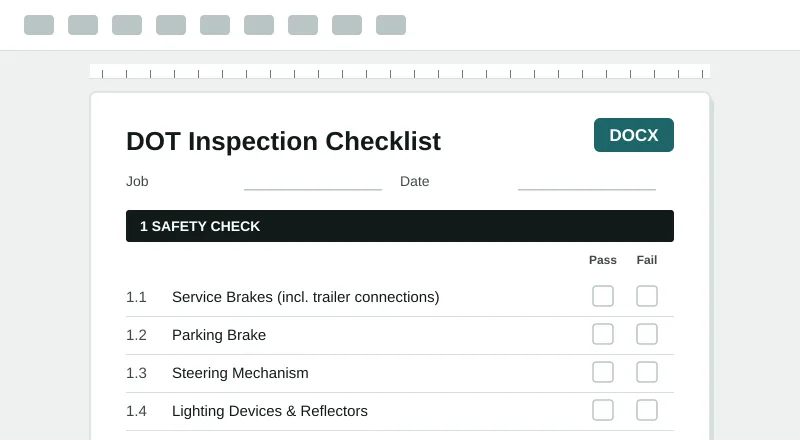
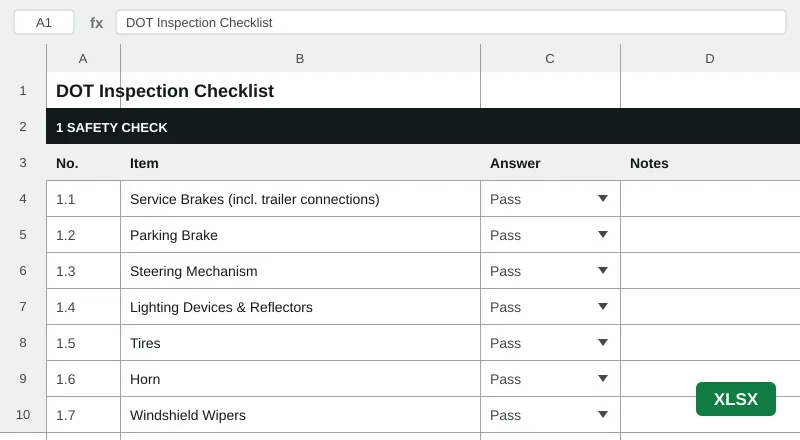
Download the DOT inspection checklist as a PDF to keep in the cab, or as a Word or Excel file to add your unit numbers and company name. It's free, with no sign-up. Prefer the walk-around on drivers' phones? The same checklist runs in Workyard.


