


A fire alarm record of completion is the signed document that closes out a fire alarm installation: it lists what was installed, how it is powered and wired, which tests it passed, and what was handed to the owner. The installing contractor and the technician fill it in at the end of the job, and the owner or inspector signs it to accept the system.
What the NFPA 72 record of completion form covers
NFPA 72, the National Fire Alarm and Signaling Code, sets out what the record has to show. This NFPA 72 record of completion form gathers it in the order you'd confirm it on a finished system.
| Section | What you record |
|---|---|
| Project details | Job address, installing contractor, permit number, authority having jurisdiction (AHJ), occupancy type, the NFPA 72 edition used, installation and final completion dates |
| System overview and control panel | Addressable or conventional, panel manufacturer and model, serial number |
| Power supply | Voltage and capacity of the primary (AC) and secondary (battery) supplies, calculated standby hours and alarm minutes |
| Device inventory | Each initiating and notification device type, the quantity and the location or zone |
| Circuits and wiring | Count and conductor gauge for initiating, notification and signaling line circuits |
| Software and documentation | Firmware version logged, as-built drawings delivered, operation and programming manuals provided |
| Testing and certification | Pass or fail for initiating devices, notification appliances, power supply supervision, battery charger, load voltage and discharge, and NAC voltage drop |
| Monitoring | Whether the system is monitored, the service, the supervising station type and the account number |
| Signatures | Installer, technician, and owner or inspector, with dates and the completion date and time |
Write down which NFPA 72 edition the system was designed to. The edition your AHJ enforces decides what the record must contain, so check it with them before closeout rather than assuming the latest one applies.
What the owner receives with the fire alarm record of completion
At the end of a fire alarm installation the owner should get more than a working panel. The documentation section of this form tracks the handover items: the record (as-built) drawings showing where devices and circuits actually went, the operation and programming manuals, and the logged firmware or software version. The signed record of completion itself goes with them. Each item is marked Done or Not Done, with a note for anything still missing, so a gap is visible before anyone signs.
Record drawings are the ones that matter most later. Shop drawings show what was planned; record drawings show what was built, and they're what the next technician uses to find a device or trace a circuit.
Getting it right before the inspector arrives
- Run the battery calculation from the real device count, not the design estimate, and enter both the standby hours and alarm minutes.
- Match the device inventory to the as-built drawings zone by zone. A count that doesn't agree with the drawings is the first thing an inspector questions.
- Note the conductor gauge per circuit type. The form's wiring section points to Chapter 12 of NFPA 72 for these circuits.
- Enter a comment against every failed test, then re-test and update the record before it is signed.
- Fill in the monitoring account number while the monitoring company is on the phone, not afterward.
Ongoing inspections after handover go on a separate record; use the fire alarm system inspection checklist for those. Other closeout and test forms for electrical and low-voltage work are under system tests.
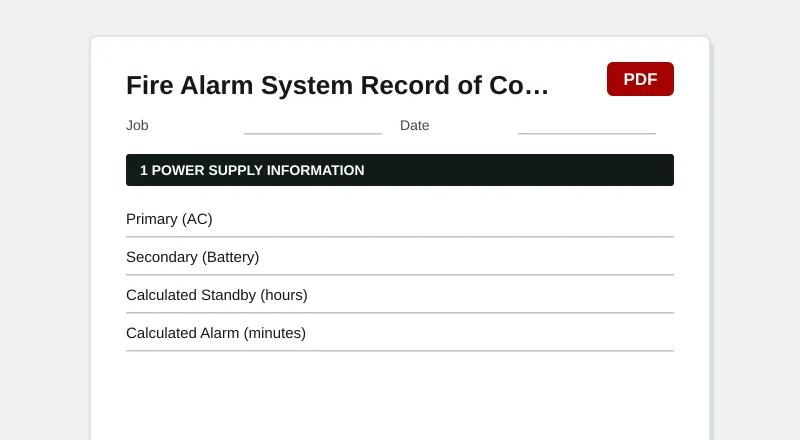
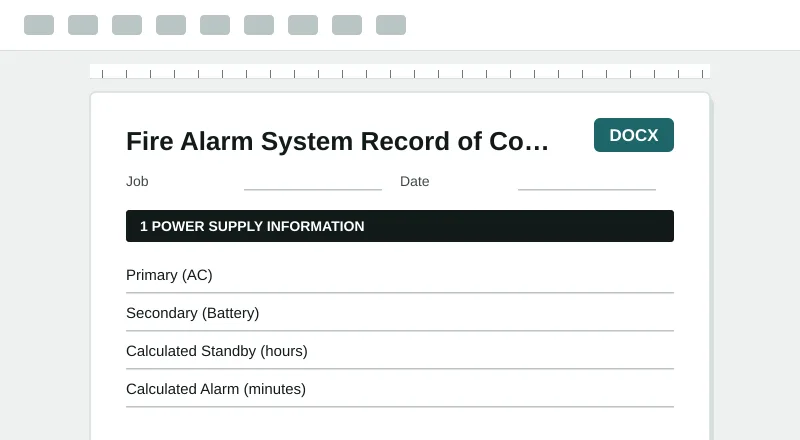
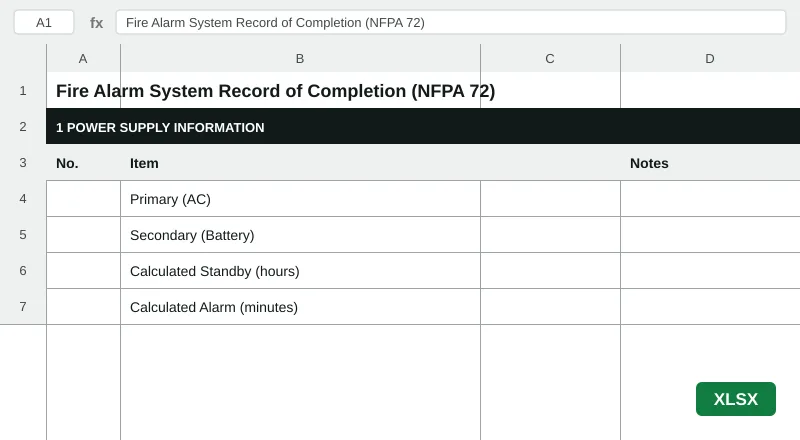
Fill it in on a phone or download it free
In Workyard, the record of completion is a digital form your technician fills in on a phone at the job, with photos of the panel and labels, and installer and owner signatures on screen. A failed test can be flagged to a named person, and the finished record is filed to the job in the office, ready to export as PDF. See forms and workflows in Workyard. Or download the free template as a PDF, Word or Excel file and check with your AHJ whether they want their own form instead.


