



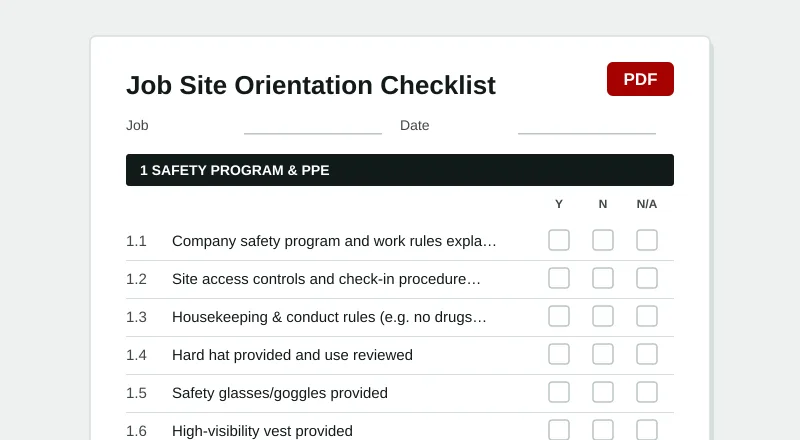
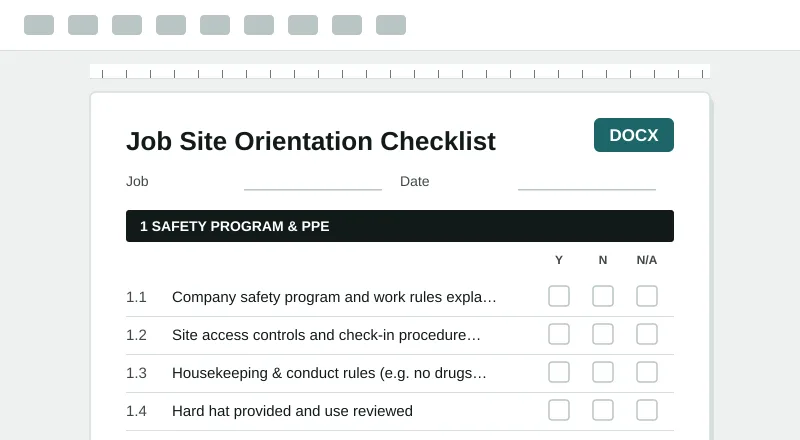
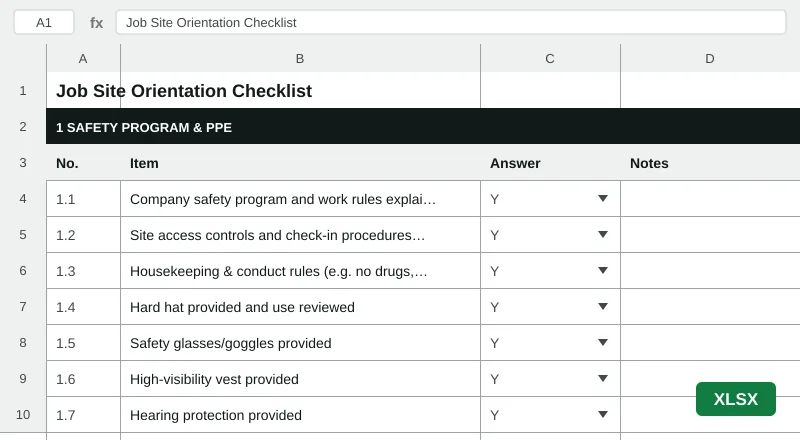
A construction site orientation checklist is the record that a worker new to a site was walked through its rules, hazards, PPE and emergency plan before starting work, and signed to say so. Supers, foremen and safety leads use it for new hires, subs' crews and anyone else arriving on a job for the first time.
What is a site orientation?
A site orientation is the briefing every worker gets before their first shift on a specific job. General safety training covers how to work safely anywhere. The orientation covers this site: how you get in and sign in, where the hazards are today, where the first-aid kit and assembly point are, and which tasks need a permit. Experienced workers need it too, because every site is laid out differently.
What the construction site orientation checklist covers
The checklist has six sections, and each section names the OSHA rules it supports. For any item marked No, the trainer adds details.
| Section | What gets covered | Rules the form names |
|---|---|---|
| Employee and site | Name, trade, company, date, supervisor | |
| Safety program and PPE | Safety program and work rules, site access and check-in, conduct rules, hard hat, eye and hearing protection, hi-vis, boots and gloves, fall protection | OSHA 29 CFR 1926.21(b)(2), 1926.95 to 1926.102, 1926.503 |
| Hazard communication and site hazards | Chemicals on site, where the SDS are, labeling and spills; fall, electrical, struck-by and caught-in hazards, plants and animals, heat | OSHA 29 CFR 1926.59 and 1910.1200 |
| Emergency procedures and first aid | Evacuation routes, assembly point, alarms, emergency numbers, first-aid kits and responder, incident reporting | OSHA 29 CFR 1926.35 and 1926.50 |
| Safe work practices | Tool and equipment inspections, housekeeping, permit tasks such as hot work and confined space, prohibited behavior, questions answered, further training needed | OSHA 29 CFR 1926.21 |
| Sign-off | Project and location, trainer's name, title and signature, worker's name and signature |
Check the current text of each rule and any state plan that applies to your site.
How to run a site orientation
- Do it before the worker starts, not after their first hour on the tools.
- Walk the site, not just a trailer table. Point out the exits, assembly point, first-aid kit and today's hazards in person.
- Fill in the checklist as you go, marking N/A only where something truly doesn't apply.
- Ask questions back. A worker who can tell you where the assembly point is has heard it.
- Both sign, and note any further training with dates and topics.
New hire safety orientation checklist vs site orientation
A new hire safety orientation checklist covers the company: policies, the safety program, PPE issue and training records. This checklist covers the job. A new hire needs both on day one; an experienced worker moving to a new job needs the site part every time. Ongoing briefings after that go on the toolbox talk attendance sheet.
Run it in Workyard or download it
In Workyard, the checklist can go on a task for the new worker's first day on a job, opening from the task's notification, with both signatures taken on screen. A No goes to the person you name, and every orientation is filed to the job in the office, ready to export when a GC or auditor asks. See Workyard's safety tools. The checklist is also free to download as a PDF, Word or Excel file.


