


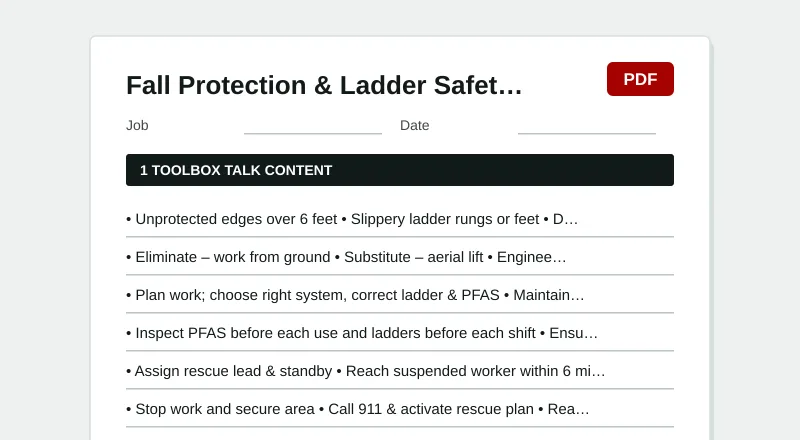
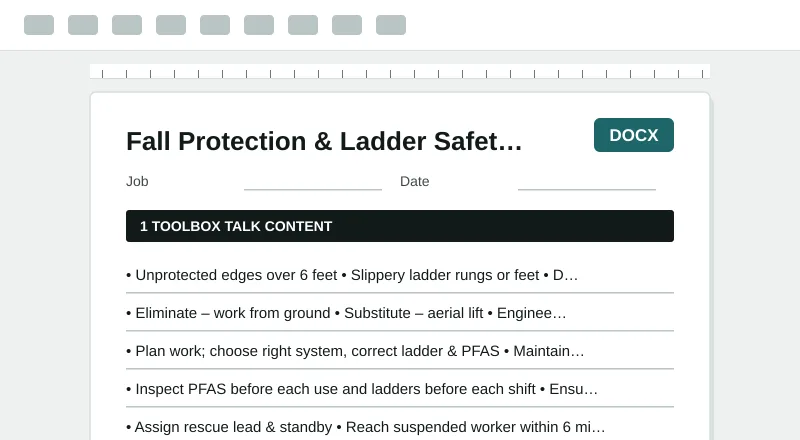
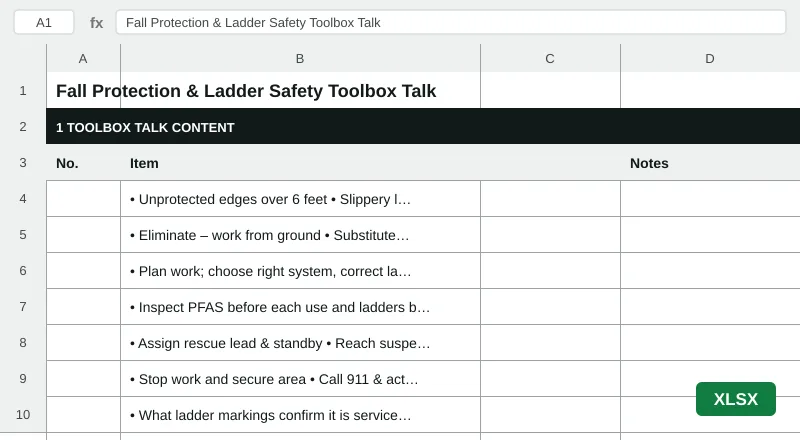
The fall protection equipment inspection log on this page is built as a toolbox talk: a foreman or safety lead runs it with the crew before work at height, covering ladder safety, harness and lanyard checks, anchors and rescue, then records who attended and gets each person's signature. Roofing, framing, steel, telecom and utility crews use it, along with any GC whose subs work from ladders, scaffolds or near unprotected edges over 6 feet. It pairs the training with the gear check, so the same sheet shows the crew was briefed and the equipment was looked at.
What the fall protection talk covers
The form has an attendance block, seven content panels with room for notes, and a signature:
- Attendance details: date, job or site, presenter and crew member.
- Typical hazards: unprotected edges over 6 feet, slippery rungs, damaged harnesses or lanyards, wrong ladder angle or duty rating, overreaching, bad weather or lighting, no rescue plan.
- Hierarchy of controls: work from the ground first, then an aerial lift, then guardrails and covers, then training and spotters, and only then a harness and lanyard.
- Safe work practices: three points of contact, ladder 3 feet above the landing, a 1:4 angle with the top secured, tie off above 6 feet to a 5,000 lb anchor, tool belts to keep hands free.
- Equipment inspection and maintenance: what to check on ladders and fall arrest gear, and what to do with defective gear.
- Rescue planning and emergency procedures: a rescue lead, retrieval or lowering gear, suspension trauma straps, calling 911, reporting to the supervisor.
- Crew discussion: eight questions, from ladder markings to where the snap hook attaches.
Fall protection inspection checklist for harnesses, lanyards and ladders
The equipment panel works as a fall protection inspection checklist. Inspect personal fall arrest systems before each use and ladders before each shift. On a harness, check the webbing for cuts or burns and look over the D-rings, buckles and stitching. On a lanyard, confirm the shock pack is intact. Confirm anchors are rated for 5,000 lb. On a ladder, check the feet and rungs and read the duty rating.
When something fails, tag it Danger, Do Not Use, take it out of service, and log the defect with its serial number and the corrective action. Writing the serial number down is what turns this into an inspection log: you can see which harness failed and what happened to it.
Fall protection equipment inspection log requirements (OSHA and ANSI)
The form lists the standards it follows: OSHA 29 CFR 1926.501(b)(1) for unprotected sides and edges, 1926.1053 for ladders, 1910.140 for personal fall protection systems, ANSI/ASSP Z359.14 for self-retracting devices and ANSI A14.2 for portable metal ladders. Your harness and ladder manufacturers' manuals set the detailed inspection points for their gear, and a competent person should check it on the schedule they set. Check the current versions before you rely on the list.
Run it on crews' phones or download it free
In Workyard the talk goes out as a digital form on crews' phones at clock-in, each worker signs on screen, photos of damaged gear go with it, and every submission is filed to the job in the office for PDF or CSV export. See how toolbox talks work in Workyard, or use the fall arrest harness inspection form for a standalone gear check and the roof fall protection inspection on roofs. You can also download this one free as a PDF, Word or Excel file, no sign-up needed.


