


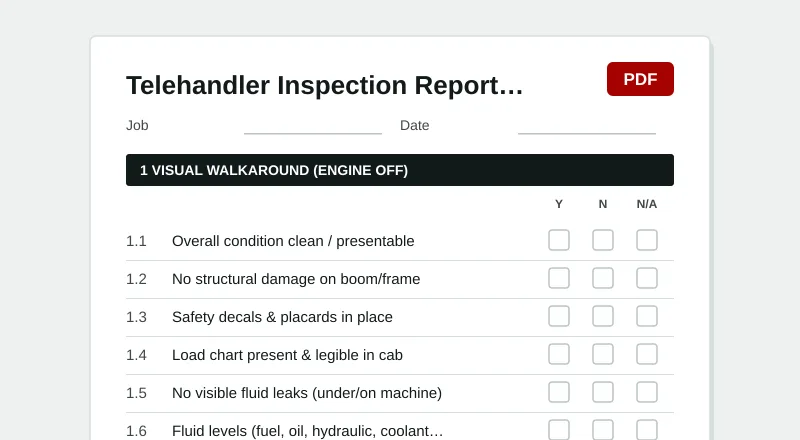
Contractors looking for a telehandler annual inspection form usually need two records: the yearly inspection a qualified technician signs, and the pre-use check the operator does at the start of every shift. This template is the daily one. Operators and foremen on commercial, concrete, framing, drywall and steel jobs use it to walk around the machine, test every function with the engine running, and mark it safe to operate or tag it out, with a signature and the hour meter reading on every record.
Telehandler annual inspection form vs daily checklist
The two inspections do different jobs, and you need both:
| Compare | Daily pre-use checklist (this form) | Annual or periodic inspection |
|---|---|---|
| Who does it | The operator or foreman | A qualified technician, often the dealer or rental company |
| When | Before the machine works each shift | On the schedule in the manufacturer's manual |
| What it covers | Visible damage, fluids, tires, safety devices and a function test of every control | A deeper check of structure, hydraulics, boom wear and safety systems |
| What it proves | The machine was safe to run that day | The machine is fit for service for the next period |
Use the manufacturer's manual, your rental agreement and OSHA's equipment rules to set the periodic schedule, and keep the annual report with the daily records for each machine. A stack of signed daily checks with no current annual, or the other way round, leaves a gap.
The four parts of the telehandler daily inspection checklist
The telehandler daily inspection checklist runs in four parts:
Visual walkaround, engine off
Check structure, boom and frame for damage, decals and placards, the load chart in the cab, leaks, fluid levels (fuel, oil, hydraulic, coolant, DEF), tires and lug nuts, forks or attachment secured, boom and lift cylinders, hydraulic hoses, belts, battery, seat and seatbelt, mirrors and windows, and the fire extinguisher if fitted.
Operational checks, engine on
Test the start and idle, gauges and warnings, horn, backup alarm, lights, wipers, steering, service and parking brakes, forward and reverse, every boom function, attachment tilt, outriggers or stabilizers, the load moment indicator and frame level indicator, and the emergency stop. Listen for unusual noise or vibration.
Post-inspection summary
Mark the machine Safe to operate or Unsafe, Do Not Use, list deficiencies and record the corrective action taken or needed.
Inspector and equipment information
Date, inspector and role, telehandler ID, site, hour meter reading and signature.
When the telehandler inspection checklist finds a problem
Any No on the telehandler inspection checklist needs a note. If the problem affects safe operation, mark the machine Unsafe, Do Not Use, tag it out and tell your supervisor before anyone else climbs in. Record what was fixed and by whom before it goes back to work.
Run it on a phone or download it free
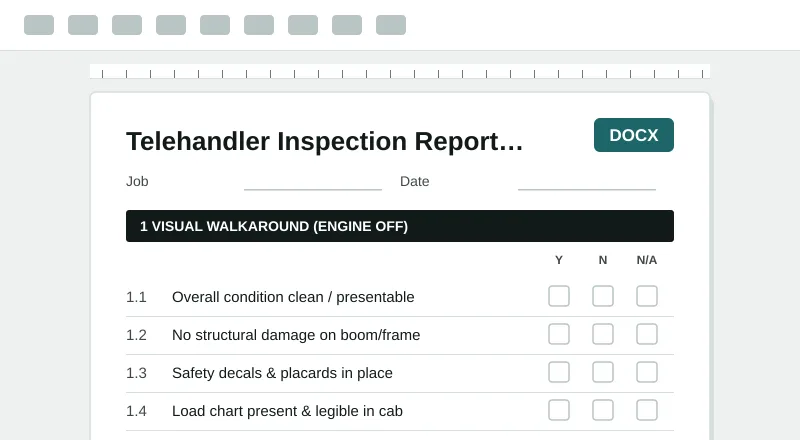
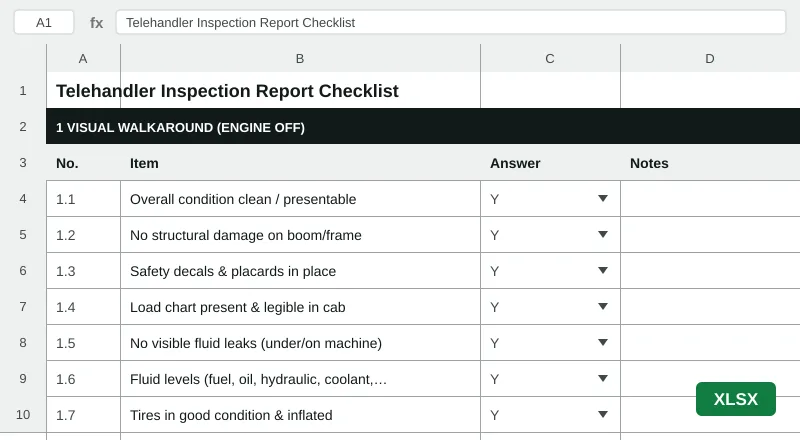
In Workyard the checklist runs as a digital form on the operator's phone at clock-in, with photos of any damage, a signature on screen, an Unsafe answer flagged to a named person, and every check filed to the job for PDF or CSV export. See how inspections work in Workyard, or use the forklift inspection checklist and other equipment pre-start checks. You can also download this one free as a PDF, Word or Excel file, no sign-up needed.


