


A tool safety toolbox talk is a short crew meeting, usually five to ten minutes before work starts, on using hand and power tools without getting hurt. The foreman or safety lead runs it at the gang box or the trailer, the crew talks through the risks on today's tasks, and everyone signs that they were there.
The template pairs tool safety with ergonomics, because the tool that cuts a hand is often the same one that wears out a wrist or shoulder over a season. Sprains, tendonitis and numb fingers build up slowly and cost lost days just like a cut does.
What a tool safety toolbox talk covers
The talk covers three things: choosing and keeping tools in safe condition, using them in ways that protect the body, and reporting problems early. Our template runs in this order:
- Why it matters. Repetitive motion, awkward grips and worn-out tools lead to injuries and lost time.
- Ergonomic risk factors. Force, posture, repetition and contact stress.
- Tool selection and maintenance. Right tool, right size, right condition.
- Safe handling. Neutral wrists, steady footing, two hands on heavy tools.
- Body mechanics and micro-breaks. Stretches, task rotation, water.
- Early symptom reporting. What to report and who to tell.
- Crew discussion, then notes, signatures and feedback.
Keep each talk to one subject. A talk on one tool or one task that crew members use this week sticks better than a broad lecture on tool safety in general.
Hand and power tool safety toolbox talk: the talking points
OSHA's construction rules for tools sit in Subpart I of 29 CFR 1926 (tools, hand and power), which starts with 29 CFR 1926.300. In plain terms, tools have to be kept in safe condition, and power tools built with guards have to be used with them.
Hand tools
- Use the right tool for the job. A screwdriver is not a pry bar and a wrench is not a hammer.
- Inspect it before every use and again before it goes back in the box. Cracked handles, mushroomed heads and loose heads come out of service.
- Keep blades and bits sharp. A dull blade takes more force and slips more.
- Clamp or secure the work. Holding a piece in one hand while cutting toward it is an easy way to lose a fingertip.
- Carry sharp tools in a sheath or holder, never in a pocket.
- Don't leave tools on ledges, scaffold planks or ladders where they can fall.
Power tools and cords
- Guards stay on and in working order. No pinned-back blade guards.
- Check cords, plugs and triggers before use. Damaged tools get tagged out and reported.
- Use double-insulated or grounded tools and GFCI-protected cords.
- Unplug or disconnect before changing a blade, bit or disc.
- Match blades and discs to the tool's speed rating.
- Secure pneumatic tools to the hose so they can't come loose under pressure.
The ergonomics half of the talk
Most soft-tissue injuries on site come from four risk factors. Name them so the crew can spot them on their own tasks.
| Risk factor | What it looks like on site | What to change |
|---|---|---|
| High force | Gripping hard to push a dull blade or bit | Sharp blades and bits, the right size tool, let the tool do the work |
| Awkward posture | Bent wrists drilling overhead, winged elbows while sawing | Keep wrists straight and elbows close, reposition or use a step platform |
| Repetition | Running a grinder or demo hammer all day, tying rebar, screwing drywall | Switch hands or tasks on a schedule, rotate the crew through jobs |
| Contact stress | Kneeling on slab or subfloor, hard handles pressing the palm | Knee pads, cushioned handles sized to your glove |
Vibration gets its own mention. Tingling, numbness or white fingers after using a vibrating tool should be reported to the supervisor right away. Limit time on those tools, choose low-vibration models where you can, and wear anti-vibration gloves. For more on ergonomic work methods, the template points to NIOSH's ergonomics guide for construction workers, publication 2007-122.
How to write a toolbox talk, and run this one in 10 minutes
A good toolbox talk is short, about something the crew will do today, and ends with a question they have to answer. Here is a simple way to run this one:
- Open with a real tool (2 minutes). Hold up a damaged one from the site: a frayed cord, a cracked handle, a dull blade. Ask what's wrong with it.
- Name the risks (2 minutes). Walk through force, posture, repetition and contact stress using today's tasks.
- Three rules (3 minutes). Right tool in good condition, guards and PPE on, report pain early.
- Crew discussion (3 minutes). Use the template's questions: which tool on today's list tires your hands most, how can we keep wrists straight when drilling or grinding, and what stretch helps on long drywall, tile or rebar days.
Sign-in and record
Each talk should leave a record: date, project, who presented, who attended, what was discussed, and any actions that came out of it. The template has fields for all of it, plus a notes box for answers from the discussion and a feedback box for the crew. If someone raised a damaged tool or an early symptom, write down what happens next and who owns it.
Running the talk on crews' phones
On paper, sign-in sheets get rained on, lost or filled in after the fact. In Workyard, the foreman opens the toolbox talk on their phone, reads the talking points from the screen, and each crew member signs on the same device. The record is saved against the job with the date and attendees, so the office can see which crews had which talk without chasing paper. See toolbox talks in Workyard.
Back the talk up with the hand tool inspection checklist and the power tool inspection checklist, or use the toolbox talk attendance sheet for your own topics. More topics are in the toolbox talks library.
Get the free tool safety and ergonomics toolbox talk
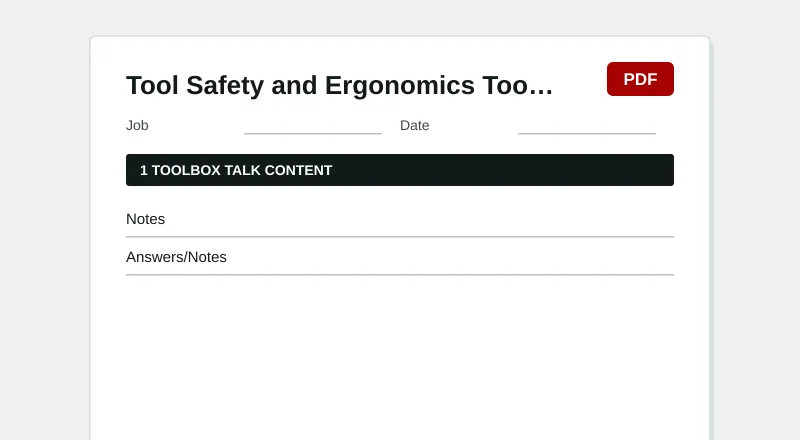
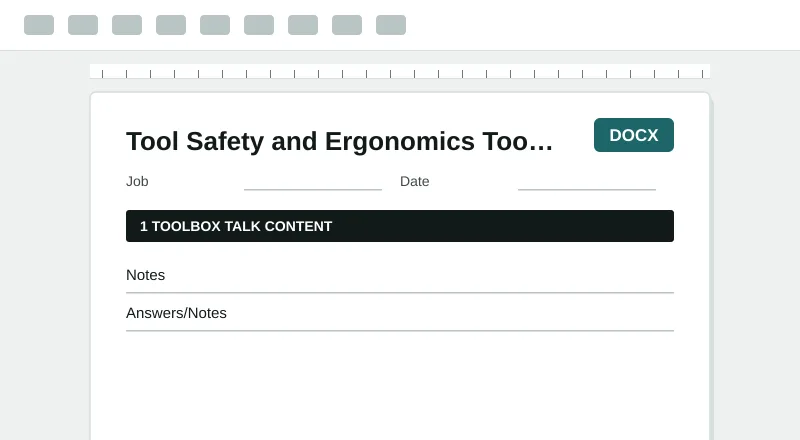
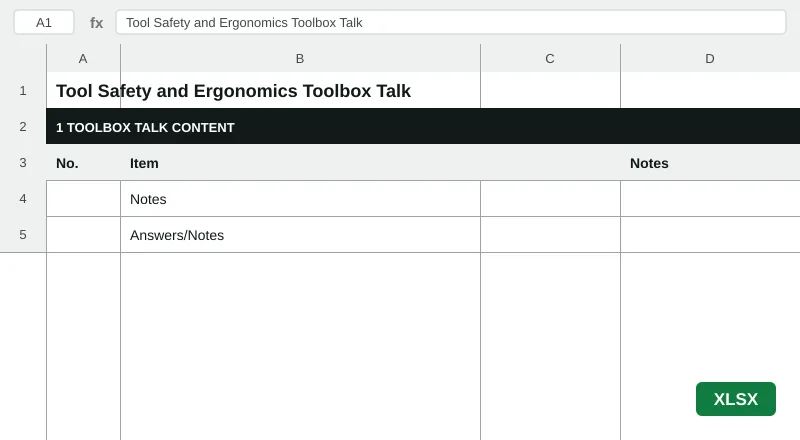
Download it free as a PDF to print, a Word document to edit, or an Excel sheet. No sign-up. Swap in the tools your crews use most, keep the discussion questions, and file the signed copy with the job.


