


A plumbing inspection checklist takes a plumber or inspector through a building's water supply, water heater, fixtures, and drain and vent piping, one line at a time, and records what is right, what isn't and what was done about it. Plumbing contractors, service techs, GCs checking a sub's work, facility teams and home inspectors all use one.
Workyard's template works on new construction and on service and maintenance calls, in homes and in commercial buildings. It opens with a safety check, runs through the systems, and ends with photos and a signature, so the finished form doubles as the report you hand the customer or GC.
Plumbing inspection form vs report template
A plumbing inspection form is what you fill in on site; a plumbing inspection report template is what you hand over afterward. The form is the checklist: Yes or No on each item, a comment for every No. The report adds what the customer needs to act: photos, the location of each problem, how urgent it is and what you recommend. When the checklist carries photos, comments and a signature, one document does both jobs.
Whichever you call it, the standard behind it is the plumbing code your jurisdiction has adopted. US jurisdictions generally adopt a version of the International Plumbing Code or the Uniform Plumbing Code, often with local amendments, and residential work may fall under the International Residential Code. Check with the local building department which code and edition applies before you treat any line as a pass or fail.
When to use a plumbing inspection checklist
Use it any time someone needs a record that the plumbing was checked and by whom:
- At rough-in, before walls and ceilings are closed
- At final, before the city inspector or the owner signs off
- On a service call, to document the system before and after the repair
- On annual maintenance for a commercial building or rental property
- Before a home or building is sold
- After a leak, to find the cause and check the rest of the system
What is required for a rough plumbing inspection?
At rough-in, the inspector wants to see the drain, waste, vent and supply piping installed, supported and uncovered, with the system under test. Expect them to look at pipe sizing and material, slope on drain lines, vents and their connections, cleanouts where they are required, hangers and supports, and a water or air test holding on the system. Test pressures and hold times are set by the local code, so get them from the building department. The plumbing rough-in inspection form covers this stage, and the plumbing pressure test report records the test.
The plumbing inspection checklist, section by section
The template has seven sections. Each item is answered Yes or No, with a comment required for every No.
| Section | What it checks | The code chapters the form points to |
|---|---|---|
| General Information | Project or location, and building type (residential, commercial, industrial or other) | None |
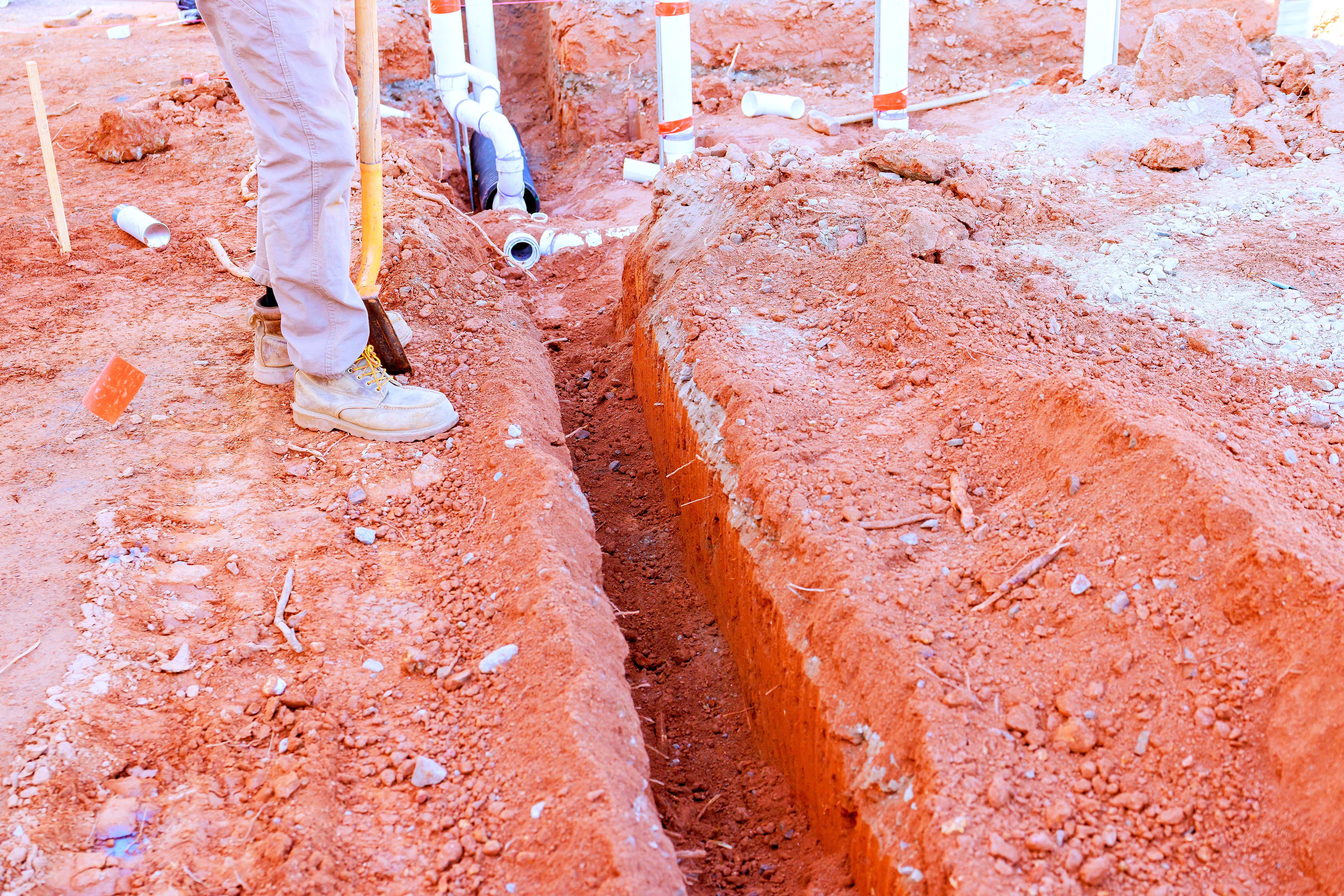
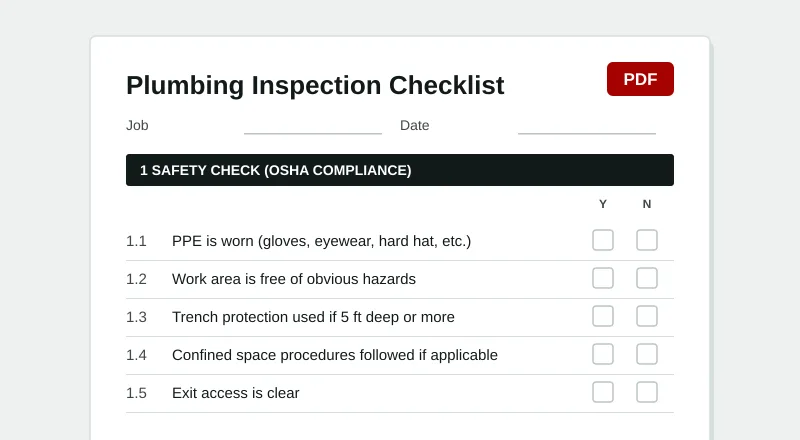
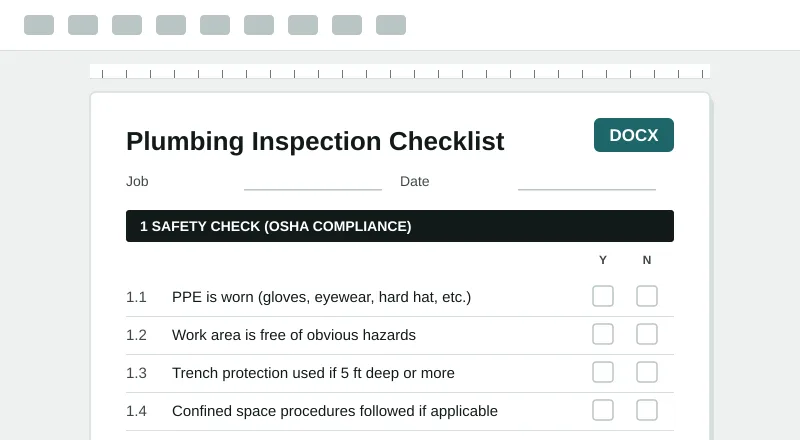
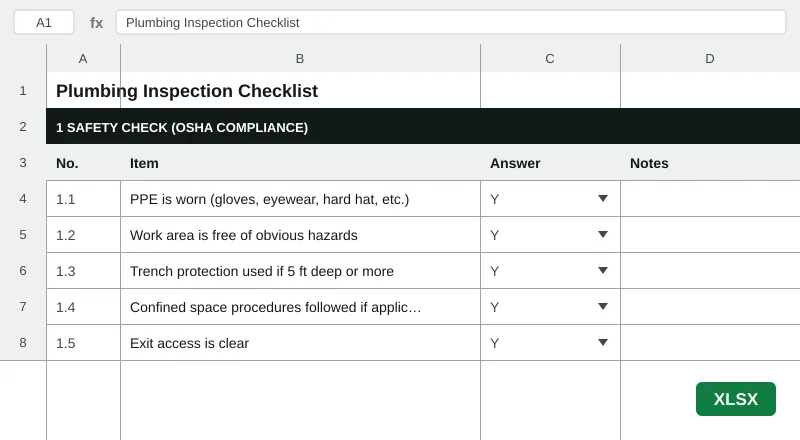
| Safety Check | PPE worn, area free of obvious hazards, trench protection at 5 feet deep or more, confined space procedures, clear exit. Any No pauses the inspection | OSHA construction standards |
| Water Supply & Distribution | Main shutoff accessible and labeled, pressure in normal range, pressure-reducing valve above 80 psi, backflow devices, vacuum breakers on hose bibbs, no leaks, no cross-connections | IPC and UPC Chapter 6 |
| Water Heater | T&P relief valve and its discharge, expansion tank on a closed system, mounting and seismic or impact protection, drain pan, vacuum relief on bottom-fed units, leaks and rust, venting and combustion air, gas shutoff and sediment trap | IPC and UPC Chapter 5 |
| Fixtures & Appliances | Every fixture operates and drains, hot water at a safe temperature (about 120°F max), hot on the left, fixtures sealed and secure, toilet clearances, traps and vents, dishwasher high loop or air gap, washer standpipe, tankless units | IPC Chapters 4 and 6, UPC Chapter 4 |
| Drainage & Venting | Free flow, no leaks, a trap and vent at each fixture, vents through the roof and open, cleanouts accessible, floor drain trap seals or primers, storm and sanitary kept separate | IPC and UPC Chapters 7 and 9 |
| Documentation & Sign-Off | Photos and videos of issues, notes, inspector name and signature, date | None |
How to record findings
Write every No so the person fixing it doesn't have to call you. Give the room, the fixture and the problem: second-floor hall bath, lavatory P-trap weeping at slip nut, towel under it is a finding. Leak in bathroom is not.
- Photograph each problem with something in frame that shows where it is.
- Sort findings by urgency in your notes: fine for now, keep an eye on it, fix soon, or fix before the water goes back on.
- Note anything you couldn't check, such as a sewer line that needs a camera or a shutoff you weren't allowed to operate.
- Sign and date the form and send it to the customer, GC or property manager the same day.
Common plumbing inspection failures
Most failed items fall into a short list:
- Leaks at joints, valves and fixture connections
- Corroded supply piping, or mixed materials such as polybutylene with plastic fittings
- A main or fixture shutoff that is seized, buried or unlabeled
- Drain lines without enough slope, or fixtures without a trap or vent
- Water heater relief valves with no discharge pipe or one piped to the wrong place
- Missing backflow protection or hose bibbs without vacuum breakers
- High static pressure with no pressure-reducing valve
- A rough-in test that doesn't hold
Digital inspection forms for plumbing techs in Workyard
In Workyard, the checklist runs as a digital form on the tech's phone, opened at clock-in on the job. Photos attach to the item they show, the inspector signs on the screen, and the submission lands back in the office the same day, filed with the job. If a failed item needs a return visit, the crew's time on the fix is tracked against that job too. See the construction inspection app and how Workyard works for plumbing contractors.
Get the free plumbing inspection checklist
Download the Plumbing Inspection Checklist as a PDF, Word or Excel file. It is free and there is no sign-up. Print the PDF for a clipboard, open the Word file to add your logo or your local code references, or use Excel to keep a running log of inspections across a portfolio of buildings.


