

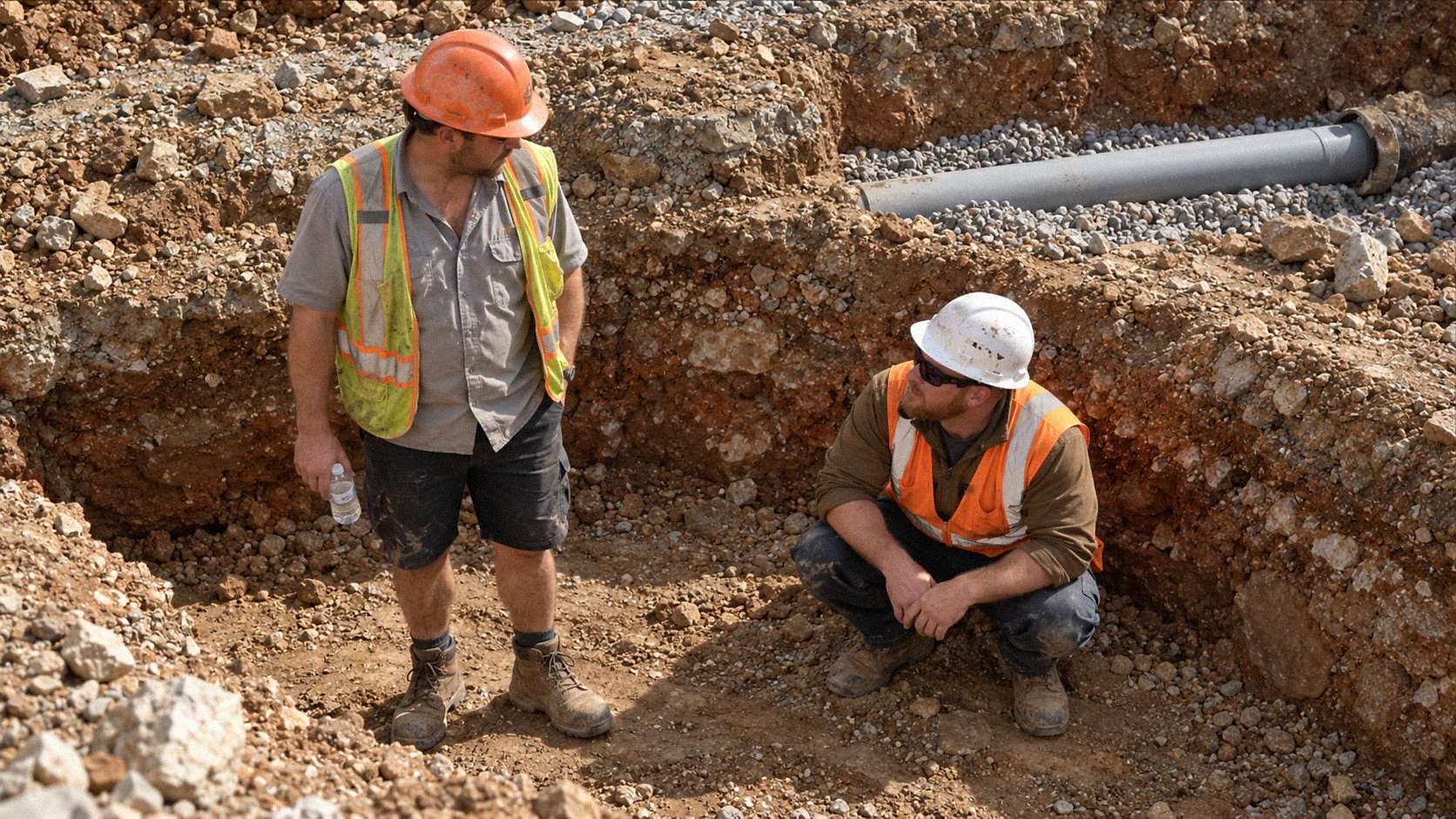

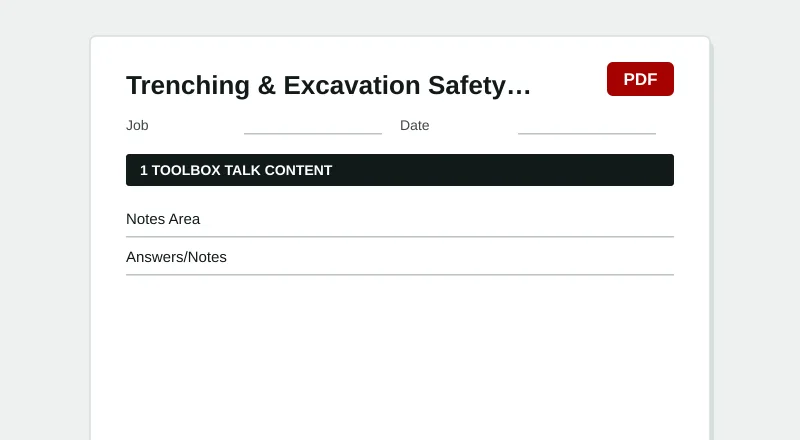
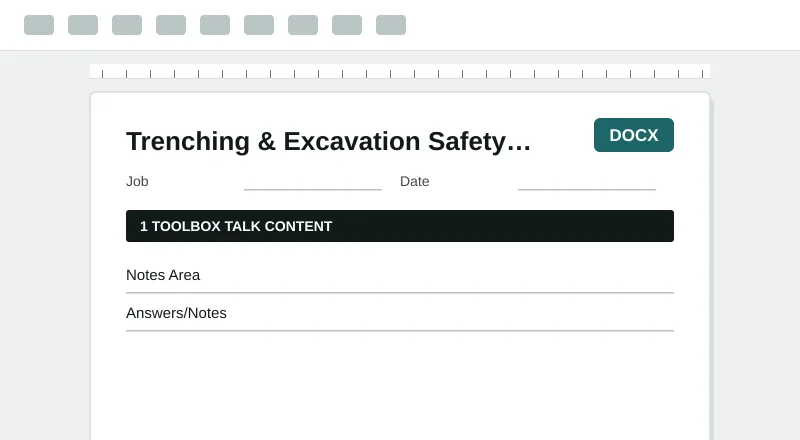
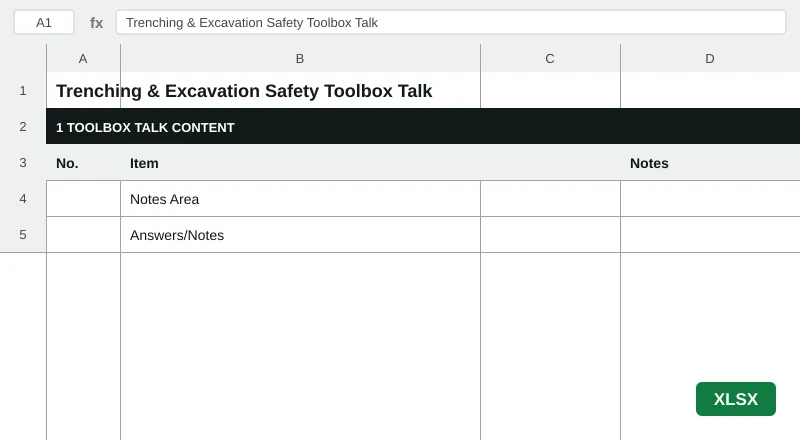
An excavation safety toolbox talk is a short crew meeting held before trenching or digging starts, covering how the soil will be classified, what protective system goes in, how workers get in and out, what the competent person watches for, and what happens if a wall comes down. Foremen and superintendents on earthwork, utility, foundation and site crews run it at the start of the shift and record who attended.
What the trenching and excavation toolbox talk covers
The talk is written out in five parts so the presenter can read it as is or put it in their own words.
| Part | Key points |
|---|---|
| Pre-excavation planning | Locate and mark utilities, set trench depth and width, choose sloping, shoring or shielding, and keep spoil piles at least 2 feet from the edge |
| Soil and protective systems | Protective system required at 5 feet deep or more unless in stable rock (OSHA 1926.652), soil classed as stable rock or Type A, B or C, Type C sloped no steeper than 1½:1 with no benching, hydraulic shoring installed from outside the trench |
| Access and egress | Ladders or ramps in trenches 4 feet or deeper, within 25 feet of workers (OSHA 1926.651(c)(2)), ladders extending 3 feet above the landing, clear walk paths |
| Hazard controls and monitoring | Daily inspection by a competent person, stop work for water, cracks or bulging, atmospheric testing in trenches deeper than 4 feet, water control, keeping heavy equipment back from the edge |
| Emergency procedures | Never enter a collapsed trench without protection, call 911, keep rescue gear on site, post the site map and emergency numbers |
A shallower trench still needs protection if the competent person sees signs of a possible cave-in. The talk says so, and it's an easy point to miss.
The figures above come straight from the talk, which also lists OSHA 1926.651 and 1926.652(b), ANSI/ASSP A10.12, FHWA MUTCD Part 6 for traffic control near roadway digs, and EPA stormwater guidance as its references. Check the current rules before each job; your competent person and your engineer make the calls for your site.
Underground utilities come first
Most of the planning section is about what you can't see. Call 811 and review the locate tickets before anyone digs, mark the lines, and know which ones are live. Read the locate marks with the crew at the trench, not just in the truck. In a trenching safety toolbox talk, this is the part that applies even on a two-foot dig for a service line, where nobody thinks about shoring but a backhoe can still find a gas line.
How to run the talk
- Fill in the attendance details. Date, job, presenter and each crew member.
- Hold it at the trench. Point to the actual spoil pile, ladder and protective system instead of describing them.
- Read or talk through the five parts. Keep it to the site you're on today.
- Ask the discussion questions. The talk includes five, such as how to classify wet sandy soil and whether a ladder 35 feet from a worker meets the rule. Write the crew's answers in the notes.
- Name the competent person. Everyone should leave knowing who it is.
- Collect signatures and feedback. Each attendee signs, and anyone can add a comment.
For the task-by-task hazards of a specific dig, pair the talk with the trenching and excavation JHA.
Get the free excavation safety toolbox talk
Download the talk as a PDF, Word or Excel file, free and with no sign-up. Print copies for the crew, or edit it to add your site's details. With Workyard's toolbox talks, the same talk runs on phones on the job: each worker signs on screen, photos of the trench go in the notes, and every talk is filed to the job in the office with the attendance list, ready to export as a PDF or CSV. More topics are under toolbox talk templates.


